


We use cookies to improve your online experiences. To learn more and choose your cookies options, please refer to our cookie policy.

05 February, 2024
I can say: Communication Skills in IB Early Years Programme
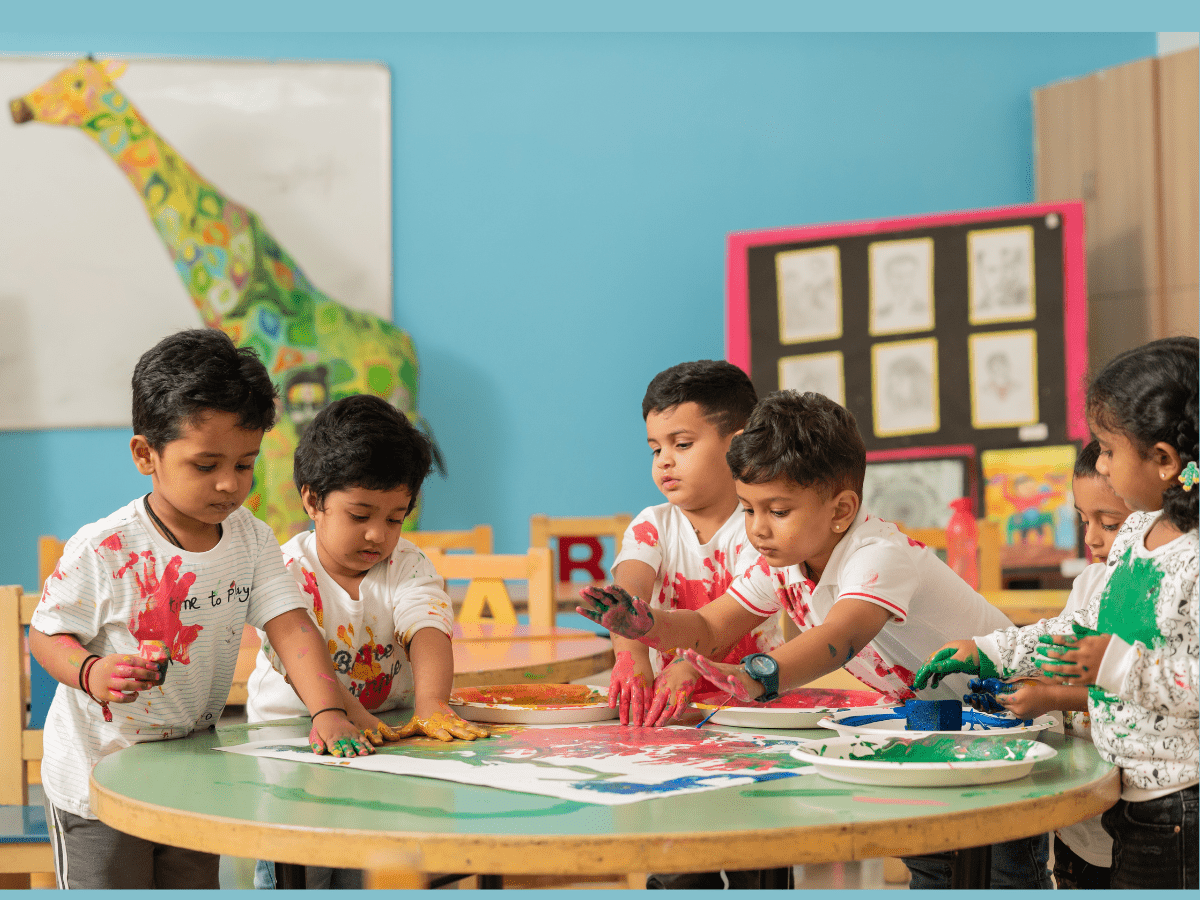
Imagine the 3 scenarios:
Child 1: May I Share this toy?
Child 2: Yes, take it.
Child 1: I want clay.
Teacher: Here, use it and put it back in its place.
Child 1: Sorry!! Are you ok?
Child 2: No problem!
Developing Communication Skills in the IB Early Years Programme: Foundations for Future Success
Have you heard a 3-year-old communicate this way? If you did, it means you have given them a stimulating environment to develop communication skills. I have heard such conversations in our Oakridge nursery classroom, such conversations are conscious consistent introductions in our early year’s classroom.
In my 10-year teaching experience, I have observed that tantrums in early years are mostly due to gaps in communication/ conversational skills. Age-appropriate communication stimuli help children communicate their needs in words or simple sentences. Most of the strategies employed in EYP classrooms help to convert non-verbal cues into communicating through words. It is our responsibility to introduce words and choices of words to our young ones.
Give 3 to 5 year-old the respect they deserve and focus on what they are saying, not necessarily on whether they are saying correct sounds in their words. Repeat what they say, so they know you heard them. Foster the amazing ideas they have and ensure they feel confident and secure.
Communicating with peers
Children of 3-5 years discover how others interpret the world. They also notice other people’s feelings and emotions and they often start to empathize and learn cooperation skills like turn taking and sharing. Instead of crying, whining, or making a noise when they want something, children start to communicate more with their peers with words and phrases. What a relief, right?
Learning the right words
It’s also important to reinforce to our 3–5-year-olds, how they can use their words to communicate with a peer to eliminate whining or crying behaviours. You can get down to their level and help support them using their words to communicate with their friends about what they want and need. This type of modelling sets the children up for success as they are newly managing these social behaviours.
Tips to facilitate children
Here are some effective techniques employed in Oakridge International School Bengaluru Early Years Classrooms that will also help in developing your child’s language and communication skills.
- Read favorite books over and over! Leave words out and see if your 3-year-old can remember what to say!
- Play imagination games or make suggestions of what your 3-year-old can play.
- Recite what you did that day - Ask, “What was your favorite part?” “What do you think we should do tomorrow?” This gives the 3-year-old the opportunity to lead the conversation.
- While reading a book, ask your 3-year-old to point out certain objects. “Can you find the sky or a bird?”
Achsah Havilah
Learning Support Facilitator
Related news
News image ![Top Things NRI Families Should Know Before Moving to Schools in Bangalore]() Blog | Best IB Schools in Bengaluru | Choosing the Right School | Top Schools in India
 Blog | Best IB Schools in Bengaluru | Choosing the Right School | Top Schools in India
Top Things NRI Families Should Know Before Moving to Schools in Bangalore
With the recent change in rules in the US, the H1 B visa, there is an influx of NRIs back into their home country.
News image ![How the Learning Environment at Oakridge Shapes Childhood]() Blog | Beyond classroom | Child Development | Early Childhood Education | Early Years | Holistic Learning
 Blog | Beyond classroom | Child Development | Early Childhood Education | Early Years | Holistic Learning
How the Learning Environment at Oakridge Shapes Childhood
Oakridge International School's Early Years Programme covers Pre-nursery to EYP 2, taught in inspiring, purpose-built learning spaces.
News image ![Pet Panel Talk Enriches PYP 3 Animal Unit of Inquiry]() Blog | Academic Excellence | Bangalore's Best IB Schools | Best IB Schools in Bengaluru | Curriculum Excellence | Learning Activities
 Blog | Academic Excellence | Bangalore's Best IB Schools | Best IB Schools in Bengaluru | Curriculum Excellence | Learning Activities
Pet Panel Talk Enriches PYP 3 Animal Unit of Inquiry
As part of PYP 3 learners' ongoing Unit of Inquiry on "Animals," Oakridge International School recently hosted an engaging Pet Panel Talk.
News image ![What Makes Oakridge a Great School to Teach & Learn]() Blog | Bangalore's Best IB Schools | Best IB Schools in Bengaluru | best international Schools | Choosing the Right School | Holistic Learning | Nord Anglia Education
 Blog | Bangalore's Best IB Schools | Best IB Schools in Bengaluru | best international Schools | Choosing the Right School | Holistic Learning | Nord Anglia Education
What Makes Oakridge a Great School to Teach & Learn
When you walk through the corridors of Oakridge International School at 7:30 AM, you'll see something special happening.


