


We use cookies to improve your online experiences. To learn more and choose your cookies options, please refer to our cookie policy.

29 June, 2022
Parenting tips on how to create an ideal learning environment at home?

Parenting Tips: Creating an Ideal Learning Environment at Home
A suitable learning environment for children can be created in the house with a little bit of tinkering. It should go without saying that before any real learning can occur, children must have access to the necessities like food, shelter, healthcare, and personal hygiene.
Anyone who is reading a piece like this has undoubtedly already put a lot of time and effort into raising healthy children. Although you may already have a fantastic learning retreat at home, here are some additional suggestions and ideas.
1. Offer unwavering affection, focus, and emotional support
Children are much more likely to be motivated to learn when they feel safe and have a loving home. Children who are happy at home will acquire the self-motivation they need to learn.
2. Make Books Available to Your Child
Parents who read have a much stronger influence on their children's future love of reading. Introduce your young child to a variety of books, including picture books, fiction, nonfiction, and reference works like dictionaries or kid-friendly encyclopedias, to provide them a wide range of experiences.
Introduce reading as a leisure activity and not as a compulsion, so that they enjoy reading without feeling the burden to complete the task.

3. Construct Functional Learning Spaces for Various Activities
Children are more likely to use their own, purposeful places, which increases their exposure to educational opportunities. Whether in the bedroom, playroom, living room, or even outside, try to make the cozy learning corners, where the child can dive deep into their imaginary world. You may try to create:
A table set aside for art projects, complete with materials and supplies.
An easel or outdoor space for messy art, such as finger painting, or painting with brushes on large sheets of paper.
A peaceful reading corner in the bedroom with a small bookcase and some pillows or bean bags to curl up on.

4. Invest in Educational Toys
Plastic toys with music and flashing lights, plastic phones and tablets, etc. have their place, but they are all extremely similar, offer the same kind of stimulation, and have a finite amount of creative potential.
Pick out the traditional toys that have been around forever as a default. Every home should include these fundamental educational toys like wooden blocks, construction toys, Lego, wooden puzzles, threading and lacing toys, educational games (including memory and matching games), board games, balls, beanbags, and so forth. This will help you to have an ideal learning environment and a play area at home.
5. Follow a Daily Routine at home
Children feel more safe and are better equipped to learn when they know what is expected of them and can anticipate how their day will proceed. For instance, a child who is allowed to watch their favourite show after breakfast for 30 minutes will cooperate better than a child who refuses to play because he wants to watch TV all day. A child who has clean-up time every day after playtime is also more likely to be tidy than a child who is constantly reminded to do so.
6. Create a Language-Rich Environment
Parents are the primary language teachers for children. Language should be abundant in your home. Have conversations with your kids throughout the day, whether it be in the shower, the kitchen, the car, or before bed. There are several opportunities for discussions in daily life- avail them.
7. Foster Independence at Home
The house should be a place of trust where your youngster feels capable and expected to complete simple (age-appropriate) duties on his own. Make your home self-sufficient for your youngster. Some instances:
- A stool to go to the sink or basin
- Accessible toys and equipment
- Basic food preparation tools
- An accessible wardrobe cupboard to get dressed
8. Engage in Meaningful Activities and Experiences
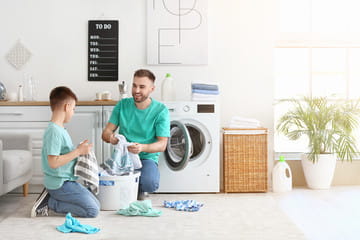
More significant experiences will be had by them as a result of your increased involvement in your daily activities. Even routine actions, like putting the laundry away, contain a wealth of unnoticed educational advantages:
- aptitude for comparing and sorting (e.g. socks)
- The idea of numbers (counting items, finding pairs, etc.)
- Both fine and gross-motor skills (e.g. closing buttons or folding sheets)
- Vocabulary and language improvement (chatting while sorting)
- Visual awareness (different sizes, colours, patterns, etc.)
- Sensory sensitivity (different textures and fabrics)
- Understanding responsibility (through chores)
- Building ties through shared time Participate in Meaningful Activities
Being one of the best International Schools, we at Oakridge Mohali try to provide the exceptional learning environment to your child. With state-of-the-art amenities, embedded with modern technology, lovely outdoor spaces- our students are motivated to learn and grow to the fullest.
Thoughts by:

Simranpreet Kaur
Communications Manager, Oakridge Mohali
Related news
News image ![OISM_Mohali_India_2022_017]() Blog | Blended Learning | Career Guidance | Education | Growing Environment
 Blog | Blended Learning | Career Guidance | Education | Growing Environment
Looking Beyond Grades: Oakridge’s Approach to Parent Partnership
Many parents look forward to report cards as a way to understand how their child is doing at school. While grades and comments provide valuable insights, they reveal only part of the picture.
News image ![Why Celebrations at Oakridge Are More Than Just Events]() Blog | Best IB school in Mohali | Best IB Schools in India | Beyond Academics | Child Development | Child Psychology | Culture | Holistic Education
 Blog | Best IB school in Mohali | Best IB Schools in India | Beyond Academics | Child Development | Child Psychology | Culture | Holistic Education
Why Celebrations at Oakridge Are More Than Just Events
News image ![Will My Child Receive Individual Attention? Here's What Parents Should Know]() Blog | best school in mohali | Beyond Academics | Blended Learning | Child Development | Early Childhood Education
 Blog | best school in mohali | Beyond Academics | Blended Learning | Child Development | Early Childhood Education
Will My Child Receive Individual Attention? Here's What Parents Should Know
News image ![Oakridge Mohali Leaders Bring Global Inclusion to Life at Nord Anglia EDIB Expedition in Tanzania]() Blog | Best IB school in Mohali | Beyond classroom | Blended Learning | Critical Thinking | Future-Ready Learning
 Blog | Best IB school in Mohali | Beyond classroom | Blended Learning | Critical Thinking | Future-Ready Learning
Oakridge Mohali Leaders Bring Global Inclusion to Life at Nord Anglia EDIB Expedition in Tanzania
Discover how Oakridge International School, Mohali strengthened inclusive education and global leadership through the Nord Anglia EDIB Expedition in Tanzania


