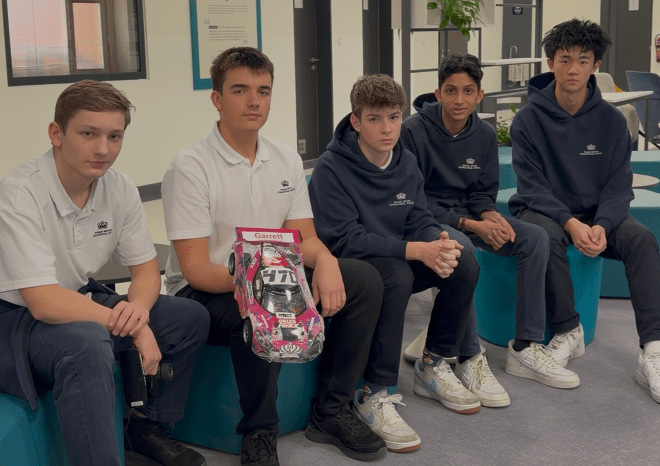
1. How long have you been at PBIS, and how did you first get involved in the Hydro Car club?
Herbie: I´ve been here since Year 3. I had a personal project in Year 9, and I made an RC hovercraft. My physics teacher saw it, and then she introduced me to the club.
Mikhail: I've been at PBIS since Year 4, so that's around eight years. Prior to Year 10, I didn't have much experience in electronics, but the club really was a big motivator for getting into all that stuff. The first time I saw the club was during the Year 9 IGCSE subject evening.
Wojciech: I joined this year. For me, I already tried a lot of clubs and small projects before I joined the school, but I think this is the first time I am really dedicated to a single project, rather than just doing a few smaller ones on the side.
2. Why did you choose to join the Hydro Car project?
Mikhail: Because it was available. I already liked racing, and this just gave me something that I could learn - different skills that I maybe didn't have the opportunity to develop before.
Herbie: Pretty much the same for me, since I just continued from the RC hovercraft.
Wojciech: I tried a lot of clubs and small projects before, but I think when I joined the school, this is the first time I was really dedicated to a single project.
3. There are 5 people in your team. What are your roles in the Junior team, and how do you work together?
Herbie: Yes, we have me, Wojciech, Mikhail, Lucas and Pragvansh as the main people for our team. And I am a mechanic.
Wojciech: I'm also a mechanic, but I also work on the circuit board. I'm making the actual printed circuit board with the components on it, while Mikhail is writing the code for it to collect data and make it a bit more efficient. But I also do driving practice for some reason.
Mikhail: I'm the driver, and while Wojciech is fully occupied with the mechanics, we also collaborate on a custom circuit board. I'm more software, he's more hardware.
4. Did you face any challenges at the race? How did you handle them?
Herbie: We had a hydrogen fuel cell issue since it was pretty old already, and in the middle of the race we had to switch it. And then during the race, I think one of our wheels fell off, so we had to replace that pretty quickly as well.
Wojciech: Another problem we had is that hydrogen was leaking at the start of the race. After we got some items from other teams, we were able to mostly fix it.
5. What did these experiences teach you - technically or personally?
Mikhail: There is a lot of stress, especially from the driving position. Once the car is out of the pits, everything is in our hands. I've learned a lot from having to deal with it - short-term but extreme stress.
Herbie: We can learn a lot from the setup of the car, like how tight the differential should be.
Wojciech: For me, we had to change the fuel cell mid-race, so that was a really stressful moment. But I think we did pretty good at that.
6. Who supports you in this project - teachers, mentors, or the school?
Mikhail: The one main part of the club is that it's student-led. Aside from financial support, where our physics teacher finds our sponsors - and that's such a job, honestly. Respect to her for that. But the main point is that we drive ourselves, and we are either our own mentors, the internet is our mentor, or other teams can be our mentors.
Wojciech: I feel like the mentor for the mechanics is Anastas - someone who has extensive knowledge. He has spent already, I think, three years on the club. We have two teams. The senior team also gives us tips on how to improve our car, and we sometimes get some of their old parts for us to try out different features.
Herbie: Yeah, I agree with all that as well.
7. What motivates you or drives you in the Hydrogen Car project?
Mikhail: For me, it's learning opportunities and being able to engage in something completely different from anything else that is offered by the school or most other STEAM activities. The Hydro Car racing is completely different. It is also giving us a chance to proactively initiate something and maybe pioneer some features. And a bit of competitiveness as well.
Herbie: For me, it's probably the competitiveness. Other schools, they specialize in building cars, like actual cars, so they already have a lot more knowledge than us. So from this, you just want to beat them every time.
Wojciech: For me, I really like the learning potential here. There is so much stuff that I never really had the motivation to even explore, and I think that is what the competitiveness gives me. It is the motivation to learn and to dedicate myself a lot to the club.
8. What is your future – in Hydrogen racing, STEAM or beyond? Did the Hydrogen Car club influence your plans?
Mikhail: To be honest, I think Wojciech and Herbie would have a better say for this, because I actually don't think I want to be involved in electrical engineering as a career in the future. I'm still interested in everything that it covers, but the STEAM club is helping me make up my mind over what exactly I want to pursue, because I'm personally interested in physics. There are a lot of universities that are mixed between electrical engineering or just engineering and applied physics, but they also have a decent mix of theoretical physics built into it. So helping pick between that is one thing that the club has done for me in terms of future plans and careers.
Herbie: Next year I'm moving to London. So I hope I can bring the hydrogen car into my next school. And I probably want to do something with engineering, maybe mechanical engineering, which involves a lot of 3D modelling and stuff like that.
Wojciech: I already knew I was going to go into engineering even before I joined this club, but I never thought of electrical engineering before. Now I realised that it's interesting to me. But I'm not fully decided if I want to go more into the mechanical or the actual electrical part of engineering. And we are also trying to maybe add another club which is kind of similar, and that is drones, and I think that might be available in a year or two.
Mikhail: Drone racing - that is something that we've looked into and went like, that looks really cool. Hydrogen car go fast, this can go faster.
9. What advice would you give to new students thinking of joining?
Wojciech: We need more people - dedicated people - because once we leave, we need someone to pass off the knowledge, so it doesn't become a mystery.