


We use cookies to improve your online experiences. To learn more and choose your cookies options, please refer to our cookie policy.

03 November, 2026
How do international schools support emotional wellbeing? Lessons from the Early Years at St Andrews International School Bangkok
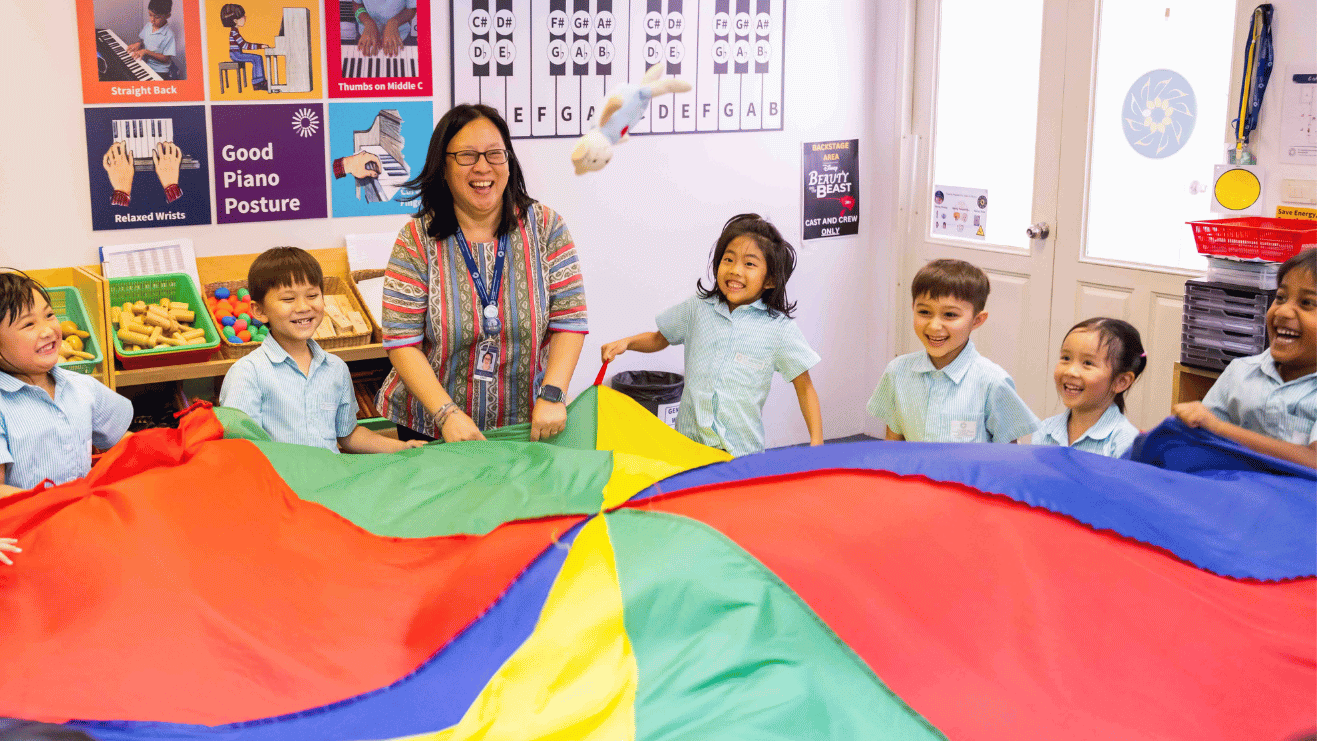
International schools support children’s emotional wellbeing by building emotionally safe relationships, giving children the language to understand their feelings, and using evidence to check what is working. At St Andrews International School Bangkok, a British international school in Bangkok, one recent example is “Say What You See”: a Foundation Stage project that changed how adults speak to young children every day. Over one term, children’s involvement in learning rose from 32–45% to 56–74%.
Why parents ask this
Many families noticed that young children found it harder to manage big feelings after the pandemic. Teachers saw it too. Ms Third, an Early Years educator with more than 20 years at St Andrews, noticed a significant increase in children struggling to recognise, express, and regulate their emotions. Often this showed up as challenging behaviour.
Parents considering an international school in Bangkok often want to know:
- Will my child feel safe and settled at school?
- What happens when my child is struggling emotionally?
- Does wellbeing really affect how well my child learns?
- How does the school know its wellbeing support is working?
What is emotional wellbeing in the Early Years?
Definition
Emotional wellbeing is how comfortable, relaxed, confident and emotionally secure a child feels in a particular situation.
Involvement is how deeply a child engages in an activity, shown through their concentration, energy, persistence, creativity and interest.
In the Early Years Foundation Stage (EYFS), emotional wellbeing sits within Personal, Social and Emotional Development (PSED), one of the prime areas of learning that supports everything else a young child does.
The two are related but separate. A child can feel completely at ease and still not be deeply engaged, or be deeply engaged while feeling under strain. That is why many Early Years teachers look at both.
How teachers observe emotional wellbeing and involvement: the Leuven Scales
The Leuven Scales of Emotional Well-being and Involvement are observation tools developed by Professor Ferre Laevers and the Research Centre for Experiential Education at KU Leuven in Belgium. The scales are separate, each with five levels. Teachers and TAs use the scales while observing children during everyday play and learning, rather than as formal tests.
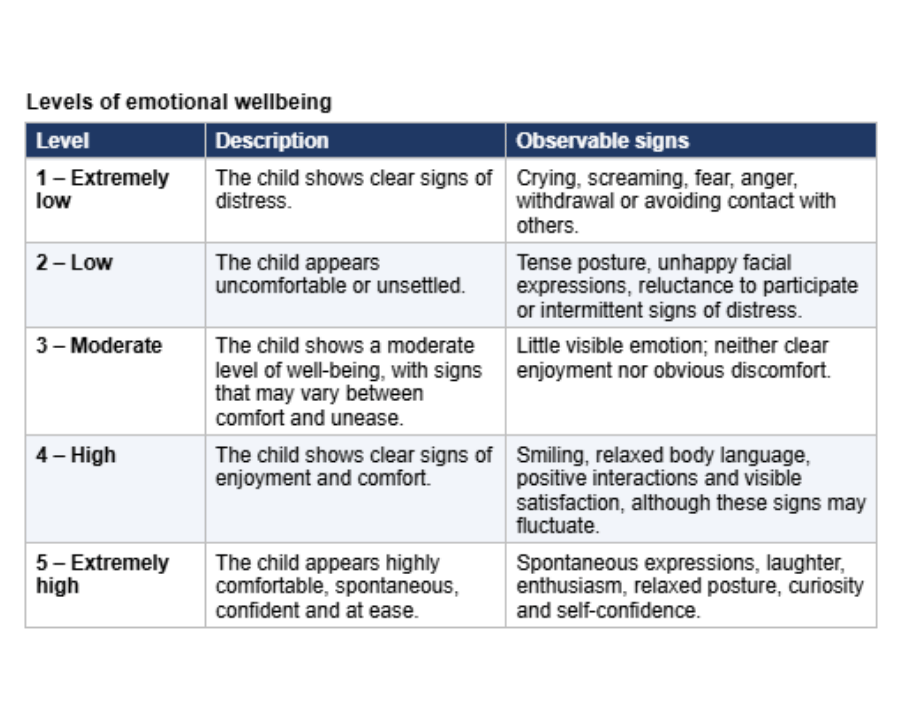
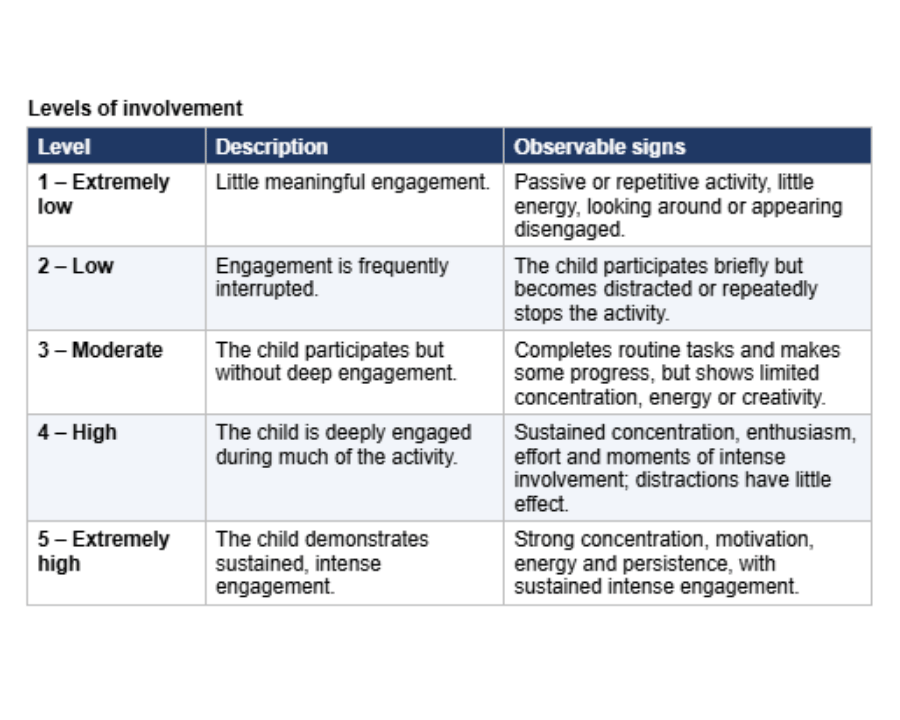
Source: Leuven Scale for Well-being, Research Centre for Experiential Education (CEGO), KU Leuven
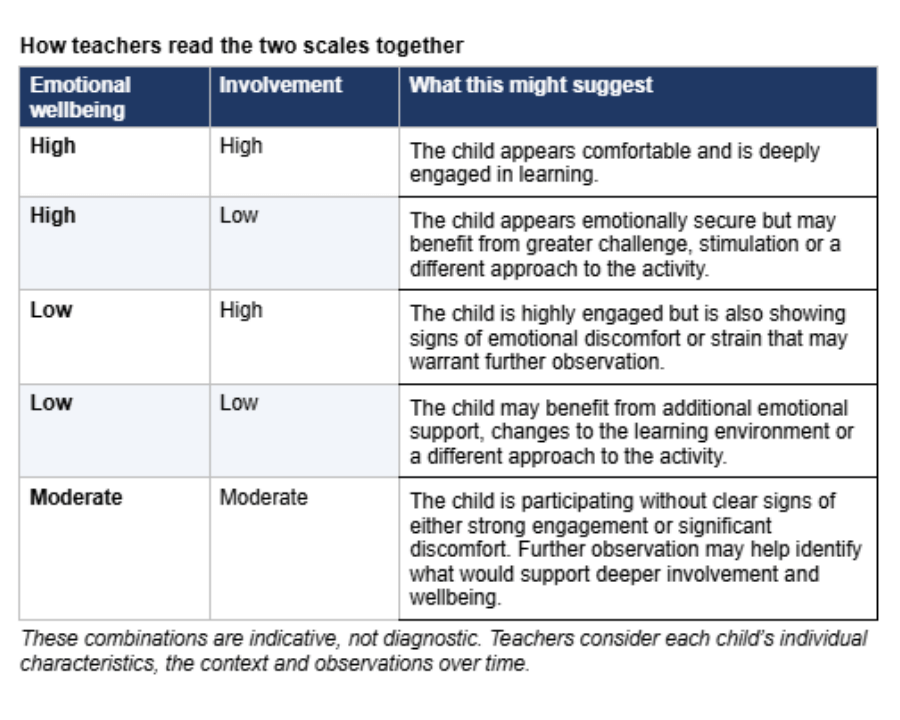
How teachers read the two scales together
Why the Leuven Scales matter in Early Years education
The scales help teachers look beyond whether children behave appropriately or complete tasks. Instead, they ask two questions:
- Emotional wellbeing: Does the child feel safe, comfortable and confident enough to take part?
- Involvement: Is the child genuinely engaged in the experience, and learning at a meaningful depth?
When teachers see low levels, they look for the reasons and adapt, for example by changing the environment, adjusting the level of challenge, offering more choice or giving emotional reassurance. The aim is not for every child to score 4 or 5 all day; children’s levels naturally rise and fall. The scales help educators spot where children’s experiences could be better and where deeper learning is possible.
How the Leuven scores were reported
The Leuven Scales use a five-point rating system, from Level 1 (extremely low) to Level 5 (extremely high). For this project, scores were converted into percentages to make comparisons across observations easier to present: Level 1 = 20%, Level 2 = 40%, Level 3 = 60%, Level 4 = 80% and Level 5 = 100%. The percentages reported in this article therefore represent converted Leuven observation scores, rather than a separate percentage-based assessment.
How international schools support wellbeing
Good international schools treat wellbeing as part of everyday teaching, not only as extra support when something goes wrong. In practice, that usually means:
- Relationships first: children learn best when they feel known and safe with the adults around them.
- Teaching emotional language: children are given words for what they feel, so they can talk about it instead of acting it out.
- Consistent adult responses: every adult in the classroom responds in a similar, predictable way.
- Evidence, not guesswork: schools observe, measure and adjust their approach over time.
At St Andrews International School Bangkok, the Say What You See project shows how all four can work together in the Early Years.
What is “Say What You See”?
Definition
“Say What You See” is an approach in which adults calmly describe a child’s actions, emotions and efforts in the moment, using descriptive, non-judgmental language rather than immediately offering praise or correction.
For example, instead of saying “Good job” or quickly correcting a child, a teacher might say:
“I can see you’re trying again even though that was difficult.”
Descriptive language like this tells the child that an adult has noticed them and understands how they feel. It also gives them words they can use for their own experience. Over time, this builds emotional awareness, an emotional vocabulary, confidence and self-regulation.
A key idea behind the project is that challenging behaviour in young children is not defiance. As Ms Third put it, these behaviours are signals that children are missing the emotional language they need and require consistent modelling and guidance.
How St Andrews put it into practice
Key facts
- Project: Say What You See (Foundation Stage, St Andrews International School Bangkok)
- Led by: Ms Third (Sutthida Dhadaniti), as her Change Project for the Nord Anglia Education Middle Leadership Programme (Cohort 13)
- Team: all Foundation Stage teachers and teaching assistants
- Children observed: 20
- Timeframe: second half of 2025, following a Plan–Do–Study–Act (PDSA) improvement cycle.
- Measure: the Leuven Scale of Well-being and Involvement, alongside staff observations and reflective notes
- Result: Involvement increased from 32–45% at baseline to 56–74% after implementation across the observed learning areas. Emotional wellbeing remained comparatively high, although the recorded range shifted from 78–90% at baseline to 68–74% after implementation. Observational data also indicated greater effort and persistence, alongside some signs of emotional strain during more structured learning experiences.
The project followed four stages:
- Plan (July 2025): reviewed research on emotional intelligence, PSED, adult–child interaction and the Say What You See approach.
- Do (August–September 2025): introduced staff to non-judgmental, descriptive language and emotional-literacy strategies, ran a small pilot and recorded baseline observations.
- Study (November–December 2025): repeated the observations with the same framework and compared them with the baseline, alongside staff reflections.
- Act (December 2025): refined the approach and began embedding it into everyday Early Years practice.
The observations took place during normal classroom life, not in isolated tests. They covered child-led play, PSED, Expressive Arts, Literacy and Mathematics, and the approach was used during play, stories, transitions and other everyday moments.
What changed for children?
The baseline revealed something important. Most of the 20 children observed already felt safe and settled, with emotional wellbeing at 78–90%, but many were not yet deeply involved in their learning. They were calm and compliant without being fully absorbed. In Leuven terms, many children showed the “high wellbeing, low involvement” pattern: secure, but likely to need a more stimulating activity or a better-matched level of challenge.
After a term of consistent Say What You See language:
- Involvement increased from 32–45% at baseline to 56–74% after implementation across the observed learning areas.
- Emotional wellbeing remained comparatively high, although the recorded range shifted from 78–90% at baseline to 68–74% after implementation.
- Involvement increased across all observed learning areas. Expressive Arts and Design showed the highest post-intervention involvement (74%) and the largest increase from baseline. Qualitative observations also showed particularly positive engagement during open-ended, child-led and creative play.
- Children shifted toward more active engagement, with greater concentration, effort, and persistence observed during learning.
The two measures need to be considered together. Although emotional wellbeing scores were somewhat lower after implementation, children showed substantially higher levels of involvement. Observational notes also indicated that some children demonstrated greater effort and persistence alongside signs of emotional strain, particularly during more structured learning experiences. This suggests that deeper engagement may have involved greater cognitive and emotional challenge for some children and highlights the importance of monitoring both wellbeing and involvement over time.
Teachers also reported richer professional conversations and visible changes in classroom practice.
What still needs work
The project was also clear about its limitations. In adult-led sessions such as Literacy (56% involvement) and Mathematics (60% involvement), some children showed what the team described as “high-effort strain”: they worked hard. They persisted with learning while also showing signs of emotional pressure. This suggests that more structured learning experiences may require additional emotional support as children take on greater challenges. The next stage of the project therefore focuses on strengthening emotional support during adult-directed learning.
This was a small-scale school improvement project, not a controlled research study. The improvements observed were associated with the approach, but cannot be attributed to Say What You See alone.
Why wellbeing and learning go together
The project shows why Early Years teachers consider emotional wellbeing and involvement together. Before the project, children generally appeared comfortable and emotionally secure, but their involvement in learning was relatively low. Afterwards, they were considerably more engaged, while observations suggested that some children experienced emotional strain during more demanding learning experiences.
Learning often involves challenge, and challenge can sometimes feel uncomfortable. The goal is not to remove challenges, but to ensure that children have the emotional language and adult support they need to manage them and keep going. This is what Say What You See is designed to support. The next stage of the project therefore focuses particularly on adult-led learning, where observations showed that some children demonstrated strong effort and persistence alongside signs of emotional pressure.
The project also highlights the value of teacher development. Ms Third developed Say What You See through the Nord Anglia Education Middle Leadership Programme. She found that sustainable change depends not only on introducing new approaches, but also on building trust, developing shared understanding and creating consistency across the team.
How teacher professional development improves emotional wellbeing in the Early Years
Continuing professional development (CPD) improves children’s emotional wellbeing because the quality of everyday adult–child interactions shapes how safe, understood and engaged young children feel. When teachers learn new, evidence-informed ways to respond to children, every child in the classroom benefits.
Say What You See began as professional learning. Ms Third developed it as her Change Project for the Nord Anglia Education Middle Leadership Programme (MLP), a year-long programme for school leaders across the Nord Anglia family of schools, which she has now completed. Over that year, she says, she deepened her self-awareness, strengthened her leadership behaviours and broadened her impact within the school.
The topic that resonated most with her was leading change through people-centred leadership:
“Sustainable improvement does not come from introducing new systems alone but from influencing mindsets, building trust, and creating shared understanding.”
What this CPD meant for children and teachers
- A shared approach across the whole team. Because every Foundation Stage teacher and teaching assistant took part, children heard the same calm, descriptive language from every adult, every day. Consistency is what helps young children learn to name and manage their feelings.
- Evidence-informed practice. The programme gave Ms Third tools to plan, measure and review change using a Plan–Do–Study–Act cycle and the Leuven Scales, rather than relying on instinct alone.
- Stronger professional dialogue. Staff reflected together on what they were seeing in children’s engagement, emotional regulation, and behaviour, strengthening practice beyond the project itself.
- Psychological safety for adults, too. Ms Third found that leading change means listening, building relationships and treating resistance as a natural part of the process, the same qualities that help children feel safe.
“Meaningful change requires patience, empathy, consistency, and evidence-informed decision-making.” Ms Third
Why it matters for the future
Ms Third believes programmes like the MLP help teachers move beyond managing daily tasks towards a more strategic perspective that contributes to whole-school improvement and student outcomes. Her next step is to coach colleagues in Say What You See, moving from leading by example to building others’ capacity so that the approach can reach more children.
For parents, this is a useful question to ask any school: how do teachers keep learning, and how does that learning reach my child’s classroom?
How parents can try “Say What You See” at home
- Describe before you respond. “You’re stamping your feet. You look really frustrated that the tower fell.”
- Notice effort, not just results. “You kept going even when it was tricky.”
- Name feelings calmly. Giving a feeling a name helps children recognise it the next time it appears.
- See behaviour as a signal. Ask “What is my child trying to tell me?” before deciding how to respond.
Frequently asked questions
What is the Leuven Scale?
The Leuven Scales are two observation tools, developed by Professor Ferre Laevers and the Research Centre for Experiential Education at KU Leuven in Belgium. Early Years educators use them to assess how emotionally comfortable children are and how deeply they engage in learning and play. Each is rated on a five-level scale.
Is praising children bad for their wellbeing?
No. Say What You See does not ban praise. It encourages adults to describe what a child is doing and feeling, which is often more meaningful to the child than general praise such as “Good job”.
Why do some young children struggle to regulate their emotions?
Young children are still learning to recognise and name their feelings. Teachers at St Andrews have seen more children struggle with this since the pandemic. Consistent adult modelling and a growing emotional vocabulary help children learn to manage their feelings over time.
How does a school know its wellbeing support is working?
By measuring it. At St Andrews, the Foundation Stage team gathered baseline observations, repeated them after a term using the same framework, and compared the results alongside staff reflections.
About the expert
Ms Third (Sutthida Dhadaniti) was an Early Years educator with more than 20 years’ experience and now serves as the Deputy School Director at St Andrews International School Bangkok. She completed the Nord Anglia Education Middle Leadership Programme (Cohort 13), where she led the Say What You See Change Project with the Foundation Stage team.
Research that informed the project
Leuven Scales for Well-being and Involvement: Professor Ferre Laevers, Research Centre for Experiential Education (CEGO), KU Leuven.
MacRae, C. & Jones, L. (2023). A philosophical reflection on the “Leuven Scale” and young children’s expressions of involvement. International Journal of Qualitative Studies in Education, 36(2), 234–246. doi:10.1080/09518398.2020.1828650
Martikainen, S., Kalland, M., Linnavalli, T. et al. (2024). Supporting social-emotional development in early childhood education and care: a randomised parallel group trial evaluating the impact of two different interventions. Scandinavian Journal of Educational Research, 68(5), 1069–1087. doi:10.1080/00313831.2023.2204119
Tilbe, Y. T. & Gai, X. (2022). Teacher-child interactions in early childhood education and their effects on social and language development. Early Child Development and Care, 192(5), 761–774. doi:10.1080/03004430.2020.1798944
Tichnor-Wagner, A., Wachen, J., Cannata, M., & Cohen-Vogel, L. (2017). Continuous improvement in the public school context: Understanding how educators respond to plan–do–study–act cycles. Journal of Educational Change, 18(4), 465–494. doi:10.1007/s10833-017-9301-4
Senoz, E. G. & Kol, S. (2025). Playing outside, thriving inside: exploring the impact of outdoor play frequency on emotional intelligence in children aged 5–6. European Early Childhood Education Research Journal, 33(2), 287–301. doi:10.1080/1350293X.2024.2439949
Related news
News image ![St Andrews Counselling Team supports CBT training for Thai - St Andrews Counselling Team supports CBT training for Thai public health personnel]() News | Academic | Staff
 News | Academic | Staff
St Andrews supports Thai Public Health personnel training in Cognitive Behavioural Therapy (CBT) for mental health and substance use
St Andrews’ Counselling and Wellbeing team partnered with the Samut Prakan Provincial Public Health Office to deliver Cognitive Behavioural Therapy (CBT) training for government health personnel. Led by School Counsellor Mr Jump, the programme equipped frontline staff with practical skills to better support individuals facing substance use and mental health challenges. This initiative reflects the school’s commitment to extending wellbeing support beyond the classroom and making a meaningful impact in the wider Thai community.
News image ![Why teacher student relationships improve learning - teacher-student-relationships-st-andrews-bangkok]() Blog
 Blog
Why students learn more when teachers truly understand them
Discover how strong teacher student relationships support confidence and learning at St Andrews Bangkok.
News image ![Teachers at St Andrews - Teachers at St Andrews Bangkok]() Blog | Staff | Primary School | STA Community
 Blog | Staff | Primary School | STA Community
The dedication and care of teachers at St Andrews Bangkok
St Andrews Bangkok is portrayed as a school where teaching is defined by care, compassion, and a commitment to student wellbeing alongside academic excellence. The article highlights Year 2 teacher Mr Sam, whose warmth, positivity, and dedication exemplify the school’s ethos and show how educators nurture confidence, individuality, and resilience in every child. Through professional development and evidence‑based practices, the school ensures that its teachers continue to inspire growth and create environments where children thrive academically, socially, and emotionally.
News image ![Regional Teaching and Learning Conference 2025 - Regional Teaching and Learning Conference 2025]() News
 News
Regional Teaching and Learning Conference 2025
Educators from St Andrews International School Bangkok joined over 200 international teachers and leaders from Nord Anglia Education schools at the NAE South-East Asia, Middle East, and India Regional Conference 2025, held at the Nord Anglia International School Abu Dhabi. The event brought together outstanding minds in education to explore leadership, resilience, innovation, and inclusion—key elements shaping the future of teaching and learning.