


We use cookies to improve your online experiences. To learn more and choose your cookies options, please refer to our cookie policy.

01 April, 2026
Why A Bilingual Approach is the Most Effective for the IB
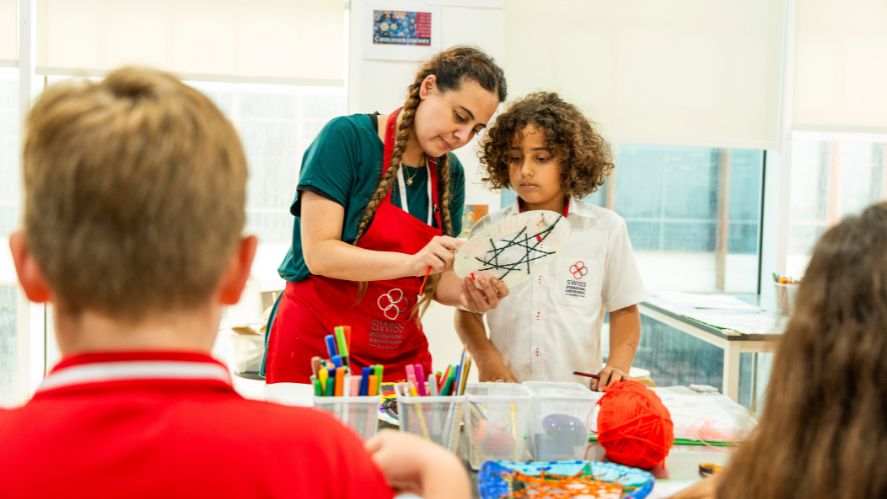
Not all International Baccalaureate (IB) educations are experienced in the same way.
While the IB is globally respected for its academic rigour and emphasis on critical thinking, the environment in which it is delivered plays a defining role in how students engage with it, and what they ultimately gain from it.
For families considering international education, particularly those considering global pathways and future university ambitions, a question that is becoming asked more and more commonly is whether a single-language IB education is enough to fully prepare a child for a truly international future. A growing number of parents would argue that it is not.
A bilingual approach does more than complement the IB. It strengthens it on all fronts: academically, cognitively and culturally, and aligns it more closely with the demands of a globalised world.At SISD, this philosophy underpins the structure of the school itself, where bilingual learning is not simply an enhancement to the IB, but a fundamental part of how it is delivered.Here’s why we believe a bilingual approach is by far the most effective way of delivering the IB programme at all stages.
The IB Is Designed for Global Thinkers
At its core, the IB is not simply a curriculum. It is a framework designed to develop students who can think independently, question assumptions and engage with complexity.Students are encouraged to engage with the subject matter in more meaningful ways. They are required to analyse over rote memorisation, apply their knowledge across disciplines and engage with multiple perspectives.
This is what makes the International Baccalaureate curriculum particularly attractive to internationally mobile families. It provides continuity across borders and is widely recognised by leading universities worldwide.
However, while the philosophy is inherently global, the delivery does not always fully reflect that intent.
Where Traditional IB Delivery Can Fall Short
In many schools, the IB is taught predominantly through a single language, typically English.While this provides accessibility and consistency, it can also create limitations.
A single-language environment can narrow the range of perspectives students engage with and limit deeper cultural understanding. This reduces opportunities for cognitive flexibility and means students aren’t always able to develop to their full potential. The result is an experience that is academically strong, but not always fully aligned with the global, multilingual reality students will eventually enter.
For families investing significantly in educationand increasingly prioritising outcomes such as international university placement, adaptability and long-term career mobility, thisis an important distinction. It is also where schools that fully integrate bilingual learning, rather than treating language as a standalone subject, are able to offer a more complete IB experience.
Why Bilingual Learning Enhances IB Outcomes
A bilingual approach introduces a fundamentally different learning dynamic.
Rather than simply adding a second language as a subject, bilingual education integrates language into the way students think, analyse and express ideas.This has a measurable impact across several areas.
Stronger Cognitive Development
Students learning in two languages regularly switch between linguistic systems. This strengthens memory, improves problem-solving ability and enhances mental flexibility.Over time, this translates into a greater ability to approach complex problems from multiple angles, which is an essential skill within the IB framework.
Deeper Conceptual Understanding
Learning concepts across two languages requires students to process meaning more carefully. They are less likely to rely on memorisation and more likely to develop genuine understanding.This synergises perfectly with the IB’s emphasis on inquiry-led learning.
Greater Academic Precision
Language shapes thought. Exposure to multiple linguistic structures allows students to articulate ideas more precisely and engage with nuance more effectively, particularly in subjects requiring analysis and evaluation.
In environments where bilingual learning is embedded across subjects, such as at SISD, these benefits are not theoretical, they are experienced daily as part of the learning process.This is especially valuable in IB assessments, where clarity of thinking and communication is critical.
Bilingual Students Are Better Prepared for Global Pathways
For many families, the IB is not the end goal; it is a pathway to leading universities and international careers.In this context, bilingualism becomes a significant advantage.
Students who graduate from bilingual IB environments are often viewed more favourably by international universities, making them more competitive in the application process. They are also better equipped to study abroad and more confident navigating multicultural environments.
As global higher education becomes increasingly interconnected, the ability to operate across languages is becoming increasingly valued at top universities and employers worldwide.
For parents seeking long-term return on their investment in education, the added layer of preparedness a bilingual education provides is highly relevant.For SISD students, this is reflected not only in their academic results, but also in their readiness to transition confidently into international university environments.
Preserving Identity While Expanding Opportunity
One of the most common concerns among internationally mobile families is the potential loss of cultural or linguistic identity.A bilingual approach addresses this directly.
Rather than replacing a student’s first language, it allows them tomaintain and develop their home language, whilst buildingfluency in English and an additional academic language. This means they are able to engage with multiple cultures, without compromising their own.
The balance of maintaining a student’s home languagewith learning a new one is particularly important for families from the GCC and Asia, where language is closely tied to identity, heritage and future opportunity.That is why, at SISD, we offer our boarding students the best pastoral care alongside a world-leading academic programme that ensures they do not have to choose between global readiness and cultural continuity, they can achieve both.
Why a True Bilingual Model Matters
Not all bilingual offerings are equal.
In some schools, languages are taught as standalone subjects. While valuable, this does not fundamentally change how students learn.A true bilingual model integrates language across the curriculum.
In practice, this means:
Subjects are taught in more than one language
Students engage with academic content through both linguistic frameworks
Language becomes part of the learning process, not separate from it
This level of integration is where the full cognitive and academic benefits of bilingual education are realised.It also reflects a more authentic interpretation of what an international education should be.
How SISD Delivers a Truly Bilingual IB Education
Understanding the value of bilingual education is one thing. Delivering it effectively is another.
At SISD, bilingualism is not treated as an additional feature or enrichment activity. It is embedded into the structure of the school and the way students experience learning every day.
Students follow one of the school’s bilingual streams,most commonly English–French or English–German, where both languages are centralto learning across subjects rather than taught in isolation. Subjects are delivered across both languages, allowing students to engage with concepts from multiple linguistic and cultural perspectives. We find this approach to be a much more authentic interpretation of international education.
It also aligns closely with the expectations of globally mobile families, many of whom are seeking an environment that supports both academic excellence and multilingual development. Research into international school parents consistently shows that bilingual capability is viewed as a key component of future readiness, alongside university outcomes and global mobility.
SISD’s Swiss educational heritage further strengthens this model. Swiss education has many benefits, and is renowned for its precision, structure and multilingual fluency, qualities that naturally complement the IB’s inquiry-led framework.
The result is a learning environment where language supports deeper understanding, rather than sitting alongside it. Students develop confidence operating across cultures and contexts and academic rigour is matched with real-world relevance.
For families considering IB schools in Dubai, it is importantto assess not onlywhether a school offers the IB, but how effectively their programme prepares students for what comes next.
The Future of International Education Is Bilingual
The expectations placed on students are changing.
Universities are looking for individuals who can think critically, adapt quickly and operate across cultures. Employers are seeking graduates who can collaborate internationally and navigate complexity with confidence. Meanwhile, education models are evolving.
The combination of the IB and a bilingual approach represents a natural progression that more closely reflects the world students are preparing to enter.For families evaluating international schools today, the question is no longer whether bilingual education is beneficial, it is whether a monolingual approach is still sufficient.
Choosing an IB school is not simply about selecting a curriculum. It is about understanding how that curriculum will shape the way a student thinks, learns and engages with the world.A bilingual approach enhances the IB at every level. It deepens understanding, strengthens cognitive development and prepares students more effectively for global pathways.
At SISD, this approach is embedded into the fabric of our school, ensuring that students do not just complete the IB, but experience it in a way that reflects the realities of a truly international future.
To learn more about SISD’s bilingual IB pathways, explore our curriculum or speak with our admissions team.
Frequently Asked Questions About Bilingual IB Education
Is bilingual education more challenging for IB students?
Bilingual education can be more demanding in the early stages, but this challenge is part of its value. Students develop stronger cognitive flexibility, problem-solving skills and adaptability over time. Within the IB framework, this often translates into deeper understanding and more confident engagement with complex topics.
Does learning in two languages improve academic performance?
Research consistently shows that bilingual students demonstrate enhanced executive function, memory and analytical thinking. These skills align closely with the IB’s emphasis on inquiry-based learning, often supporting stronger academic outcomes across subjects.
Will my child become fully fluent in both languages?
In a true bilingual model, where languages are integrated into academic subjects rather than taught in isolation, students typically achieve high levels of fluency in both languages. The level of proficiency will depend on prior exposure, consistency and engagement, but outcomes are significantly stronger than in traditional language-learning models.
Is bilingual IB suitable for students without prior second-language experience?
Yes, depending upon the school’s programme.Our bilingual pathways are designed to support students at different starting points. With the right structure and support, our students successfully develop proficiency over time while continuing to progress academically.
Does bilingual education affect university applications?
In most cases, it strengthens them. Universities increasingly value multilingualism as an indicator of adaptability, global awareness and cognitive ability. For students applying to international institutions, bilingualism can be a clear differentiator.
How is bilingual IB different from simply learning a second language?
Traditional language learning focuses on vocabulary and grammar as standalone subjects. Bilingual IB integrates language into the learning process itself; students engage with academic content in multiple languages, which deepens understanding and strengthens critical thinking.
Related news
News image ![SISD Partners with Dubai Creek Golf Club Academy]() News | Educational Insights | Nord Anglia Education
News | Educational Insights | Nord Anglia Education
 News | Educational Insights | Nord Anglia Education
 SISD Partners with Dubai Creek Golf Club Academy
SISD partners with Dubai Creek Golf Club Academy to give IBCP students hands-on experience in golf, sport, and the wider sports business ecosystem.
News image ![SISD Renews Partnership with Speedo Swim Squads - SISD renews long standing partnership with Speedo Swim Academy]() News | Educational Insights | Nord Anglia Education
News | Educational Insights | Nord Anglia Education
 News | Educational Insights | Nord Anglia Education
 SISD renews long standing partnership with Speedo Swim Academy
SISD renews its long-standing partnership with Speedo Swim Squads, strengthening a comprehensive swimming programme that supports students from their first lessons through to competitive performance.
News image ![Introducing The Learning Curve - Introducing The Learning Curve]() News | Educational Insights | Nord Anglia Education
News | Educational Insights | Nord Anglia Education
.jpg?h=1600&iar=0&w=1600&rev=96e25ab25b6e44c8bee0e21221f7e9a1&hash=DFCBBDCC84B62CDC0C5B3088C3419842) News | Educational Insights | Nord Anglia Education
News | Educational Insights | Nord Anglia Education Introducing The Learning Curve - A new podcast for families navigating school, parenting, and growing up
Every parent has questions. Some are practical. Others are deeply personal. Is my child happy at school? Are they developing as they should? How much homework is too much? Is university still worth it? What role should AI play in learning?
News image ![Image_SISD_Dubai_2025 (41)]() Blog | Educational Insights | Advice and Guidance
Blog | Educational Insights | Advice and Guidance
 Blog | Educational Insights | Advice and Guidance
 Choosing Between English-French and English-German Bilingual Education
At SISD, we offer both English-French and English-German educational pathways. Find out which may be best for you and speak to our admissions team for more information.