What Is the IB Primary Years Programme?
The PYP is the International Baccalaureate (IB) programme for younger learners. At SISD, children follow the framework throughout Early Years and Primary before progressing into the IB Middle Years Programme(MYP).
Rather than treating every subject as an entirely separate experience, the PYP uses units of inquiry that help children make connections between different areas of learning.
That does not mean subjects such as maths or language disappear. SISD Primary students continue to develop knowledge across language, maths, science, the arts and other curriculum areas. The difference is that children are regularly given opportunities to apply what they know within a wider question or concept.
This helps learning move beyond remembering information. Children begin to understand where their knowledge fits and how it can be used.
Learning Through Inquiry: What Does It Look Like in the Classroom?
The easiest way to understand inquiry is to look at how it starts.
In SISD’s Early Years classrooms, PYP learning is play-based. A learning experience might begin with something a child has noticed, a question that has emerged during play or an idea introduced by the teacher. Children are given space to explore it while developing the knowledge needed to take their thinking further.
Play therefore has a purpose. An activity might develop an early mathematical concept while also encouraging children to explain what they have noticed. Another may lead them towards a scientific question that the class can explore further.
Inquiry does not mean children are expected to work everything out for themselves.
Teachers deliberately design the learning environment and decide when new knowledge needs to be introduced. They observe how children respond, guide questioning and adjust the learning according to what students are ready for next.
The SISD environment supports this approach too. Early Years children have dedicated classroom and play spaces, while the wider campus gives students access to specialist facilities as their learning develops. Technology is also integrated throughout classrooms and specialist spaces.
From an early age, children are encouraged to have a voice in their learning and reflect on what they have discovered. Parents can begin to see that process too. SISD invites families into learning through opportunities such as mini-exhibitions and student-led meetings, rather than only sharing a result at the end of the year.
The questions, choices and reflections children begin making in Early Years become more sophisticated as they move through Primary. By the time they reach Grade 5, those same habits underpin the much more independent inquiry they undertake during the PYP Exhibition.
The Learner Profile and Approaches to Learning
Two ideas parents will encounter regularly within the PYP are the IB Learner Profile and Approaches to Learning.
The Learner Profile describes the qualities the IB wants students to develop over time. A child might, for example, become more reflective about their own work or increasingly confident explaining an idea to somebody else.
At SISD, these qualities are not treated as abstract ideas. The school’s primary behaviour expectations are informed by the Learner Profile, so attributes such as reflection and responsibility also shape how students are encouraged to contribute to the wider school community.
Approaches to learning focus more closely on how children learn. These include skills such as research and self-management, which become more sophisticated as students move through the PYP.
SISD’s teaching approach also encourages students to reflect on how they learn and to use these skills consistently across different subjects. In practice, that might mean a younger child learning how to explain why they think something happened, while an older student may need to decide which information is useful for an inquiry or organise a longer piece of work.
The important point is that these skills develop alongside academic knowledge rather than replacing it.
What Is the PYP Exhibition?
One of the clearest examples of this approach comes at the end of the Primary years.
In Grade 5, SISD students complete the PYP Exhibition, a substantial project centred on a real-life issue that resonates with them. Previous inquiries have explored subjects ranging from digital life and wellbeing to environmental concerns, with students also making connections to wider global challenges such as the United Nations Sustainable Development Goals.
Students investigate their chosen subject in depth and consider what action could come from what they have learned. Digital technology may become part of the process, whether that means developing a website or creating another resource through which they can communicate their ideas.
Throughout the Exhibition, teachers and staff mentors are available to guide the process. Where possible, students are matched with a mentor whose experience or interests relate to their inquiry. That adult can question their thinking and encourage reflection while the student retains ownership of the direction their project takes.
The culmination is also shared with the wider SISD community. Students first present their learning to staff and fellow students before parents are invited to see the outcomes of the project.
By Grade 5, they are bringing together skills and learning habits that have been developing throughout their Primary years.
Do Children Still Learn the Fundamentals?
For parents moving from a more traditional national curriculum, this is often the biggest question.
The answer is yes.
At SISD, Primary students continue to study core areas. Early Years learning similarly develops knowledge across subject areas through purposeful, age-appropriate experiences.
Inquiry gives children opportunities to use those foundations. After all, asking a good question about a subject becomes much easier when you have knowledge to build from.
How Will I Know If My Child Is Making Progress?
An inquiry-based curriculum should not leave parents guessing about how their child is doing.
Teachers continually observe how students are developing and use evidence from learning to understand what a child is ready to work on next. SISD’s teaching and learning approach also uses student data to inform planning and provide appropriate levels of challenge or support.
Parents receive more formal opportunities to understand that progress too.
In Early Years, SISD uses report cards alongside parent-teacher meetings. There are also meetings involving the parent, student and teacher together, as well as student-led meetings where children have an opportunity to share their own learning.
That matters within the PYP because progress is not only visible through a test score. Parents can see what their child knows while also gaining a clearer picture of how confidently they are beginning to use that knowledge.
Preparing for What Comes Next
As children approach Secondary school, the academic expectations change. Work becomes more complex and students are expected to take greater responsibility for how they approach it.
The PYP gives children repeated experience of applying what they know to unfamiliar situations. Over time, they become more accustomed to explaining their thinking and managing work that does not always have an immediate answer.
At SISD, students can then progress into the IB Middle Years Programme, where Grades 6 to 10 study across eight subject groups while continuing to make practical connections between their studies and the wider world.
The value of those learning habits is not limited to staying within the IB, however. They support the broader transition towards the greater academic demands students will encounter as they move beyond Primary education.
Is the PYP Right for My Child?
Children do not need to arrive already independent or naturally confident at asking questions to benefit from the PYP.
At SISD, teachers plan with individual learning profiles in mind, with opportunities for small-group teaching and one-to-one support where appropriate. This gives children different ways into a topic rather than expecting everyone to engage in exactly the same way.
That can be particularly reassuring for children joining a new school or moving to Dubai. SISD also uses orientation activities to help new students become familiar with the school environment and meet future classmates before term begins.
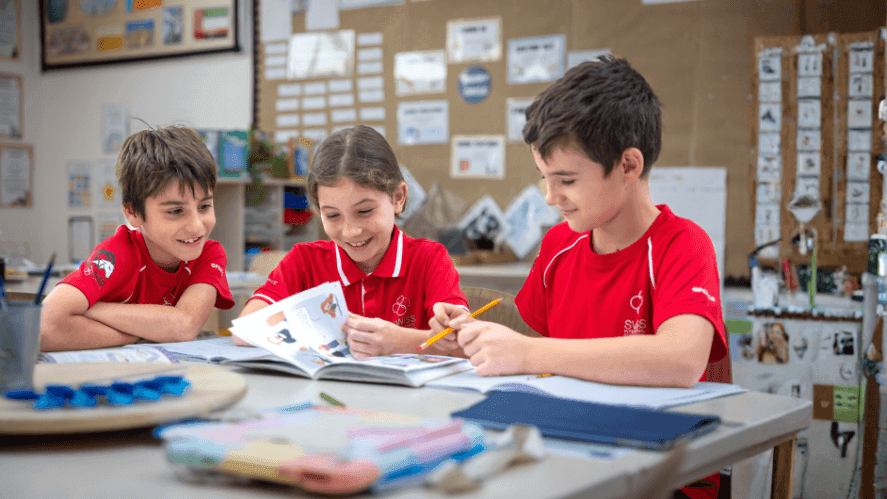
For some parents, the biggest adjustment may simply be recognising that a classroom can look different from the one they experienced themselves. A child discussing a question with classmates or exploring a concept through play is not necessarily doing less academic learning. The purpose is to help them understand what they are learning deeply enough to do something with it.
See the PYP in Practice at SISD
Some aspects of the PYP make much more sense when you can see them happening.
During a campus tour, you may see how an Early Years classroom moves between guided learning and purposeful exploration, or explore the specialist spaces Primary students can use as their inquiries develop. It is also an opportunity to speak to the team about how learning and progress would look for your own child.
Book a campus tour and experience the PYP at SISD.




.jpg?h=1600&iar=0&w=1600&rev=96e25ab25b6e44c8bee0e21221f7e9a1&hash=DFCBBDCC84B62CDC0C5B3088C3419842)