



We use cookies to improve your online experiences. To learn more and choose your cookies options, please refer to our cookie policy.

10 November, 2026
What does CIS accreditation mean for St Andrews Bangkok?

Bangkok has more international schools than almost any city in Asia, and for families, the choice can feel overwhelming. Curricula, fees and facilities are easy to compare. Quality is harder to see from the outside.
That is where accreditation comes in. One of the most widely recognised marks in international education is CIS International Accreditation, awarded by the Council of International Schools. St Andrews International School Bangkok is also accredited by WASC (the Western Association of Schools and Colleges).
Together, these two organisations provide an independent evaluation of a school's educational quality, leadership, student support and commitment to continuous improvement.
Here is what CIS and WASC are, how accreditation works and why it matters for families choosing an international school in Bangkok.
Key takeaways: What parents need to know
- CIS and WASC are independent accreditation organisations that evaluate school quality worldwide.
- CIS focuses on international education, including global citizenship, intercultural understanding, safeguarding and student well-being.
- WASC evaluates educational quality, including academic standards, student achievement, teaching and learning, and school leadership.
- Accreditation involves more than an inspection. Schools undertake detailed self-evaluation, external assessment and ongoing improvement.
- St Andrews International School Bangkok was re-accredited by CIS/WASC in 2026, following a joint evaluation across its Primary and High School campuses.
- For parents, accreditation provides reassurance that a school is independently evaluated and committed to maintaining and improving its educational standards.
What are CIS and WASC?
The Council of International Schools (CIS) is a global, not-for-profit membership community of more than 1,635 schools and universities across 120 countries. It aims to foster "healthy, interculturally competent global citizens" through international education.
CIS is both a membership network and an accrediting body. Schools can join as members and then register for CIS International Accreditation. CIS is itself held to account: it is accredited by the International Council Advancing Independent School Accreditation (ICAISA), the body that accredits accrediting organisations.
WASC (Western Association of Schools and Colleges) is a US-based accreditation organisation that evaluates schools, colleges, and universities, including international schools worldwide. It is particularly well known for its work with American and international schools.
While both organisations assess educational quality and encourage schools to keep improving, they bring different perspectives:
- CIS places particular emphasis on international education, global citizenship, intercultural understanding, safeguarding and student well-being.
- WASC focuses on educational quality, academic standards, student achievement, leadership and evidence-based school improvement.
Having both accreditations means a school is evaluated against two internationally recognised frameworks, providing a broader perspective on its educational provision.
How does a school earn CIS/WASC accreditation?
Accreditation is not a one-off inspection. It is an ongoing process of self-review, external evaluation and school improvement.
CIS describes its approach as developmental: schools are encouraged to reflect on what they do well, identify areas for growth and demonstrate how they are making progress.
The CIS accreditation cycle has four main stages:
- Cornerstone Conversations. Ongoing, reflective dialogue between the school and CIS about strengths, areas for growth and progress over time.
- Preparatory Evaluation. Trained CIS evaluators visit the school, usually for three days, to confirm it is ready and agree on a plan.
- Self-Study. The school identifies two to four Development Initiatives linked to CIS standards and its own strategic priorities, then gathers evidence of the changes and improvements made.
- Team Evaluation. A team of volunteer peer evaluators from other schools visits, usually for four days, to observe learning, talk with the school community and evaluate its progress.
WASC also uses self-study and external peer evaluation to examine how effectively a school supports student learning and meets its educational goals.
The CIS standards cover three broad areas: Purpose, Practices and Planning; Guiding Principles; and Learning and Well-being. The framework also embraces the UN Declaration of Human Rights and incorporates recommendations from the International Taskforce on Child Protection.
What does accreditation mean for families?
For parents, CIS/WASC accreditation offers reassurance that experienced education professionals have independently reviewed a school. It is an opportunity to look beyond facilities and academic results and understand how a school supports children throughout their education.
An accredited school demonstrates a commitment to:
- Teaching and learning: Maintaining high standards of teaching and creating opportunities for every student to make progress.
- Safeguarding and well-being: Putting child protection, student safety and pastoral care at the heart of school life.
- Global citizenship: Helping students develop intercultural understanding and the skills to contribute positively to the wider world.
- Leadership and accountability: Having clear educational goals, effective leadership and systems for evaluating progress.
- Continuous improvement: Listening to feedback, reviewing practices, and making changes where needed.
In practice, that matters in four ways for families.
Quality you can check. With so many schools in Bangkok, accreditation gives families a common benchmark beyond marketing and league tables. It means an independent team has looked closely at how a school operates and supports its students.
Safeguarding and well-being. Child protection and student well-being are built into the accreditation standards, rather than treated as an add-on. Families can feel confident that these areas form part of the school's ongoing evaluation.
Global citizenship. Many Bangkok classrooms bring together children from dozens of nationalities. CIS places intercultural learning and global citizenship at the centre of its framework, helping schools prepare students to understand and contribute to an increasingly connected world.
University pathways. CIS states that ministries, education departments, and universities worldwide recognise its accreditation. Its international network also connects school counsellors with university admissions teams. However, accreditation does not automatically determine whether an individual student's diploma is recognised. Qualifications such as the IB Diploma, A Levels and IGCSE have their own recognition.
St Andrews and the CIS/WASC community
St Andrews International School Bangkok, founded in 1997 and part of Nord Anglia Education, is a member of the Council of International Schools.
St Andrews was re-accredited by CIS/WASC in 2026. Our journey began with a Preparatory Engagement Visit across both campuses in March 2025. Over the following year and a half, in line with the Self-Study stage of the accreditation cycle, the school worked on three Development Initiatives: Quality First Teaching, supported by work on Assessment and the Use of Data, and Professional Learning. This work culminated in 2026 in a week-long visit from a joint CIS/WASC evaluation team, allowing us to share our progress in these areas.
During their visit, the team met with school leaders, teachers, operational staff, parents, and students, and observed lessons throughout the week to gain a broad understanding of school life and our community's experiences.
Reflecting on the visit, team chair Dr Jennifer Swinehart said the team “heard and saw STA’s commitment to inclusion reflected in the passionate and thoughtful ways that adults and children alike described what it meant to be a part of the STA family.”
The visit allowed us to celebrate our strengths, reflect on our progress, and consider how we can continue to improve every student's experience.
Our staff also contribute to the wider CIS community. In 2026, a member of our High School leadership led a CIS Preparatory Engagement visit at Yew Chung International School of Qingdao, helping another school begin its own accreditation journey.
CIS/WASC accreditation sits alongside our other external recognitions, including British Schools Overseas (rated "Outstanding") and Inclusion Quality Mark Centre of Excellence status. St Andrews was the first school in the world to receive this recognition in 2024.
With more than 2,400 students from over 70 nationalities, our commitment to inclusion, academic development and student well-being is part of everyday life. Our Careers and Higher Education programme also supports every student from Year 10 to Year 13 as they prepare for their next steps beyond school.
Questions to ask when choosing an international school
When visiting international schools in Bangkok, families might find it helpful to ask:
- Which organisations accredit or evaluate the school, and when was its last review?
- How does the school keep students safe, and how is this checked externally?
- How does the school develop global citizenship and intercultural understanding?
- What university guidance does it offer, and where do graduates go?
- What is the school currently working to improve?
Accreditation is not the only thing that matters when choosing a school, but it is one of the clearest signs that a school is open to scrutiny, values feedback and is committed to getting better.
For families in Bangkok, understanding CIS/WASC accreditation is a useful starting point when looking beyond the prospectus and finding a school where their child can learn, grow and feel they belong.
Frequently asked questions about CIS/WASC accreditation
What is CIS accreditation?
CIS accreditation is an international quality assurance process awarded by the Council of International Schools. It evaluates how effectively a school supports student learning, well-being, safeguarding, global citizenship and continuous improvement. It involves a detailed self-review and an independent external evaluation by experienced education professionals.
What is WASC accreditation?
WASC stands for the Western Association of Schools and Colleges. It is a US-based accreditation organisation that evaluates schools and educational institutions worldwide. WASC accreditation examines academic quality, student achievement, teaching and learning, leadership and how effectively a school meets its educational goals.
What is the difference between CIS and WASC accreditation?
Both CIS and WASC independently evaluate the quality of schools and encourage continuous improvement. CIS has a particular focus on international education, global citizenship, intercultural understanding and student well-being. WASC places particular emphasis on academic standards, student achievement and evidence-based school improvement. Together, they provide complementary perspectives on a school's educational provision.
Is CIS/WASC accreditation important when choosing an international school?
Accreditation can help parents make a more informed decision when comparing international schools. It demonstrates that a school has undergone an independent evaluation of its educational standards, leadership, safeguarding and student support. It also shows a commitment to reviewing performance and making improvements over time. However, parents should consider accreditation alongside the school's curriculum, teaching, facilities, community and suitability for their child.
How often is a CIS-accredited school evaluated?
CIS accreditation follows an ongoing cycle of self-evaluation, external review and continuous improvement. The process includes preparatory evaluation, a school-led self-study and an external team evaluation. Schools are also expected to monitor progress against their development priorities between formal evaluation visits. The precise review cycle and requirements depend on the school's accreditation status and CIS procedures.
Does CIS/WASC accreditation mean a school offers an internationally recognised curriculum?
No. Accreditation evaluates the quality of the school as an educational institution; it is not the same as curriculum accreditation. Schools may offer different programmes, including the British National Curriculum, the International Baccalaureate (IB), or the American curriculum. Qualifications such as IGCSEs, A Levels and the IB Diploma have their own recognition and university entry requirements.
Does CIS/WASC accreditation guarantee university admission?
No. Accreditation does not guarantee that a university will accept an individual student. Admissions decisions depend on the student's qualifications, academic performance, university requirements and other application criteria. However, CIS accreditation provides access to an international education network and opportunities for school counsellors to connect with universities worldwide.
Is CIS accreditation the same as being a member of CIS?
No. CIS membership and CIS accreditation are different. Membership gives schools access to the CIS international education network and its professional resources. Accreditation involves a much more detailed process of self-evaluation and independent external review against CIS standards.
Is St Andrews International School Bangkok CIS/WASC accredited?
Yes. St Andrews International School Bangkok was re-accredited by CIS/WASC in 2026, following a joint evaluation process across its Primary and High School campuses. The evaluation team met with school leaders, teachers, operational staff, parents and students to gain a broad understanding of the school and its community.
What other external accreditations and recognitions does St Andrews Bangkok have?
Alongside CIS/WASC accreditation, St Andrews International School Bangkok has received an Outstanding rating from British Schools Overseas (BSO) and holds Inclusion Quality Mark Centre of Excellence status. In 2024, St Andrews became the first school in the world to receive this inclusion recognition.
Related news
News image ![STA maintains IQM Centre of Excellence status - STA maintains IQM Centre of Excellence status]() News | Academic | Beyond the Classroom
 News | Academic | Beyond the Classroom
St Andrews maintains Inclusion Quality Mark (IQM) Centre of Excellence status following re-accreditation visit
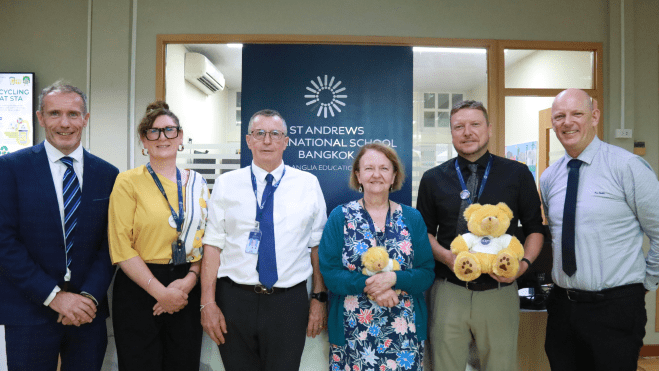
St Andrews proudly celebrates the renewal of its Inclusion Quality Mark (IQM) Centre of Excellence status following a successful re-accreditation in May 2026. This recognition reflects the school’s strong and sustained commitment to inclusive education. As the first international school to achieve this milestone in 2024, St Andrews continues to lead in creating a supportive environment for every learner while sharing its expertise more widely. The school also hosted the IQM Thailand event, bringing together educators from across the country to advance inclusive practice.
News image ![How schools create a safe learning environment - school safeguarding st andrews bangkok]() Blog
 Blog
Why safeguarding and clear systems matter more than parents often realise
Discover how safeguarding systems and strong school practices protect students at St Andrews Bangkok.