
.jpg?h=249&iar=0&w=374&rev=5c3dacca1895403ea4fbab0c28e6fe0d&hash=E43DDE2E55CCD139473D7779AE3ADAD8)


We use cookies to improve your online experiences. To learn more and choose your cookies options, please refer to our cookie policy.
13 April, 2026
Why long-term investment in a school matters more than it first appears

When families evaluate a school, the focus often begins with academic results, curriculum, and teaching quality. These are essential. But over time, another factor becomes increasingly important: how a school invests in its environment and its future.
This is not about appearance. It is about what those investments signal and how they shape the student experience over many years.
At The British School Tashkent (BST), long-term investment reflects a broader commitment to consistency, quality, and the overall experience of students and families.
What investment really signals to families
School investment is often misunderstood as a focus on facilities alone.
In reality, it reflects something deeper. It shows whether a school is planning for the long term and whether it is committed to improving the experience of its community.
Rebecca Wolfe, Head of Secondary, explains this clearly.
“Long-term investment shows families that we care about the whole school experience, not just academic outcomes.”
For parents, this provides reassurance that the school is not focused only on short-term results, but is actively building an environment where students can grow over time.
The link between environment and learning
The physical environment of a school plays a direct role in how students learn.
Purpose-built spaces are not simply designed to look impressive. They are designed to support specific types of learning and to help students engage more deeply with their subjects.
“At BST, purpose-built learning environments are designed to stimulate imagination and help students connect more meaningfully with their learning,” explains Rebecca.
This might include:
- science laboratories that allow for practical experimentation
- creative spaces that support performance and design
- flexible classrooms that encourage collaboration and discussion
These environments change how students experience learning. They make it more active, more engaging, and more relevant.
Supporting consistency over time
One of the key concerns for families is whether a school will remain strong over time.
Investment plays a role in addressing this concern. It supports consistency by ensuring that facilities, resources, and environments remain aligned with the school’s academic ambitions.
When investment is ongoing, schools are better able to maintain high standards, adapt to changing educational needs and support both current and future students.
This continuity helps ensure that students experience a stable and well-supported learning environment throughout their time at school.
A reflection of ambition and direction
Investment also reflects a school’s long-term vision.
At The British School Tashkent, the development of a new campus is not simply an expansion. It represents a clear statement about the future of the school.
“The new campus reflects the ambition of the school, ensuring that the quality of facilities match the quality of education we provide,” adds Rebecca.
This alignment shows that the school’s physical environment is evolving alongside its academic programme.
For families, this investment provides confidence that the school is moving forward, rather than remaining static.
Beyond facilities: the wider experience
While facilities are visible, the impact of investment extends beyond the physical environment.
It influences how students feel in school, how confidently they engage with learning and how well the school supports a broad range of experiences.
A well-designed environment supports not only academic learning, but also creativity, collaboration, and personal development.
Over time, this contributes to a more balanced and fulfilling school experience.
A clearer way to understand value
When parents consider the value of a school, it is easy to focus on academic outcomes alone.
But value is also shaped by the quality of the experience that leads to those outcomes.
At The British School Tashkent, long-term investment supports both. It ensures that students learn in an environment that is designed, maintained, and developed to meet their needs.
For families, this provides reassurance that the school is committed not only to academic success, but to the overall development of each child.
Parents who would like to learn more about the school’s facilities and long-term vision are always welcome to speak with the academic team and explore how these investments support learning across the school.
Related news
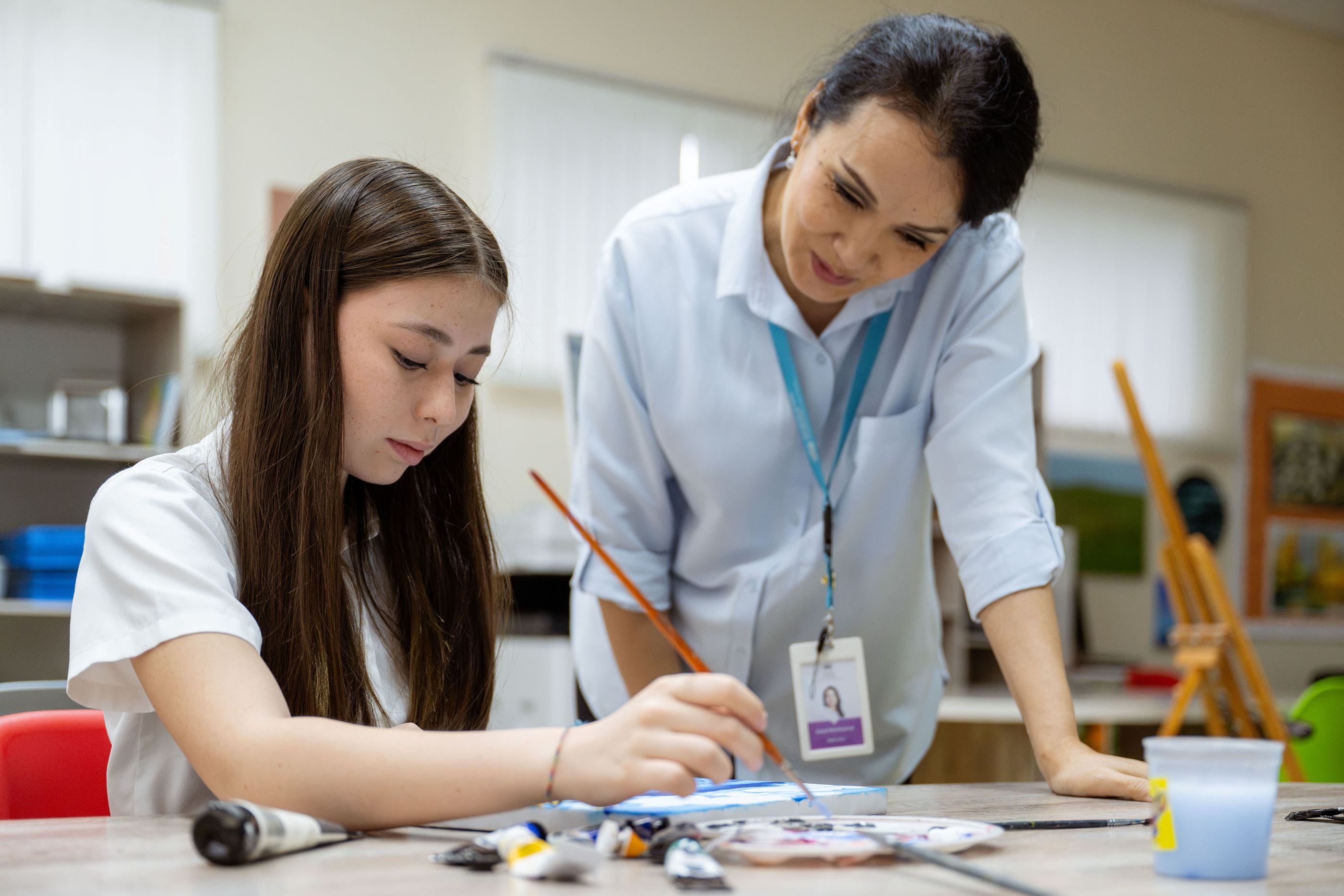
News image ![Secondary student developing an Art project at The British School of Tashkent.]() Blog | Art
Blog | Art
 Blog | Art
 Why study Art at GCSE and A Level? The value of creative education
Discover the benefits of studying Art at GCSE and A Level, including academic skills, creative thinking, university pathways and future career opportunities.
News image ![Students from The British School of Tashkent celebrating at Graduation by throwing their caps in the air]() News | Academic | Highlights
News | Academic | Highlights
 News | Academic | Highlights
 Celebrating GCSE and A Level success at The British School of Tashkent
The British School of Tashkent celebrates strong 2025/26 GCSE and A Level results, with students achieving highly at different stages of their education