


We use cookies to improve your online experiences. To learn more and choose your cookies options, please refer to our cookie policy.
10 February, 2026
Where choir meets wellbeing: the story of Giocoso
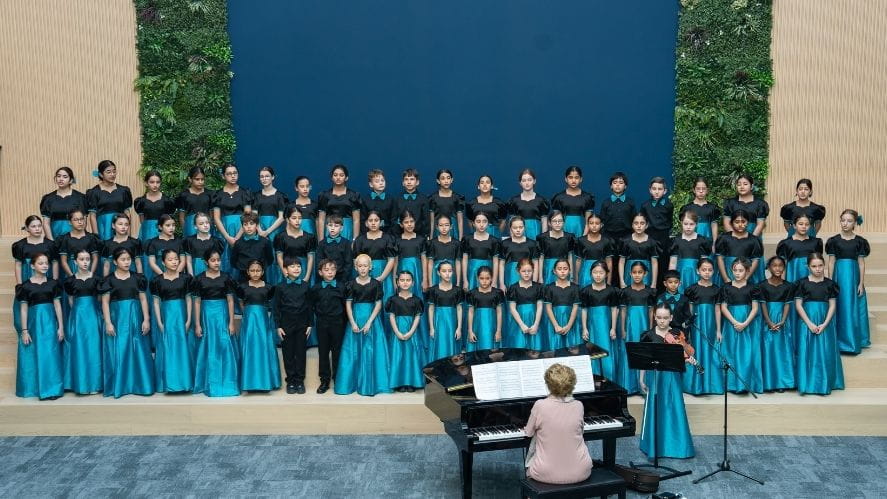
What belonging sounds like in a school choir in Dubai
In a region known for ambition, innovation, and world-class opportunity, it is easy to overlook how powerful a single invitation can be. For our Giocoso Choir, one invitation reshaped everything. The Firdaus Orchestra, an all-female ensemble and initiative of Expo City Dubai, extended an exclusive invitation for Giocoso to perform alongside them on the Expo stage. Our choir was the only school ensemble selected for this collaboration.
To understand how this moment came to life, we need to return to the beginning, to one teacher with a clear vision and a decision to take children’s musical potential seriously. Meet Deborah Bannister, our Head of Primary Music, whose leadership has transformed the music department across all primary year groups. She created the choir Giocoso, which is an Italian musical term meaning 'joyful' and 'playful'. It also carries personal significance for Deborah, who sang in a choir with the same name while growing up in Canada. That experience shaped her understanding of what choir can offer children beyond music.
Why not create that same experience here?
A Vision That Refused to Stay Small
Meet Deborah Bannister, our Head of Primary Music, whose leadership has transformed the music department across all primary year groups. When Deborah first took over the primary choir here at NAS Dubai, she noticed a familiar pattern. Children arrived enthusiastic, attended for a few weeks, and then gradually drifted away as homework, family commitments, travel, and other clubs took priority. The children loved singing, but the group moved like a tide: full one week, half-empty the next. The choir’s sound couldn’t settle because the choir itself kept changing.
Deborah speaks about this stage with honesty rather than polish. “I started getting quite frustrated as the children dabbled in the choir,” she explains. “There was no consistency.” This frustration was never directed at the children. It came from a deeper place: the ache that something far stronger was possible if the right foundations were put in place.She wanted more than casual involvement. “I wanted attitude from the students,” Deborah says. “The ones who lived and breathed music. The ones who wanted to become elite.” By elite, she did not mean trophies or exclusion. She meant commitment, focus, pride in improvement, and ownership of learning. To build that culture, she made a decision that many inclusive schools hesitate to make: she made it harder to join so it could become easier to belong.
Setting the Standard
“Just like anything competitive, I held auditions,” Deborah explains. “Two rehearsals a week, and if you missed more than three, you were out.”On paper, it sounds strict. In reality, it solved a problem that often goes unspoken. Children invest more deeply when they know the group beside them will show up, when expectations are clear, and when progress feels meaningful.
Suddenly, being in Giocoso meant something: you chose this, and other people chose it too. Parents noticed. Children noticed. Commitment settled into the room. Rehearsals no longer felt like constant restarts. Instead, they became a continuation of learning, week after week.“I wanted it to feel formal,” Deborah explains. “An opportunity for children to be part of something serious.” In practice, that formality wasn’t stiff or intimidating; it created safety. It told students, ‘I trust you with something real.’ And children typically rise to that kind of trust faster than adults expect.
Teaching Children to Read the Language of Music
With commitment established, Deborah introduced a new challenge: reading music notation. “I began teaching them actual music scores, so they got used to reading music manuscripts,” she explains.
If you’re imagining primary-age children reading notation and thinking, isn’t that too advanced? That’s exactly why this part is so powerful. It breaks the usual pattern where children think singing is either a gift you have or a skill you don’t. It replaces that story with a better one: you can learn this.
As their understanding grew, so did their curiosity. Students began asking questions that musicians ask, listening more closely, and recognising how their individual parts contributed to the whole. At the heart of this learning was one powerful message. “I taught them their voice is the most precious instrument,” Deborah says. “It’s a gift to sing.”
For many students, that’s the start of a new relationship with their own voice. For the confident ones, it adds responsibility: take care of your instrument. For the shy ones, it offers permission: your voice belongs here.
So, when the choir finally clicked, Deborah did what any good coach does: she gave them a match.
Dubai Opera as the “Match” to Aim For
“Any performing group needs a performance,” Deborah says. “It’s like every football team needs a match.” When children know where they’re going, they work differently.
Their first major performance took place at Dubai Opera, alongside the National Youth Orchestra. “For our first performance to be at Dubai Opera, that was a big moment,” Deborah recalls. “It set the bar high.”
The experience changed how the children saw themselves. Parents witnessed new confidence, and staff saw the school’s artistic identity strengthen. The students understood that their hard work led to something tangible and meaningful. For a while, the story runs exactly the way you want a school story to run: better rehearsal habits, better sound, bigger opportunities, more pride.
When Effort Doesn’t Get the Result You Expected
Not every chapter was neat. At Choir Fest, the outcome didn’t match the effort the children had put in. Deborah is careful with how she tells it, because the point isn’t the event; it’s the emotional truth that followed. The children weren’t simply disappointed; they were confused. “It was that sort of, ‘Explain this to us, Mrs Bannister. We don’t understand,’” she recalls.
This moment became a lesson in resilience. Deborah protected the children’s confidence while acknowledging their feelings, guiding them through disappointment without diminishing their effort, and then redirected the story toward something constructive.
An Evening with Giocoso
To mark the end of the season, the choir hosted a red-carpet event and concert that celebrated commitment and progress. “That evening was about recognising the effort the children had put into the choir,” Deborah explains. Students helped decide what some awards should be. They noticed one another in ways adults don’t always see: the child who always turns up, the child who steadies the group when nerves creep in, and the child who practises quietly and improves week after week.
These moments reinforced the culture established from the beginning. Giocoso was not just about performance. It was about belonging, effort, and shared achievement. When students returned the following year, they did so with a stronger sense of belief.
“A Step Above” in Voices in Harmony
Within two years, Giocoso built a repertoire that many people don’t associate with primary choirs: songs across genres and languages, including pop arrangements, folk songs, and pieces in French, Arabic (including the national anthem), and even Swahili. Deborah notes a proud milestone too: “NAS is the first school to ever have their own choir sing and play the national anthem on the school speakers.”
Other schools began to notice at the Voices of Harmony event. “We could really see that the Giocoso’s were a step above,” Deborah says. “The difficulty of the repertoire went beyond typical primary school expectations.” This progress reflected a broader trend within the UAE, where families increasingly value depth, structure, and meaningful enrichment beyond the classroom.
Collaborating with the Firdaus Orchestra
One of the adjudicators at Voices in Harmony had links to the Firdaus Orchestra, an all-female orchestra founded during Expo. A conversation became a possibility. A possibility became a plan, then suddenly Deborah found herself looking at the date in the diary. “Oh my, we’ve had four weeks off over the Christmas holiday.” Deborah laughs. Anyone who has ever tried to keep a child’s routines steady through a long break understands the concern.
Deborah remained committed to protecting the choir’s ethos. The focus stayed on proper choral learning rather than simply learning songs. Rehearsal hours increased, practice expectations were clear, and students worked independently using annotated scores and online resources. Some students even began to lead parts of rehearsals by pointing to exact pages and bars: “Page three, bar two, I can’t get my part there.” That is ownership. That is confidence built through skill.
The concert itself was the kind of experience children remember for years: the Giocoso’s on stage for almost the entire performance, learning to follow a conductor, holding their focus, and feeling the sound of voices and orchestra together. “The growth was incredible,” Deborah reflects.
A Multinational Choir Learning a Shared Language
In a multinational school, not every child arrives knowing choir culture, how to blend, how to listen, or how to follow a conductor. Giocoso became a place where those differences melt into a shared language. That’s also why Giocoso isn’t “a room full of soloists”, as Deborah puts it. It’s a team sound. A group that learns that belonging isn’t about being the loudest; it’s about being part of the harmony.
“I think… they find their people.” For children who don’t see themselves on the football pitch, the choir becomes the place they are most understood. “Choir… it’s our safe space.”
Growing evidence shows that singing supports wellbeing in meaningful ways, from improving breathing to easing stress, and these benefits unfold naturally through regular rehearsal. Deborah often reflects on how many adults grow up believing they “can’t sing”, usually because they were never given the chance to practise properly. Giocoso gently challenges that narrative, teaching children early on that singing is a skill developed over time. Belonging comes first; confidence follows, and “good enough” becomes something children grow into rather than wait for.
Onwards and Upwards: The Next Chapter for Giocoso
Giocoso’s future remains focused on maintaining joy while continuing to raise standards. Upcoming performances will include guest artists from the school community and visiting professionals, offering students new perspectives and inspiration.
What is being built extends far beyond singing. Children are learning commitment, collaboration, resilience, and pride in effort. They are discovering what can happen when dedication meets opportunity.
Interested in joining Giocoso or learning more about our music pathway? Keep an eye on upcoming performances, speak to our music department, or explore how our arts programme supports confidence, focus, and wellbeing from primary onwards.
Related news
News image ![Student jumping during hurdles on sports day]() Blog | School Events
Blog | School Events
 Blog | School Events
 Why school sports matter
Explore how NAS Dubai uses sport to nurture healthier, happier learners through movement, community, and balanced student development.
News image  Blog | Learning and Education Insights | School Events | blog | Homepage Featured Article
.jpg?h=600&iar=0&w=900&rev=a671695f1ded429d82ae2973e781f60d&hash=A4C52CE4C91F5707602BBD67FAE89158 "NAS-Dubai-Sixth-Form-Open-Evening-Guidance-Discussion.jpg") Blog | Learning and Education Insights | School Events | blog | Homepage Featured Article
Blog | Learning and Education Insights | School Events | blog | Homepage Featured Article A Levels vs IB vs BTEC in Dubai Explained: How to Choose the Right Path
Confused between A Levels, IB or BTEC in Dubai? This parent’s guide explains the differences and helps you choose the right pathway.
News image ![Professor Rose Luckin speaking with students during an AI and digital fluency panel discussion at Nord Anglia International School Dubai.]() News
News
 News
News Welcoming AI Expert Professor Rose Luckin to NAS Dubai: Why Responsible AI Education Matters for Families Today
Professor Rose Luckin visits Nord Anglia School Dubai to explore ethical AI in education, critical thinking, digital wellbeing, and how AI can enhance – not replace – learning.


