


We use cookies to improve your online experiences. To learn more and choose your cookies options, please refer to our cookie policy.
23 November, 2026
Student Achievement at NAS Dubai: Meet Sultan Al-Farhan
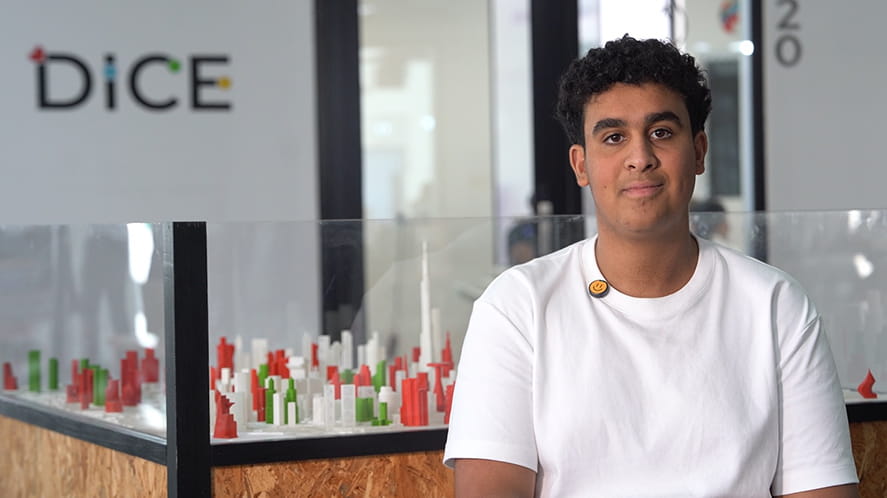
Grades matter, but they cannot capture every dimension of student achievement. A transcript records outcomes; it does not show the questions a student asks, the problems they choose to solve or how confidently they can take an idea beyond the classroom.
At NAS Dubai, academic excellence is connected to purposeful application. That is the foundation of meaningful STEM education: knowledge becomes more valuable when students use it to test ideas, respond to challenges and create something tangible.
Sultan Al-Farhan’s journey brings that approach into focus. His interest in mathematics and physics has led to academic competitions, student innovation and real-world learning that show how direction can develop through experience.
Finding a passion through learning
Sultan joined NAS Dubai in Year 5, when his interests and future direction were still developing. Over time, mathematics and physics became more than subjects in which he performed well: they became ways to understand how the world works and to ask more ambitious questions about what might be possible.
His teachers provided the foundations and encouragement to explore further, while leaving room for him to experiment and think independently. That balance between guidance and ownership helped turn classroom interest into a sustained academic pursuit.
His commitment has brought recognition in mathematics competitions, the Emirates Aviation competition and the Physics Olympiad. These academic competitions are useful tests of knowledge and problem-solving, but they are not the definition of achievement. Their deeper value lies in showing Sultan how he thinks under pressure and where understanding can take him next.
When classroom learning meets real-world innovation
Practical projects reveal whether knowledge can transfer beyond assessment. Sultan’s creation of a recyclable ping-pong table, a student innovation project that attracted the attention of Gulf News, brought together design, application and sustainability. It showed mathematics and physics operating as tools for responding to a real-world challenge.
An internship offered a different view of the relationship between education and professional life. Seeing academic concepts in a wider setting helped Sultan recognise possibilities connected to his interests without assuming that his future had to follow a fixed plan.
Together, these experiences made learning more concrete. They gave him opportunities to test strengths, act on ideas and develop a more grounded sense of how STEM education might shape what comes next.
Looking ahead: Turning ambition into action
Now in his final year of Sixth Form at NAS Dubai, Sultan is building on a journey shaped by questions, challenges and experimentation rather than a single fixed route. His latest project, the creation of his own website, reflects both technical curiosity and the initiative to learn independently while turning an idea into something real.
We spoke with Sultan about the experiences that have shaped him, the projects he has pursued, the teachers who have supported his development and the ambitions he is now considering. His perspective adds the thinking behind the achievements.
Watch the interview to hear more about Sultan Al-Farhan’s journey, his website project and the connection between his mathematics and physics interests and his plans for the future.
The NAS Dubai approach to student achievement
Sultan Al-Farhan’s story shows that academic excellence is one part of NAS Dubai student success, not its whole measure. Competition results and recognition matter, but so do the initiative to pursue a project, the resilience to work through uncertainty and the ability to apply understanding beyond the lesson.
Teachers help create that balance by recognising individual strengths, offering thoughtful direction and then giving students ownership of their next steps. The aim is not to prescribe a future but to create the conditions in which students can discover what motivates them and act on it.
That is the lasting value of learning beyond the classroom: achievement becomes more than a list of results when students can use what they know, test what they might do and turn learning into action.
Related news
News image ![Kenny Duncan gives talk to parents about how NAS Dubai supports year 6 to 7 transition]() Blog
 Blog
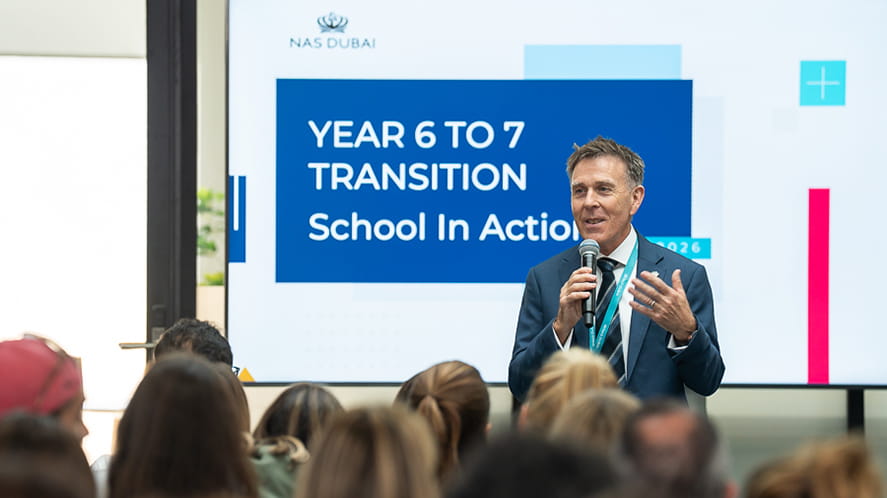
Year 6 to Year 7 Transition: Helping Students Feel Ready for Secondary School
Discover how NAS Dubai’s year-long Year 6 to Year 7 transition programme prepares students and supports parents through the move to secondary school.
News image ![NAS Dubai staff giving talk during Black History Month]() Blog
 Blog
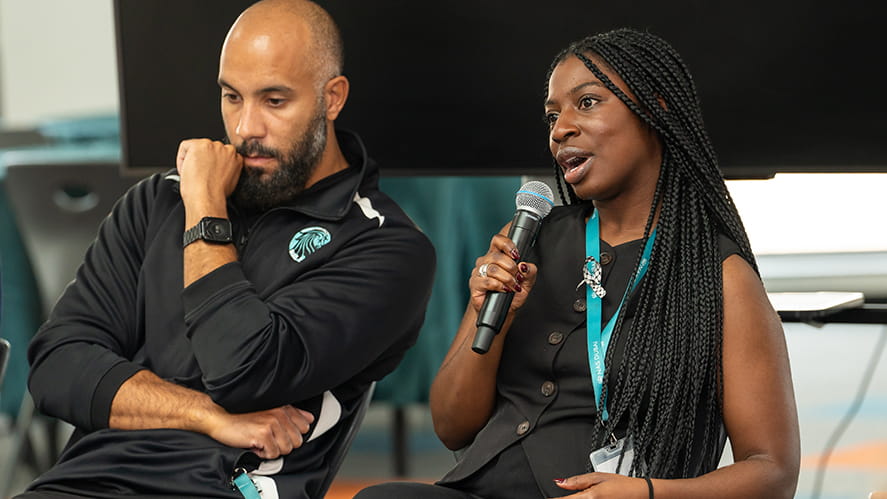
Stories We Carry: Voices, Identity and Belonging
Stories We Carry: Voices, Identity and Belonging, NAS Dubai's Black History Month 2026 staff anthology. Through powerful personal reflections on culture, language, heritage and identity, staff members share the experiences that have shaped who they are and their sense of belonging.


