What EAL Means and Why It Matters
EAL stands for English as an Additional Language. It describes the provision made for students whose first language is not English. At international schools in Warsaw, EAL students typically fall into two groups: Polish-speaking children who are joining an English-language school for the first time, and children from expat families who speak a home language other than English and who may have limited English on arrival.
Both groups need support, though the nature of that support differs. Polish-speaking children often have some exposure to English already and may progress quickly once they are immersed. Children arriving with very limited English, from families who have moved to Warsaw from outside Europe, may need more intensive initial support before they can engage fully with the curriculum.
The research on this is consistent. Cummins (2000) identifies a clear distinction between the conversational fluency children develop relatively quickly in a new language and the academic language proficiency needed to succeed in the classroom, which typically takes several years to build. Structured EAL support accelerates that development. Children who receive it progress more quickly and more confidently than those expected to absorb academic language through immersion alone.
How TBS Warsaw Approaches EAL
At The British School Warsaw, EAL support is embedded across all stages of the school, from Early Years through to secondary. Students are assessed on entry to establish their current level of English and to identify the kind of support that will be most useful for them. This assessment informs how the EAL team works with each student and how classroom teachers adapt their delivery to ensure that new English learners can access the curriculum from the start.
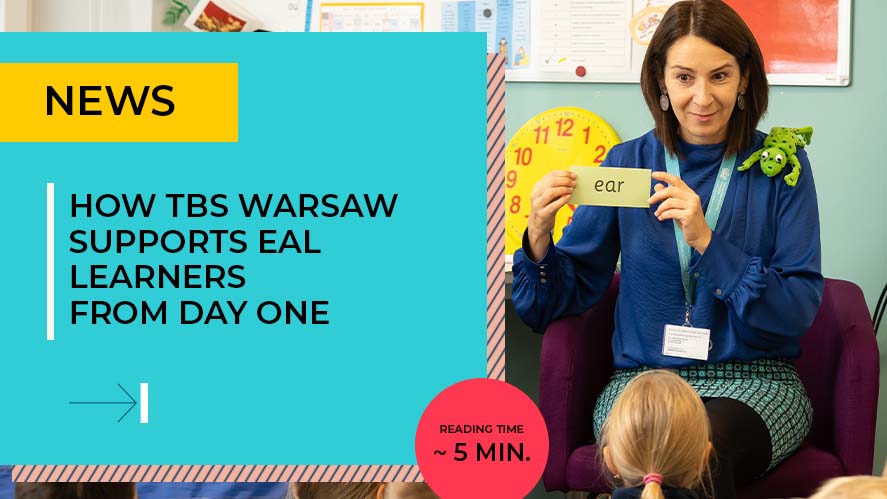
The EAL programme at TBS Warsaw is delivered by specialist teachers who work both in class alongside subject teachers and in small group sessions. This dual approach means that EAL students are not removed from mainstream lessons for long periods and do not miss out on curriculum content. They receive targeted language support while remaining part of the class, and their mainstream teachers are supported to adapt their approach for students who are still developing their English.
What the First Term Looks Like for an EAL Student
The first term is where the foundations are laid. A new student arriving at TBS Warsaw with limited English will be assessed quickly and allocated to the appropriate level of EAL support. They will be assigned a buddy, a peer who can help them navigate the practical realities of a new school in a new language. Their form tutor will monitor their progress and their overall experience closely, and the EAL team will be in regular contact with their subject teachers.
Most children make significant progress in English within the first term, particularly at primary level where the language environment is immersive and consistent. By the end of the first year, the majority of EAL students at TBS Warsaw are functioning in English at a level that allows them to engage fully with the curriculum without intensive support. Some students need more time, and the programme adapts accordingly.
EAL at Different Stages of the School
Children at this stage are at the optimal age for language acquisition. The brain's capacity to absorb new languages is at its peak in the early years, and an immersive English environment, combined with structured EAL support, produces rapid and lasting progress. At TBS Warsaw, Early Years and primary EAL students benefit from a language-rich classroom environment, specialist EAL teaching, and a community in which multiple languages are the norm rather than the exception.
Secondary
EAL support at secondary level is more nuanced because the curriculum demands are higher and the academic language students need to access is more complex. A student who can hold a conversation in English may still struggle with the specific vocabulary and register required for a science report or a history essay. The EAL team at TBS Warsaw works closely with secondary subject teachers to support students in developing the academic English they need alongside their subject knowledge.
For students preparing for the IGCSE or IB Diploma, the EAL programme also supports the transition to examination English, helping students understand how to interpret questions, structure responses, and demonstrate their knowledge in the way that examinations require.
The Role of the Home Language
One of the most important things for families to understand is that strong EAL provision does not ask a child to leave their home language at the door. At TBS Warsaw, the multilingual nature of the school community means that students who speak Polish, French, Arabic, Korean, or any other home language are surrounded by peers who are also navigating between languages. That shared experience builds solidarity and reduces the isolation that can come with being new to a language.
The EAL team also works with families to help them understand how they can support English development at home without sacrificing the home language. The goal is always to build confident bilinguals, not to produce children who are strong in English but have lost connection with their first language.
A Note for Families Who Are Uncertain
If you are considering TBS Warsaw and your child's English is limited, the best thing you can do is visit the school and speak to the EAL team directly. They will give you a full picture of what support is available, what progress typically looks like over the first year, and whether the school is well placed to meet your child's specific needs.
Most families who have been through this process are surprised by how quickly their children settle and how rapidly their English develops in an immersive, supportive environment. While the transition is significant, dedicated EAL support helps ensure it is as positive and smooth as possible.
Contact our admissions team to arrange a visit or to speak to the EAL team before you make your decision.
Bibliography:
Cummins, J. (2000). Language, power and pedagogy: Bilingual children in the crossfire. Multilingual Matters.