


Explore how the Juilliard–Nord Anglia Performing Arts Program helps every student build confidence, creativity, and artistic understanding through exploration, reflection, and meaningful engagement with Core Works.

March 04, 2026
Why Every Young Person Deserves to Feel Successful in the Performing Arts: The Juilliard Approach in Action
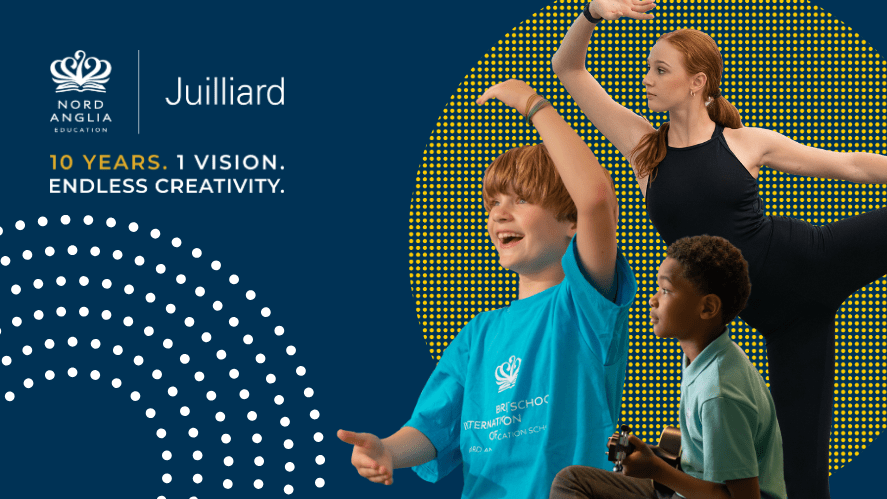

How Does the Juilliard–Nord Anglia Performing Arts Program Inspire Students?
In my role as a Juilliard Lead Teacher, I am often asked what makes the Juilliard approach distinctive. For me, the answer is simple: it ensures that every child experiences success in the performing arts.
Not success defined by perfection or polish. Not success reserved for the most confident or technically advanced. Instead, the Juilliard approach nurtures success rooted in growth, exploration, and personal expression.
Developed through the collaboration between The Juilliard School and Nord Anglia Education, the Juilliard approach is grounded in five key pillars. In our performing arts classrooms, these shape how a Juilliard teacher plans, questions, and responds.
1. Success for All
“Success for All” is where everything begins. The Juilliard approach recognizes that the performing arts are not the possession of a talented few, but the authentic expression of individuality.
A Juilliard teacher sees this daily. A student hesitant in discussion may flourish through movement. A quiet musician may reveal deep insight when invited to connect a piece to personal experience. When learning is structured so every student can contribute meaningfully, confidence grows.
Success might look like a brave improvisation, a thoughtful reflection, or an alternative interpretation. These moments matter.
2. Active and Exploratory Learning
Learning through experience reminds us that education is not the affair of “telling” and being told, but an active and constructive process. This principle is central to the Juilliard–Nord Anglia performing arts philosophy.
Rather than beginning with explanation, a Juilliard teacher begins with exploration. Students might experiment with rhythm before naming its structure or embody a character before analyzing motivations. Understanding is built through doing.
A key part of this is personal connection. Students are often asked: What does this remind you of? Where have you felt something similar? By tapping into lived experience, the work becomes more accessible. From that place of familiarity, deeper artistic insight can develop.
3. Igniting Creativity
Creativity is not treated as an optional extra; it is central to the learning process in Juilliard classrooms.
Whether students are shaping a short movement phrase or reimagining a musical motif, they are encouraged to make choices. There is structure, certainly—but there is also space. That space allows students to think like artists rather than simply replicate outcomes.
Students begin to take ownership. They grow more willing to take risks, try again, and refine their ideas. Creativity builds resilience, and resilience builds confidence.
4. Inquiry and Reflection
Reflection is where learning deepens. This idea underpins the questioning culture within a Juilliard performing arts classroom.
After an activity, we give students time to pause and think. They are asked: What did you notice? Why did you choose that? These questions shift the focus from simply completing a task to understanding the thinking behind it.
Over time, students become more articulate about their creative process. They begin to evaluate their choices and consider alternative perspectives. This habit of reflection strengthens not only their artistry but also their confidence as learners.
5. Encounters with Core Works
A defining feature of the Juilliard approach is engagement with carefully selected Core Works—professional pieces of music, dance, and drama chosen for their richness and depth.
In a Juilliard classroom, the professional piece comes at the end of the learning sequence. Students first work as artists themselves, generating movement, shaping music, and making creative decisions without the pressure of copying a “perfect” model.
By the time they encounter the Core Work, they are not passive observers. Instead, they view the professional piece with confidence and curiosity. They compare. They notice. They might say, “We tried something similar,” or “Our version expressed that feeling differently.”
They encounter professional art as developing artists, not imitators—and that distinction is powerful.
Why This Matters
When young people feel successful in the performing arts, the impact reaches far beyond the classroom. They become more confident communicators, more empathetic collaborators, and more willing to take thoughtful risks. They learn that their voice has value.
The Juilliard approach is not about producing a select few performers. It is about nurturing creative, reflective young people who feel capable and seen.
Through exploration, reflection, creativity, and meaningful engagement with inspiring works, we create learning environments where every child can thrive—not only as an artist, but also as a young person.
Read more about Nord Anglia Education's Collaborations
Related news
News image ![The Impact: How HYROX Training Can Benefit Student Performance in School and Sport - HYROX Academy The Impact How HYROX Training Can Benefit Student Performance in School and Sport]() Blog
Blog
.jpg?h=499&iar=0&w=887&rev=52893d88dd924b9296ce01521d8817e1&hash=F2D7D46F8E6CB78925F9601E7AF264E2) Blog
Blog The Impact: How HYROX Training Can Benefit Student Performance in School and Sport
Discover how HYROX Academy at BISC South Loop helps students build fitness, confidence, resilience, and teamwork through fun, age-appropriate challenges.
News image ![Choosing the Right School in Chicago - Choosing the Right School in Chicago]() Blog
Blog
 Blog
Blog Choosing the Right School in Chicago: Visit BISC South Loop’s Open House on November 7
Join our November 7 Open House and experience our vibrant learning community.

.png?h=499&iar=0&w=887&rev=f3ea2ecd12584cddb1349430fdc05c4b&hash=817F92C1D2A10F174568D7E5018B2996)


