.jpeg?h=600&w=600&rev=7aebc45fc6884d0998d9b51222cd7540&hash=A3C7543160B4D04247556E0809925931)
"Every creature has its own 'portrait', its own expression and movement"
Portraiture is an encounter between artist, subject and viewer.
It is Thursday, Period 2 and the Year 10 artists are analysing the portraiture work of Lucian Freud and Francis Bacon. The two artists are often positioned in opposition yet connected by a shared insistence on presence. Whilst their handling of paint, surface and distortion differs, both use portraiture to confront the viewer with form that feels weighted, exposed and unresolved. Our discussion centres on how these works are perceived: not as images to be read quickly, but as encounters that demand sustained looking and emotional attention.
During the lesson, Ms. Hamstra steps into the room and, on seeing a Freud portrait under discussion, remarks simply, “Oh, that’s me.” What follows is a moment of light-hearted recognition, quickly leading to something more unexpected. She mentions that her uncle is a painter, and that there might be a shared sensibility - not just in subject matter, but in the way form and presence are handled.
That passing comment later opened up a wider conversation about the importance of engaging with artists as real people working in the world around us. The class discussed how asking questions allows students to better understand process, intention, and decision-making as lived practice. With this in mind, the students wrote to Pieter Pander, sharing the context of their discussion and their questions.
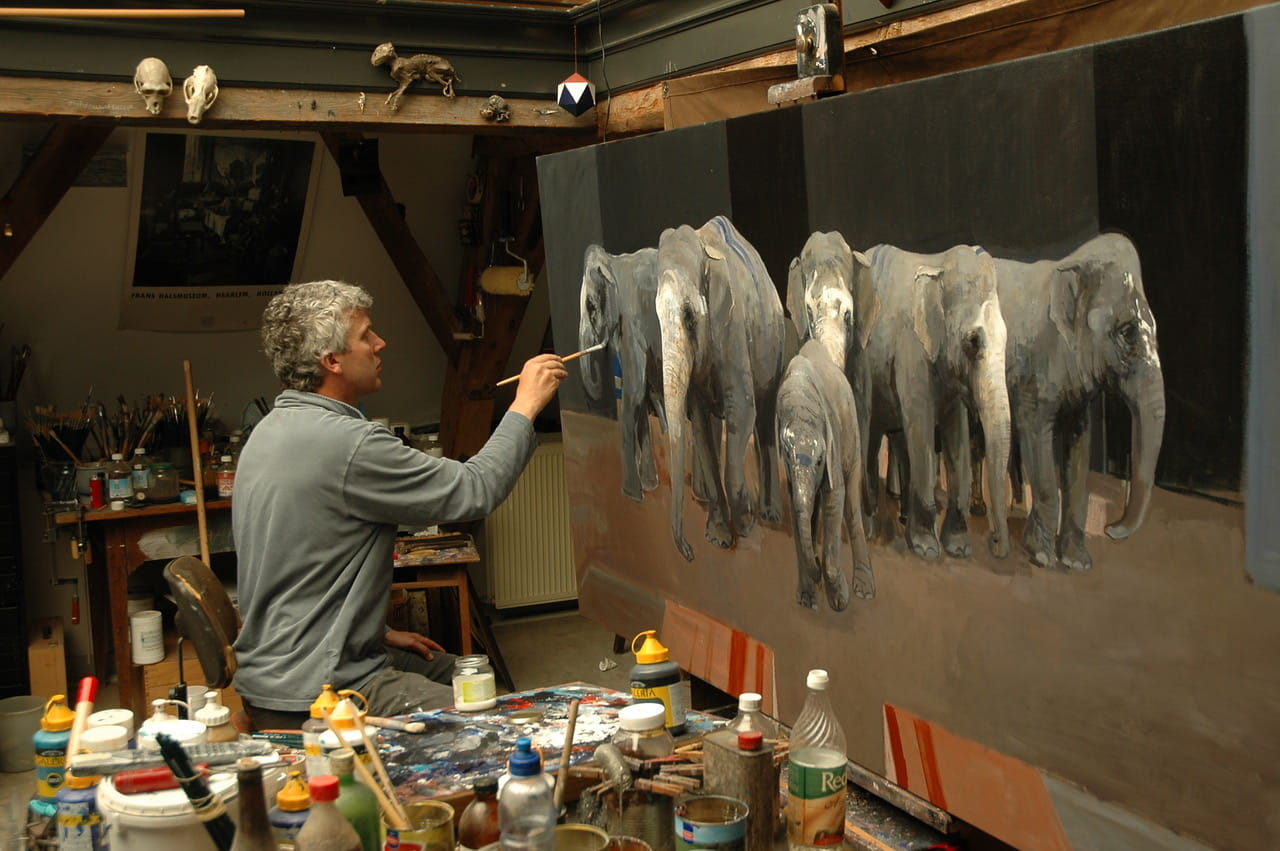
Pander’s response unfolded as a thoughtful reflection on his practice, shaped by the students’ curiosity.
Form, Stillness and Subject Matter
Questions from Julie Vojtiskova (Czech Republic) focused on the stillness and isolation of the animals in Pander’s work, and whether these choices were rooted in symbolism or personal history.
Pander explained that his interest in animals emerged through circumstance rather than metaphor. After graduating, he spent time drawing and painting at a horse breeder’s yard, where animals became his subject. The decision to place subjects alone within space is deliberate, allowing three-dimensional form to exist clearly and convincingly. His focus, he explained, is on construction and structure rather than narrative.
Process, Tension, and Visibility
The students were particularly interested in the contrast between finely worked and unresolved areas within the same painting. Jodie Zhu (China) questioned whether this tension was a way of resisting completion.
Pander described his work as being driven more by tonal values and plasticity than by colour. Tonal control allows him greater command over form, while shifts between refined and rough areas enable the viewer to see how the painting has been made.
Symbolism and Restraint
Natsume Itani (Japan) asked whether animals in his work carry symbolic meaning. Pander was clear that they do not. He prefers what he describes as “constructive subjects” - animals, shipyards and construction sites - chosen for their anatomy, perspective and spatial clarity rather than metaphor.
He also noted that art should not be taken too seriously, and that humour has an important place, even within work that appears quiet or restrained.
Developing a Personal Voice
Questions from Naia Juarros (Spain) explored the role of colour and texture, as well as advice for young artists developing their own style.
Pander explained that colour plays a secondary role in his practice, with tonal values taking precedence. When it comes to style, his advice is simple: it cannot be forced. Through sustained practice - drawing, painting and working consistently - an individual way of seeing inevitably emerges.
For the students, Pander’s response reframed the way his works had first been encountered. Hearing the artist speak plainly about his practice shifted attention back to the physical act of making: to drawing as a way of understanding form, to tonal decisions shaped through repeated looking, and to the quiet discipline of working closely with a subject over time. What initially appeared unresolved began to read as attentive - the result of staying with a form rather than forcing it towards conclusion.
Central to this was Pander’s insistence on engagement through doing. His connection to animals emerged not through symbolism or narrative, but through time spent drawing them, becoming familiar with their structure, movement and presence. In this sense, the paintings are not representations at a distance, but records of encounter - shaped by proximity, patience and sustained observation.
This way of working also reframed the idea of style. Rather than something to be sought or imposed, style became a natural consequence of repeated physical engagement with subject and material. A personal visual language emerged through drawing, revision and familiarity - through the accumulated decisions that come from loving the act of looking and making.
Returning to Freud and Bacon, the students recognised a shared commitment to this kind of encounter: one grounded in attention, exposure and material engagement rather than explanation. The exchange did not resolve the paintings, but it sharpened how they were approached - as works shaped through presence, labour, and the ongoing act of drawing as a way of thinking.