

.jpg?h=5464&iar=0&w=8192&rev=d25c2e8a10054f4eaa147d554bcdc656&hash=0513C3A7A8B0D63204022FDBF42240DC)


We use cookies to improve your online experiences. To learn more and choose your cookies options, please refer to our cookie policy.
06 March, 2026
Recognising real learning progress across the school journey
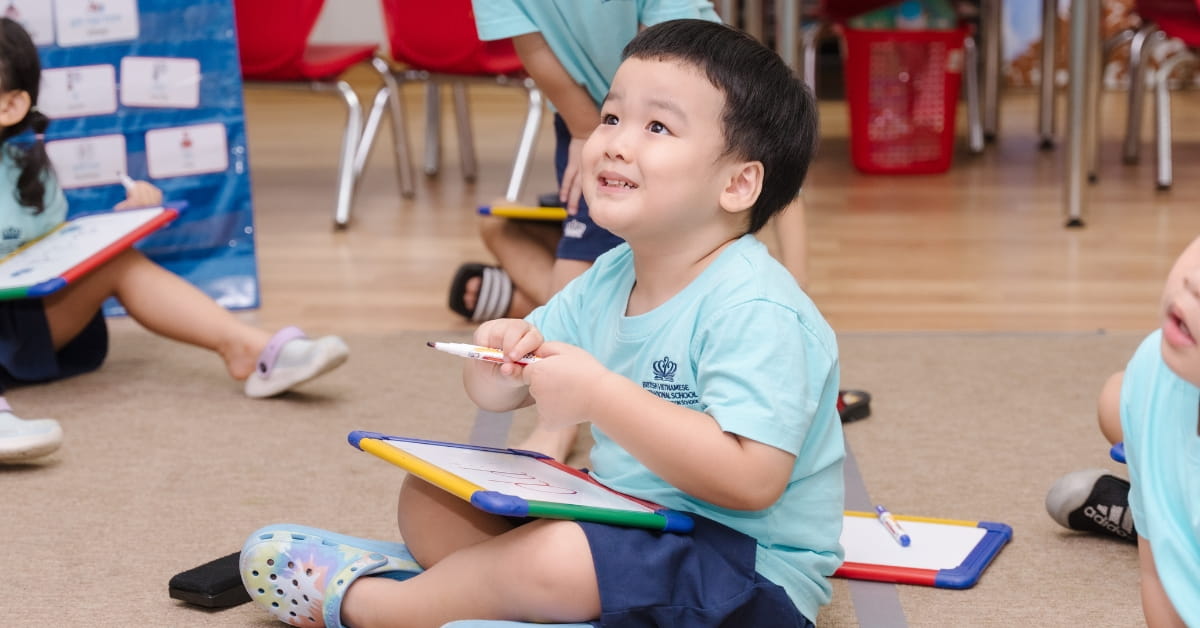
Learning progress is not always a dramatic growth spurt. More often, it is visible in steady shifts. A student contributes more confidently in discussion. Written work becomes more structured. Mathematical reasoning becomes clearer. Independence increases. These moments signal genuine academic progress not yet measured by examinations.
At the British Vietnamese International School Hanoi (BVIS Hanoi), leaders look closely at both visible confidence and measurable academic development. Malcolm Wood, Head of Primary, explains, “Children who are learning well usually look confident, engaged and happy, both in the classroom and with others.”
That outward confidence is not separate from academic rigour. It is supported by structured assessment, clear expectations, and regular teacher feedback across the school.
.jpg?rev=db2ec95201df4495b224f85f95a82059&hash=C4D42865C1F9E9488ABA572C8C969504)
Monitoring learning progress with structure and clarity
Learning progress is tracked carefully through continuous assessment. Teachers observe classroom participation, review written work, assess understanding through questioning, and use formal assessment points during the year. This applies across subjects and key stages, ensuring that student progression is consistent rather than left to chance.
Malcolm notes, “We use rigorous assessment to monitor students’ academic progress. You see growing confidence in English and Vietnamese speaking, reading, and writing and in maths. You also see a curiosity and readiness to try new things; a growing independence and steadily improving results.”
.jpg?rev=6488c77c0c414476aae6c23514447e17&hash=E3FD602C8FD87D97B6F077997C13152C)
This combination of daily teacher feedback and structured assessment builds a reliable picture of academic progress. When teachers identify gaps, they adjust instruction. When they see strength, they extend challenge. That responsiveness strengthens skill development and maintains high standards over time.
Clear monitoring leads to impact. When students understand expectations and receive timely feedback, their learning becomes more secure and sustained.
Communication that strengthens partnership
For families, learning progress becomes reassuring when it is visible and explained. Regular communication reduces uncertainty and builds trust. Teacher feedback does not sit quietly in the background.
“Our teachers communicate regularly by message and face-to-face with parents,” Malcolm explains. “We also have written reports and parent-teacher conferences several times per year."
.jpg?rev=ae87e5bf665a404babb941a1424f219d&hash=22CC525EFA8EF5EDA21AF2B72310B65F)
Progress reports and structured meetings ensure that academic development is transparent, which helps parents to understand where their child is performing strongly and where further support or challenge is needed. This clarity supports a genuine partnership between home and school.
When feedback is specific and timely, families are better able to reinforce learning habits and expectations beyond the classroom.
The connection between confidence and academic growth
Across all age groups, student wellbeing and academic progress are closely linked. As routines become familiar and expectations are understood, confidence grows. That confidence then reinforces academic engagement.
Students may appear more relaxed, more willing to speak in class, more independent in managing homework, and prouder of their work. These behavioural shifts are not separate from learning progress. Confidence in discussion supports deeper understanding. Independence strengthens academic stamina. Feeling socially secure allows students to focus fully on their studies.
Skill development and academic progress tend to advance together.
.jpg?rev=ff50b0ee2b8641c0bf8c7d50c8ea24aa&hash=062770DBD2CEE67C782AF7CBA13A49E0)
Steady progression, not sudden leaps
The best international schools in Vietnam build foundations carefully and monitor development consistently. Vocabulary expands, and writing improves. Analytical thinking deepens, and mathematical reasoning becomes more sophisticated. Over time, these incremental gains shape sustained student progression.
A well-designed assessment structure ensures that learning progress is measured accurately at each stage, from early years through to A levels. Clear expectations, consistent teacher feedback, and formal assessment milestones create a coherent academic pathway.
.jpg?rev=3879e453333a44ef962878bf5b1f1df1&hash=0B611FF3AE496E178146C16F09A5833B)
For families considering how to recognise genuine learning progress, the most reassuring evidence is both visible and measurable. Confidence in the classroom, structured progress reports, thoughtful feedback, and steadily improving academic results together tell the story.
Parents who would like to understand how learning progress is monitored and communicated across the school are welcome to speak with our academic leaders. Clear systems and open conversation remain central to building long-term confidence in student progression.
Related news
News image ![Student Highlights & Success Stories (28/09 - 02/10/2026) | BVIS Hanoi - Weekly Updates 02-10-26]() News | Weekly School Updates
News | Weekly School Updates
 News | Weekly School Updates
 Student Highlights & Success Stories (28/09 - 02/10/2026)
Student Highlights & Success Stories updated from BVIS Hanoi's Senior Leadership Team (28/09 - 02/10/2026)
News image ![Student Highlights & Success Stories (21/09 - 25/09/2026) | BVIS Hanoi - Weekly Updates 25-09-26]() News | Weekly School Updates
News | Weekly School Updates
 News | Weekly School Updates
 Student Highlights & Success Stories (21/09 - 25/09/2026)
Student Highlights & Success Stories updated from BVIS Hanoi's Senior Leadership Team (21/09 - 25/09/2026)


