

We use cookies to improve your online experiences. To learn more and choose your cookies options, please refer to our cookie policy.

January 13, 2026
Little adventures, big lessons: the impact of play-based learning in Preschool
A WORLD-CLASS EDUCATION
British International School of Boston gives your child just the right balance of support and challenge that they need to accelerate through their strengths. We welcome you to visit our campus to meet our talented teachers and see our world-class learning experiences firsthand.
Inquire nowPreschool at British International School of Boston (BISB) is a joyful time.
Our littlest learners are discovering the world around them and experiencing many things for the first time. This means every moment is a learning experience, as they follow their natural curiosity, experiment, and express their creativity.
The sense of wonder we seek to spark in the Early Years is driven by our play-based learning approach. But what is play-based learning? And how does it nurture our youngest students’ cognitive, physical, social, and emotional growth?
We explain the power of play in this blog – and highlight the research-backed benefits of play-based learning in early childhood education.
What is play-based learning?
Play-based learning is the development of knowledge, understanding, and skills through playful activities.
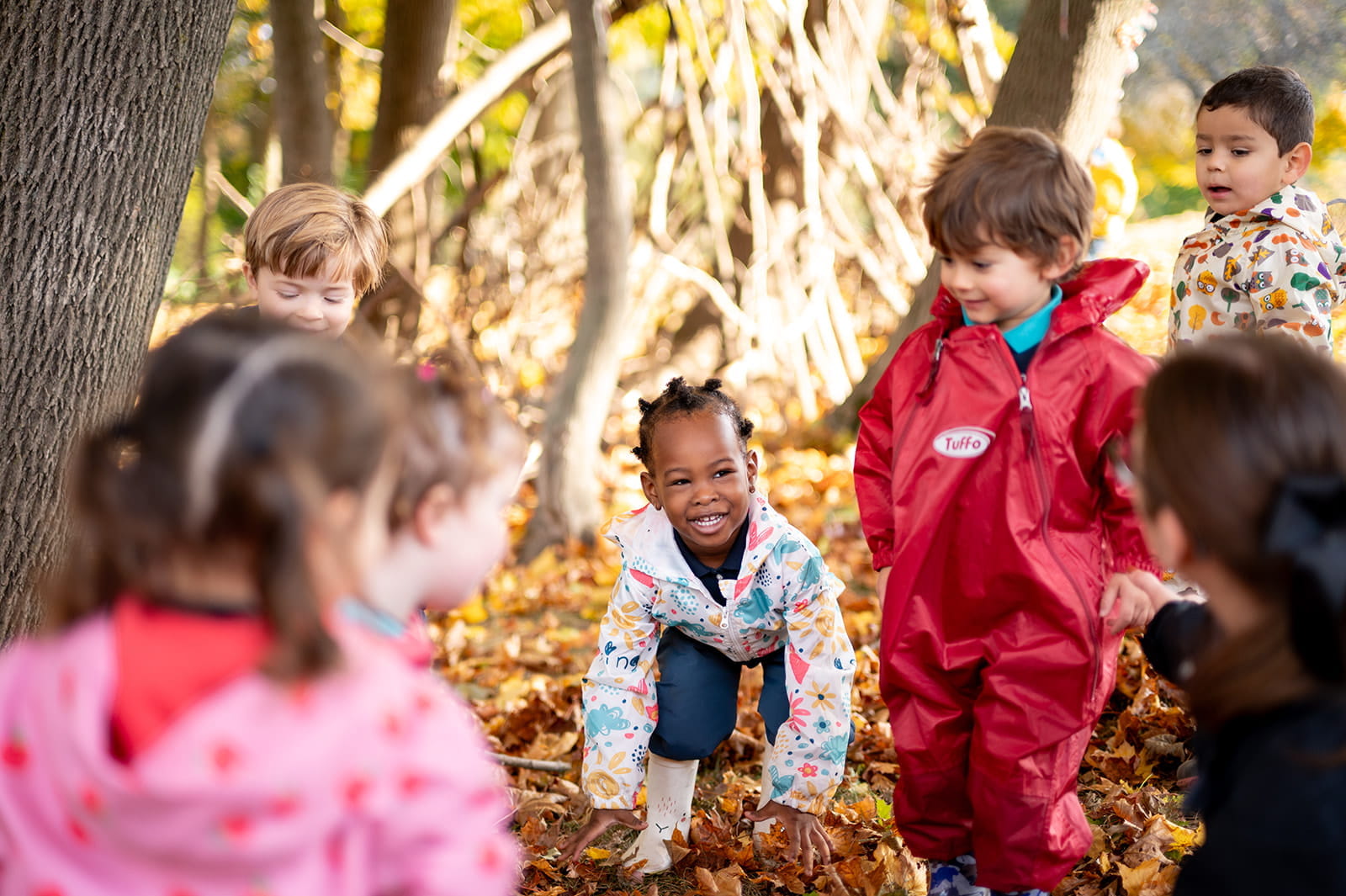
At BISB, play-based learning takes many forms. It includes, for example, hands-on, sensory activities at our Forest School, where children experiment, explore sounds and textures, and get moving outdoors. It also involves imaginative play with dress-up clothes, which encourages children to take on different roles and develop their communication and social skills.
The aim is to engage our Preschool children with the people, objects, and environment around them. These immersive, experiential opportunities develop lifelong skills, including problem-solving, creativity, and independence.
There are two types of play-based learning
Play-based learning falls into two categories: guided and free play. Our early childhood education experts use both approaches in combination, adapting how and what they teach to the individual needs of each child.
Guided play
Guided (or structured) play typically has some level of teacher involvement or guidance. For example, a teacher may weave maths patterns into a building block activity or introduce phonics concepts as part of story time.
Free play
Free, unstructured, or child-directed play takes place without prompting from adults. For example, a group of children may create an imaginary world, establish their roles and rules, and play games, without a teacher or support colleague giving any instructions.
The power of play-based learning is evidenced by research
Our play-based learning approach aligns with the curricula we teach and is grounded in science.
Research shows that play unlocks powerful learning opportunities across all areas of early childhood development. In fact, studies indicate that children who take part in regular play-based learning develop better emotional intelligence, cognitive skills, and adaptability than those who engage in more traditional learning methods.
Every activity and experience we offer is carefully aligned to our Early Years Foundation Stage (EYFS) program and International Early Years Curriculum (IEYC). This ensures our students hit key developmental milestones. It also prepares them for Lower (Elementary) School.
What are the benefits of play-based learning?
Learning through play brings so many benefits. We’ve summarized just some of them below.
- Social and emotional growth: Play encourages cooperation, cultivates empathy, and allows emotional expression.
- Cognitive development: Play enhances critical thinking, problem-solving, and analytical skills.
- Self-esteem: Play builds confidence by providing opportunities to take control and choose activities.
- Creativity: Play sparks imagination and innovation through role-play, arts, and crafts.
- Communication: Play boosts vocabulary, communication, and language comprehension.
- Motor skills: Physical play improves coordination, balance, and movement skills.
- Self-regulation: Play teaches decision-making, impulse control, and following rules.
- Engagement: Play keeps children motivated and involved in learning.
Examples of play-based learning activities
Our youngest students’ days are packed with meaningful play experiences. These are built into specialist lessons, like music, drama, and STEAM, as well as into breaks, after-school activities, and registration time.
Some examples include:
- Sensory play: Getting tactile with mud, leaves, and water at our Forest School (develops fine motor skills and sensory awareness).
- Outdoor play: Running, jumping, climbing, and ball games (develops physical coordination and social skills).
- Pretend play: Role-playing as animals, superheroes, or family members (develops creativity and social skills).
- Arts and crafts: Drawing, painting, and crafting (develops creativity and fine motor skills).
- Music and movement: Singing, dancing, and playing instruments (develops coordination and self-expression).
- Social play: Group games like tag and hide-and-seek (develops teamwork and social skills).
- Circle time: Listening to stories, sharing adventures, and singing a song (develops language and communication).
Guided by our play-based learning specialists
Our talented Preschool teachers are play-based learning experts. They guide our learners through Preschool and Pre-Kindergarten, nurturing their interests, addressing their needs, and ensuring they make great progress.
They do this in imaginatively designed indoor and outdoor spaces, which are purpose-built to encourage excellence and exploration. Our teachers foster a warm, welcoming environment, too, where every child feels safe and supported. This ensures learning is impactful – and that our children can’t wait to come to class every day!
Related news
News image ![Children Playing Outdoors]() Blog | TeachingPractice | LatestNews
Blog | TeachingPractice | LatestNews
Blog | TeachingPractice | LatestNews Little adventures, big lessons: the impact of play-based learning in Preschool
Learn how BISB’s play-based learning approach sparks joy and wonder, nurturing our Preschoolers’ cognitive, emotional, and physical growth.
News image ![2027 Niche Rankings Are in - 2027 Niche Rankings Are in]() Blog | Admissions | Homepage Featured Article | LatestNews | School News
Blog | Admissions | Homepage Featured Article | LatestNews | School News
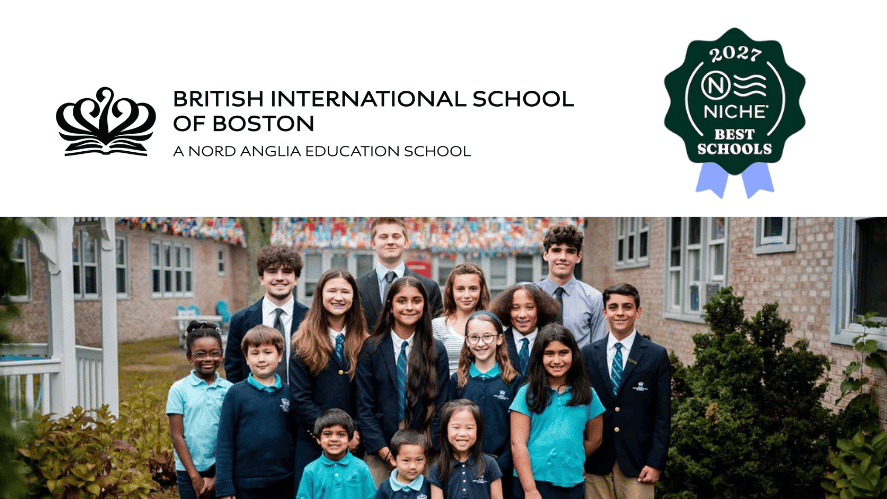 Blog | Admissions | Homepage Featured Article | LatestNews | School News
 British International School of Boston Earns Top Recognition in the 2027 Niche Rankings
With an A+ rating, #2 Best Private K-12 School in the Boston Area and Massachusetts ranking, BISB continues to be recognized as one of the top private educational destinations. These rankings reflect our commitment to academic excellence, global citizenship, and helping every student create their future.