


Explore why common science misconceptions—like bats being blind or humans having only five senses—persist, and how challenging these myths helps students build stronger scientific thinking and evidence-based reasoning skills.

February 11, 2026
Why Science Misconceptions Matter, and What They Teach Us About Learning
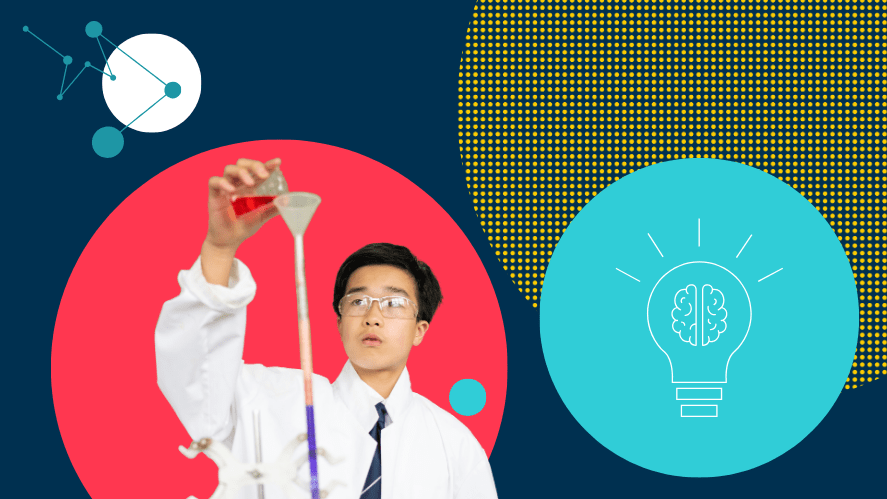

Bats are not blind, humans have more than five senses, you’ve used far more than 10% of your brain just to read this sentence, black holes don’t “suck” like vacuum cleaners, and there is no such thing as a scientific fact – at least, not a permanent one.
Uncomfortable yet? Good. Learning should be a little uncomfortable. Real learning takes energy, effort, and biological change in the brain: strengthening some neural connections while pruning others.
We’ve all heard colloquialisms and common science myths rooted in fragments of truth. These sayings are picked up in childhood and carried forward. Then students arrive in science class and confidently announce, “It’s a scientific fact that bats are blind.”
I secretly feel relieved when that happens. Not because misconceptions are helpful, but because moments like this show exactly where science teaching matters most: helping students think better, not just remember better.
It is comforting to believe that science is an authority that produces fixed truths. But that comfort can come at a cost. It outsources the critical thinking that science education is supposed to nurture and develop.
At the heart of our science instructors’ teaching philosophy is this: science is a method for building knowledge, not a list of facts to memorize and regurgitate. Scientists ask questions, design tests, gather evidence, and build models that explain observations. And nothing reveals the importance of this approach more clearly than the misconceptions students bring with them.
Take the famous saying “blind as a bat.”
Bats are not blind. They use both vision and echolocation for different tasks. There’s vision for long‑range navigation and echolocation for detecting nearby prey. Yet the myth persists because it offers a simple explanation for a complex biological system.
Or consider the familiar idea that humans have only five senses. It’s tidy. It’s easy to teach. But it leaves out balance, proprioception, interoception, temperature, and pain. There’s an entire world of sensory information our bodies rely on every moment.
The “10% of your brain” myth is equally sticky. The promise of hidden, untapped potential is compelling, even though neuroscience has debunked it repeatedly. Simply reading this blog engages widespread brain regions.
Even black holes fall victim to oversimplification. They don’t “suck” objects in like cosmic vacuum cleaners; instead, objects fall toward their event horizons under the laws of gravity and orbital dynamics. As with many scientific ideas, the reality is more complex—and more interesting—than the myth.
These examples aren’t just trivia. They illustrate a crucial truth: students do not enter the classroom as blank slates. They enter with mental models. Some are accurate. Many are incomplete. And all of them shape how new information is interpreted.
When new evidence conflicts with an old model, the model must change. Think of it like an infant growing into a toddler: the model is their adorable little onesie; the new evidence is that the toddler is bigger than the infant. Forcing the toddler into the same onesie would be bad practice. Science works the same way: it is bad practice to force new evidence into old models that no longer fit.
Why Addressing Misconceptions Matters in Science Education
If students leave science lessons believing science is just a pile of facts, we have taught compliance, not scientific thinking.
At BISC-SL, we want students to leave with something more powerful: the ability to question claims, evaluate evidence, revise explanations, and tolerate uncertainty while they reason carefully. That is not just useful for science exams. It is useful for life.
Science is not weakened by changing its mind.
Science is strengthened by it, and so are our students.
Related news
News image ![The Impact: How HYROX Training Can Benefit Student Performance in School and Sport - HYROX Academy The Impact How HYROX Training Can Benefit Student Performance in School and Sport]() Blog
Blog
.jpg?h=499&iar=0&w=887&rev=52893d88dd924b9296ce01521d8817e1&hash=F2D7D46F8E6CB78925F9601E7AF264E2) Blog
Blog The Impact: How HYROX Training Can Benefit Student Performance in School and Sport
Discover how HYROX Academy at BISC South Loop helps students build fitness, confidence, resilience, and teamwork through fun, age-appropriate challenges.
News image ![Choosing the Right School in Chicago - Choosing the Right School in Chicago]() Blog
Blog
 Blog
Blog Choosing the Right School in Chicago: Visit BISC South Loop’s Open House on November 7
Join our November 7 Open House and experience our vibrant learning community.
.png?h=499&iar=0&w=887&rev=f3ea2ecd12584cddb1349430fdc05c4b&hash=817F92C1D2A10F174568D7E5018B2996)


