



We use cookies to improve your online experiences. To learn more and choose your cookies options, please refer to our cookie policy.
24 April, 2026
How schools develop character alongside academic learning


WHAT MAKES NAS JAKARTA SO SPECIAL?
At NAS Jakarta, your child will build the confidence to thrive through every experience, embracing what makes them special and having the courage to take on any of life's colourful challenges. Contact our Admissions team today to visit our vibrant campus and meet our talented teachers.
ENQUIRE NOWFor many parents, academic success is only part of the picture. An equally important question is whether a school will help their child develop the character and habits needed to succeed over time.
Confidence, resilience, and the ability to work with others are not developed through isolated lessons. They are built through daily experiences, guided by a clear approach to teaching and learning. At Nord Anglia School Jakarta (NAS Jakarta), character development is embedded within the International Primary Curriculum (IPC), ensuring that children grow not only in knowledge, but in how they think, behave, and interact.
Collaboration as a foundation for character development
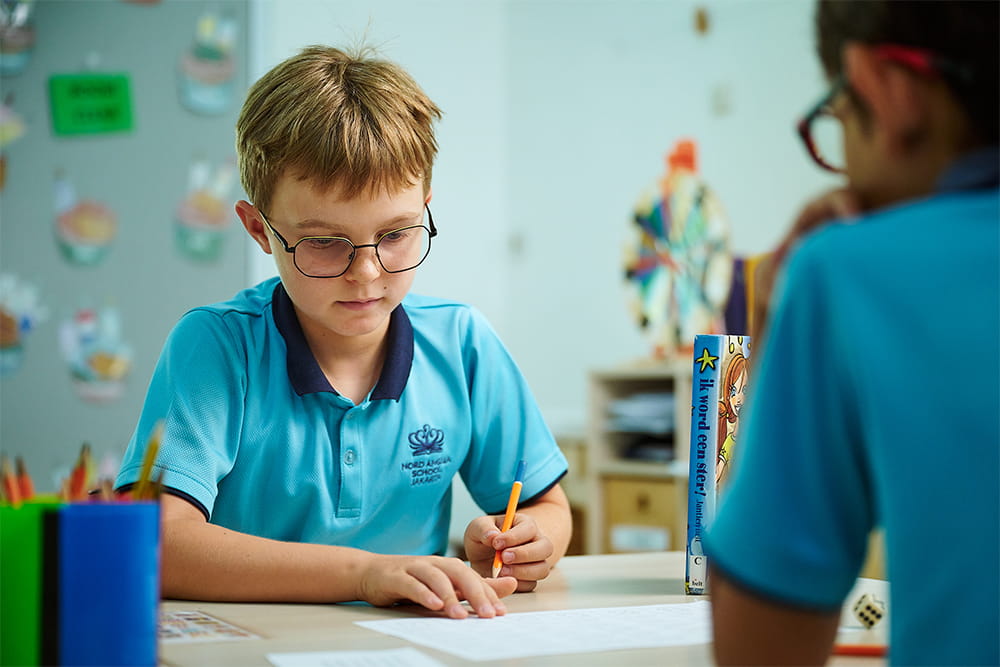
One of the most effective ways to develop character is through structured collaboration. When children work together regularly, they learn how to communicate, negotiate, and take responsibility within a group.
David Webb, Milepost Leader and IPC campaign leader, explains how this is approached in practice. “Collaboration underpins the IPC approach. Students are given defined roles within a group, such as researcher, organiser, timekeeper, or scribe, so that each child contributes meaningfully and drives learning forward.”
When exploring a historical site, students may take on roles as historians, researching and presenting information. Others may focus on geography, creating maps, while another group designs models or visual representations.
This structure ensures that group work is purposeful. Each student has a clear role and responsibility, reducing the likelihood of disengagement and encouraging active participation.
When disagreements arise, they are treated as learning opportunities. Teachers guide students through conflict resolution, helping them understand different perspectives and develop positive communication strategies.
These experiences build essential collaboration and teamwork skills that extend beyond the classroom.
Building resilience through structured challenge
Resilience is not developed by avoiding difficulty. It is built through carefully designed challenges that encourage children to persist, reflect, and improve.
At NAS Jakarta, we build on the sequential structure of the IPC, where learning increases in complexity over time. This allows students to develop their knowledge and skills step by step, building confidence as they take on new challenges.
“Resilience is developed through well-designed learning experiences that build step by step on prior knowledge,” David Webb explains.
When students encounter difficulty, support is provided in a way that encourages independence. Peers may step in to offer guidance, creating a collaborative learning environment where students learn from one another.
Mistakes are treated as a natural part of the learning process. Rather than being avoided, they are discussed and analysed, helping students understand how to improve.
This approach reinforces a growth mindset. Children learn that progress comes through effort, reflection, and persistence.
Reflection that strengthens independence and self-regulation
A key aspect of character development is the ability to reflect on one’s own learning and behaviour.
Throughout IPC units, students are encouraged to consider not only what they have learned, but how they have approached their work.
“Students reflect on their experiences, including how effectively they have worked with others,” David Webb explains.
This process supports the development of self-regulation skills. Children become more aware of their strengths and areas for improvement, allowing them to take greater ownership of their learning.
Over time, this leads to increased independence. Students are better able to manage their time, adjust their approach, and respond constructively to feedback.
Preparing children for a global and collaborative future
Character development is closely linked to global citizenship. In a world where collaboration, adaptability, and communication are essential, these skills are as important as academic knowledge.
At Nord Anglia School Jakarta, the IPC integrates citizenship education and holistic education into everyday learning. Students learn to work with others, respect different perspectives, and adapt to new situations.
As David Webb notes, “Students recognise that working together means communicating positively, managing failure, learning from feedback, and adapting to change.”
These are not abstract ideas. They are practised daily, becoming embedded habits that support long-term success.
A balanced approach to knowledge and character
A strong education does not separate academic learning from personal development. It brings them together in a structured and consistent way.
At Nord Anglia School Jakarta, character education is built into the curriculum through collaboration, challenge, and reflection. Students develop not only subject knowledge, but also the decision-making skills, resilience, and confidence needed to thrive.
For parents considering their child’s long-term development, this provides reassurance. Children are not only learning what to think, but how to approach challenges, work with others, and continue growing over time.
Families who would like to understand more about how character is developed alongside academic learning are always welcome to speak with the academic team and explore how these values are embedded in daily practice at NAS Jakarta.
Related news
News image ![How Transparent Assessment Helps Parents Understand Their Child's Progress - How Transparent Assessment]() Blog
Blog
 Blog
Blog How Transparent Assessment Helps Parents Understand Their Child's Progress
Please input short description.
News image ![Moving to Jakarta - Moving to Jakarta]() Blog
Blog
 Blog
Blog Moving to Jakarta? Here’s What to Know About Choosing an International School
Choosing a school from overseas can feel overwhelming. You may find yourself comparing websites late at night, calculating commute times, exploring different curricula and wondering how your child will adapt to yet another new environment.


