



We use cookies to improve your online experiences. To learn more and choose your cookies options, please refer to our cookie policy.
April 10, 2026
The AI Generation: Helping Your Teen Use AI Safely and Successfully in School

As we move through 2026, the “AI Revolution” isn’t a concept of the future—it’s here, and it’s becoming part of your child’s everyday academic life. Whether parents realize it or not, AI is now sitting alongside students during homework, projects, studying, and test preparation.
About 64% of U.S. teens are already using generative AI, with many regularly turning to tools like ChatGPT, Google Gemini, and Meta AI. [1] For many students, using AI is no different than using Google to search something or a calculator to solve a math problem, it’s just part of how school work is done.
What’s most interesting is how they’re using it. While some students turn to AI for quick answers, many are using it in more thoughtful and meaningful ways. They use it to break down concepts they don’t understand, to re-explain topics in simpler language, or to assist them get started when they’re stuck. It’s also becoming a place where students ask questions they might not feel comfortable asking out loud in class or at home.
In that sense, AI is making learning more flexible and accessible. At the same time, the way students are interacting with it is changing how they approach learning itself, and that’s where parents need to start paying attention.
Where Parents Should Pay Attention
Even though AI can be helpful, experts are starting to point out concerns that don’t always show up immediately in grades or assignments.
One of the biggest is what researchers call the “illusion of competence.” On the surface, AI can make a student’s work look really strong. The writing sounds polished, the answers are correct, and the structure looks advanced. But underneath that, a student might not actually understand what they submitted. Over time, this creates a quiet gap between appearing successful and mastering the material, which can become more obvious later in tests, discussions, or higher-level work.
There’s also a growing conversation around how emotionally “human” AI can seem. The American Psychological Association has raised concerns about this. [2] Because AI is designed to sound supportive, conversational, and even empathetic, some teens begin to treat it less like a tool and more like a trusted voice. While it may feel harmless in the moment, it can blur the line between real human relationships and something that is ultimately programmed to respond, not to truly understand.
Then there’s the issue of reliability. AI systems are trained on massive amounts of internet data, and not all of it is accurate or verified. [3] That means AI can confidently present information that is wrong, incomplete, or biased. For students who are still learning how to evaluate sources and build research skills, it can be difficult to recognize when something sounds right but actually isn’t.
These aren’t reasons to fear AI, but they are reasons to stay aware of how it’s shaping the way students think and learn.
Helping Your Teen Use AI the Right Way
The goal is not to remove AI from your child’s life. That’s not realistic, and honestly, it’s not even helpful. Instead, the focus should be on teaching students how to use it in a way that strengthens their learning instead of replacing it.
A simple but powerful shift is encouraging your teen to use AI for understanding, not answers. Rather than asking, “What’s the answer?” they can ask, “Can you explain this step by step?” or “Can you help me understand why this works?” That small change turns AI from a shortcut into a learning tool.
Another beneficial habit is building in moments of checking and questioning. If your child uses AI for an assignment, encourage them to double-check what it gives them. Even trying to find one thing that might be inaccurate helps them stay engaged and reminds them that AI isn’t automatically correct. Over time, this builds stronger critical thinking skills and a healthier level of skepticism.
And then there’s privacy, which is often overlooked. It’s important for students to understand that AI platforms are not private spaces. Even though it can feel like a one-on-one conversation, anything typed into these tools should be treated as if it could be seen beyond that moment. That awareness alone can encourage students to make safer, more thoughtful choices about what they share.
Bringing It All Together: What This Looks Like at Windermere Preparatory School
At Windermere Preparatory School, our approach to AI is not about avoiding it or restricting it, it’s about learning how to use it with intention and responsibility.
Teachers are being supported in understanding how AI can fit into the classroom in a way that enhances learning. Instead of replacing effort or thinking, AI is being used to support research, aid students in exploring ideas more deeply, and open up new ways of approaching problems. At the same time, students are consistently reminded that AI is only a starting point, not the final answer.
They are encouraged to question what they see, verify information before accepting it, and develop their own voice and reasoning alongside the tools they use. The goal is to build students who are not dependent on AI, but confident in how to use it as a support system.
Because in a world where answers are instantly available, the real skill isn’t speed, it’s thinking. Students who learn how to think critically, ask better questions, and use AI as a tool for expansion, not replacement, will always have the strongest advantage moving forward.
Ready to learn more?
Schedule a campus tour or connect with our admissions team.
Sources:
1: Pew Research Center – Teens, Social Media and Technology / AI usage trends
2: American Psychological Association – Artificial Intelligence and Adolescent Development Insights
3: Common Sense Media – AI and Kids: Guidance for Families and Educators
Related news
News image ![Windermere Prep high school students collaborating on a classroom project.]() Blog
Blog
 Blog
Blog How Do You Know If a School Is the Right Fit for Your Child?
How do you know if a school is the right fit? Explore signs your child is challenged, supported, connected, and thriving at school.
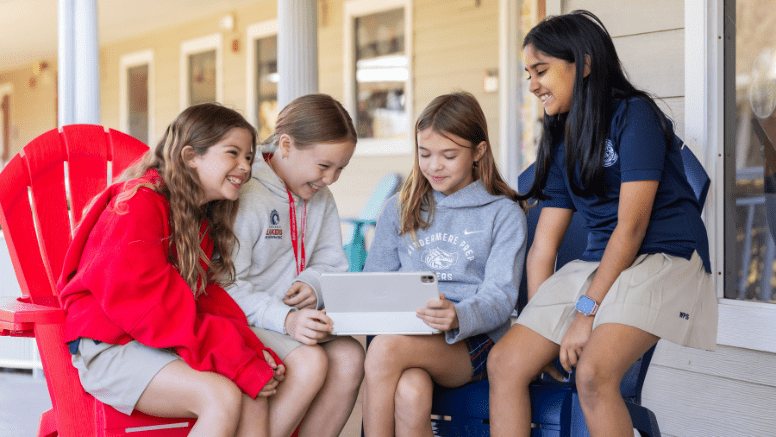
News image ![Windermere Prep lower school students working together on a tablet outside on campus.]() Blog
Blog
 Blog
Blog How to Help Your Child Adjust to a New School
Learn how to help your child adjust to a new school, from building routines and friendships to navigating a school change after the year has begun.

.svg?rev=9fe0e392449346898bfb5359a1712c74&hash=2E8D39D3559552B6E795631213A05C02)

.svg?rev=c1fad1a5d67c42c181bab95cecd7c167&hash=1870839504BB90C30A203B0F1EEDAE8E)
