


23 October, 2026
Settling into a new school in São Paulo: how international children find belonging

Moving to a new country means a new language, new routines and new friends. For international children in São Paulo, belonging grows fastest when they feel known, supported and free to be themselves. Two BCB families share what made the difference
A PERSONALISED JOURNEY TO SUCCESS
At The British College of Brazil, we put students' best interests at the heart of everything we do. Contact our Admissions team today to discover how our teachers will tailor your child’s journey – preparing them for success, no matter what the future brings.
Enquire nowSome time after his family moved from South Korea to São Paulo, Seok Dohyung made an announcement. He wanted to study hard so he could one day become President of Brazil and make the country better for everyone. By then, his classmates at The British College of Brazil (BCB) had nicknamed him “Paulo”. For his mother, Eunyoung Cho, his ambition said something more. Brazil was no longer a temporary stop. It was home.
Paulo’s family is one of many. Over the past 25 years, São Paulo has recorded more than 500,000 international immigrant registrations, according to Federal Police data (Sismigra) analysed by the São Paulo Observatory of Migration at Nepo/Unicamp.
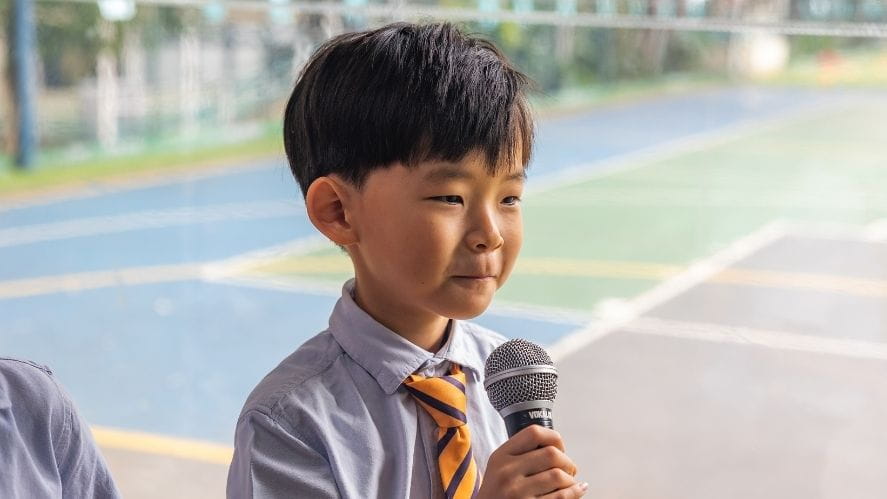
Seok Dohyung, known at school as “Paulo”, hopes to one day become President of Brazil.
Paulo’s classroom reflects that city. At BCB, part of the Nord Anglia Education family of schools, around half of the 610 students come from outside Brazil. They represent 38 nationalities, from Korea, Japan and Argentina to the United States and the UK, and they learn alongside Brazilian classmates every day.
What helps international children feel at home in a new school?
Children feel at home when they are known as individuals from the start and don’t have to leave their own culture behind to fit in. Being greeted by name, feeling noticed by their teachers and having friends for the first weeks all build confidence quickly.
“One of the biggest misconceptions is that children need to leave behind who they are in order to fit in,” says Principal Maurice Hartnett. “The most successful transitions happen when students feel confident sharing their own culture while also becoming part of a new community.”
For the Knott family, moving is part of life. “We change countries every three or four years, so we’ve become quite experienced at starting new lives,” says Angela Knott, mother of Adam and Daniel.
Even so, her first visit to BCB stayed with her. “The Principal was saying hello to every student by name. I was really emotional. I just thought: this is a place where I want my children to be.”
Six weeks later, at their first parents’ evening, the boys’ teachers told her they kept forgetting how new Adam and Daniel were. “It felt as if they’d been at the school forever. As a mum, I was so proud.”
How can parents build a community after moving to São Paulo?
The quickest route is often through your child’s school. Parent associations, school events and shared activities, such as a parents’ choir, give newly arrived families a ready-made network. They also bring friendships that make a new city feel familiar.
For Courtney House, an American mother of Andrew and Susanna, diversity was a deciding factor. “We saw it as very important for our children to have peers from all over the world. And they do have that here.”
She found her own place quickly, too. “On my first day, I was invited to several PTA events and even joined the choir. Of course we want our children to belong, but it’s important for us parents to connect locally too. The choir is definitely one of the best parts of my week.”
How does The British College of Brazil support new international students?
Every new student at BCB is paired with a buddy, where possible one who shares their language. Children receive personalised academic and wellbeing support, with extra English lessons where needed. Around 75% of BCB’s teachers are also international.
Why does the school year matter when moving to Brazil?
In Brazil, the school year usually starts in January or February, while many international families are used to one that starts in the second half of the year. A school that follows the Northern Hemisphere school year makes moving between countries smoother. It also keeps older students on track for university applications abroad.
BCB teaches the British National Curriculum and follows the Northern Hemisphere school year. For families on the move, that continuity matters. “We wanted the British curriculum so that, wherever we moved, the boys could keep the same level of education,” says Angela.
What should parents ask when choosing an international school in São Paulo?
Ask four things. How does the school welcome a new student in the first weeks? What support is on offer, academically and emotionally? Is there a parent community you can be part of? And will the curriculum and school year give your child continuity?
The answers often reveal what matters most: whether a school will help your child feel they belong. For Paulo, it was the place where a new country started to feel like his own.
Frequently asked questions
Do children need to speak English before joining an international school in São Paulo?
Not always. At BCB, children who are still developing their English receive extra English lessons where needed, so they can learn alongside their classmates as their confidence grows.
How can my child keep their own culture at a new school?
Choose a school where cultural diversity is part of everyday life. At BCB, students from 38 nationalities learn together, and new students are paired, where possible, with a buddy who shares their language.
Which nationalities study at The British College of Brazil?
Around half of BCB’s 610 students are international, representing 38 nationalities, including Korean, Japanese, Argentine, American and British families, alongside Brazilian students.
Can international schools in Brazil follow a different school calendar?
Yes. Brazil’s National Education Guidelines and Framework Law (LDB) allows schools to set their own calendar, provided they offer at least 200 school days a year and meet minimum teaching hours.
How do I contact BCB Admissions?
Message the Admissions team on WhatsApp, or visit www.britishcollegebrazil.org. They can help with questions about settling in, school routines and joining the community.
Key facts about The British College of Brazil
The British College of Brazil (BCB) is a premium international school in São Paulo and part of Nord Anglia Education, a global family of schools. From Early Years to Year 13, BCB combines the English National Curriculum with Brazil's National Common Curricular Base (BNCC), offering an international education that prepares children to thrive in a changing world.
Home to a diverse community representing more than 40 nationalities, with approximately 75% international teachers, BCB brings a wealth of global perspectives into everyday learning. Its inclusive, internationally minded environment helps children develop cultural awareness, independence, resilience and the confidence to pursue their individual ambitions.
Academic excellence is central to the BCB experience. Students follow an educational pathway that includes the International General Certificate of Secondary Education (IGCSE) and the International Baccalaureate Diploma Programme (IBDP), developing the knowledge, critical thinking and independent learning skills needed for further study and beyond.
Beyond the classroom, BCB offers exceptional opportunities through collaborations with organisations including Juilliard, MIT and UNICEF. Combined with personalised learning, a strong focus on wellbeing and a caring international community, these experiences help students discover their strengths, explore new interests and prepare for a wide range of university pathways and future careers.
Moving to São Paulo with children?
Whether your move is months away or just around the corner, our Admissions team can answer your questions about settling in, school routines and joining our international community. Message us whenever you are ready.
Related news
News image ![International Schools in São Paulo: 5 Questions to Ask | BCB - Choosing an International School]() Blog | Global Education | globaleducation
 Blog | Global Education | globaleducation
Choosing an International School? 5 Questions to ask first
Five questions to help you find an international school where your child learns alongside the world, not just about it.
News image ![Image_The_British_College_Of_Brazil_2025_24573]() Blog | Global Education | globaleducation
 Blog | Global Education | globaleducation
Choosing an International School in São Paulo, What Really Matters?
Choosing an international school is about more than studying in English. Discover what to consider when it comes to curriculum, teaching, wellbeing, global opportunities and your child’s future
News image ![Image_The_British_College_Of_Brazil_2025_27328]() Blog | Global Education | globaleducation | SecondaryBlog
 Blog | Global Education | globaleducation | SecondaryBlog
What Does Success Really Look Like in Education Today
What Does Success Really Look Like in Education Today
News image ![Image_The_British_College_Of_Brazil_2025_25072]() Blog | Global Education | Secondary Blog | SecondaryBlog
 Blog | Global Education | Secondary Blog | SecondaryBlog
How to apply to universities abroad: a complete guide for families
Studying abroad is an increasingly popular choice for Brazilian students. This guide explains how early preparation, personalised university counselling and global opportunities help students successfully apply to top universities overseas.


