
We use cookies to improve your online experiences. To learn more and choose your cookies options, please refer to our cookie policy.

December 16, 2025
Why the IB Diploma Programme Outshines AP Exams


A WORLD-CLASS EDUCATION
British International School of Boston gives your child just the right balance of support and challenge that they need to accelerate through their strengths. We welcome you to visit our campus to meet our talented teachers and see our world-class learning experiences firsthand.
Inquire nowWhen families consider advanced academic programs for high school students, two options often come to mind: the International Baccalaureate (IB) Diploma Programme and Advanced Placement (AP) courses. While both are rigorous, the IB Diploma Programme offers a truly holistic, globally recognized education that prepares students for success far beyond high school.
Here are the reasons why:
1. A Comprehensive, Balanced Curriculum
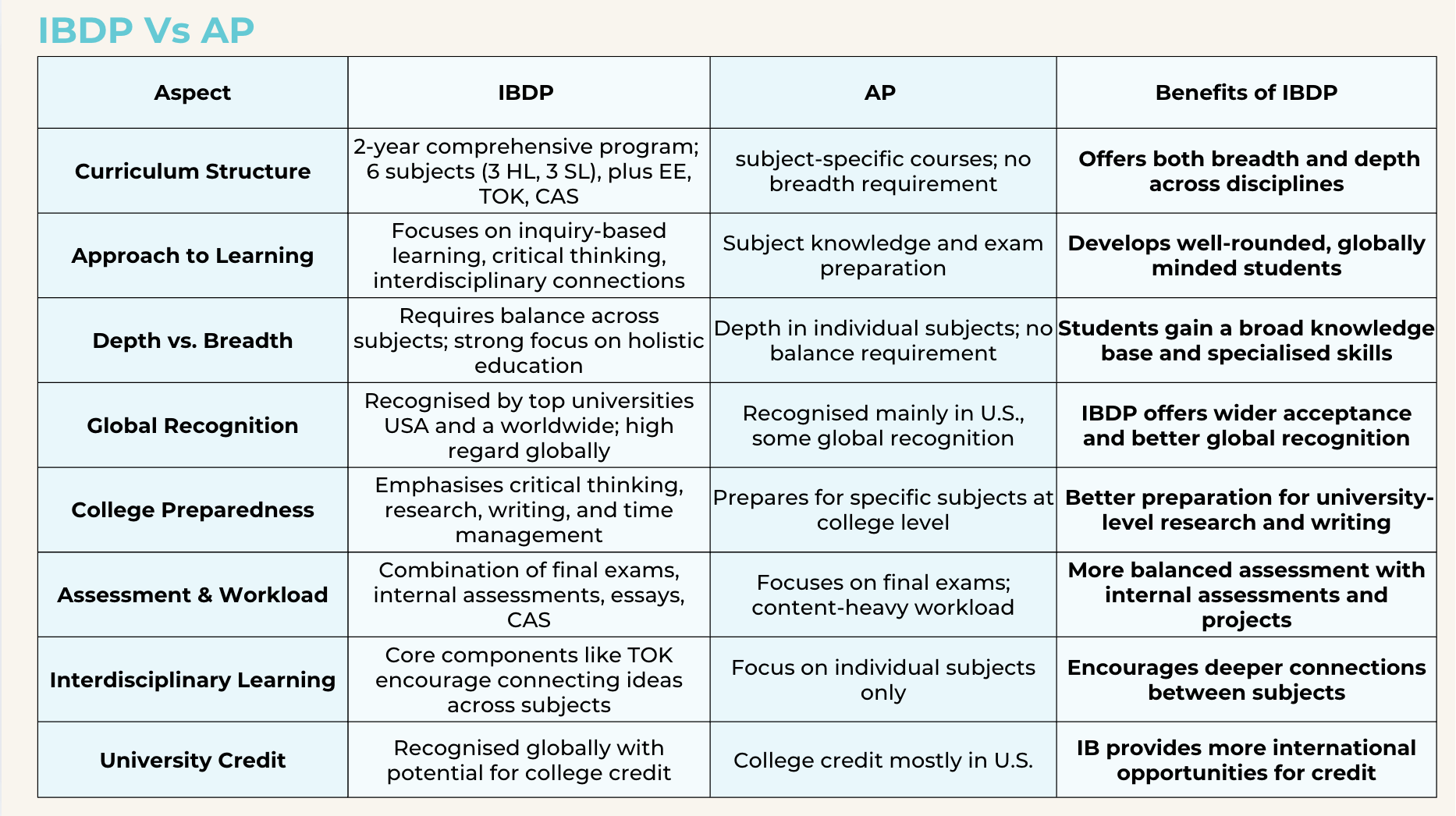
AP courses allow students to choose individual subjects, but the IB Diploma Programme is a cohesive two-year curriculum designed to develop well-rounded learners. Students study six subjects across multiple disciplines, ensuring depth and breadth of knowledge. This balance fosters critical thinking and adaptability—skills essential for college and life.
Unlike AP, which focuses on subject mastery, IB integrates learning through its Core Components:
· Theory of Knowledge (TOK) – Encourages students to question how knowledge is constructed.
· Extended Essay – A 4,000-word independent research project that builds college-level writing skills.
· Creativity, Activity, Service (CAS) – Promotes leadership, creativity, and community engagement.
2. Global Recognition and University Advantage
The IB Diploma is considered the gold standard by universities worldwide. Admissions officers value the program’s rigor and its emphasis on research, writing, and independent thinking. IB graduates often receive advanced standing or course credit at top universities in the U.S., UK, and beyond.
In fact, many universities report that IB students are better prepared for college-level work because they’ve already mastered time management, critical thinking, and interdisciplinary learning.
3. Focus on Skills, Not Just Scores
While AP emphasizes exam performance, IB prioritizes skills development. Through TOK, students learn to analyze information critically. The Extended Essay builds research and writing skills, and CAS nurtures empathy and global awareness. These experiences prepare students not only for academic success but for life as adaptable, thoughtful leaders.
4. Preparing Global Citizens
IB students don’t just learn facts - they learn how to make a difference. The program encourages international-mindedness and social responsibility, aligning perfectly with BISB’s mission to develop global citizens who will change the world for the better.
From service-learning projects to global collaborations through Nord Anglia’s Global Campus, BISB students gain experiences that broaden their perspectives and inspire them to lead with purpose.
5. Personalized Support for Academic Success
A key strength of the IB Diploma Programme is its emphasis on supporting students as whole learners. The program is designed to challenge students academically while also giving them the tools, feedback, and structure they need to succeed. With built-in elements like internal assessments and ongoing reflection, the IB fosters meaningful relationships between students and educators and encourages individual growth.
At BISB, students benefit from:
· Small class sizes for individualized attention
· Expert guidance from world-class teachers trained in IB methodology
· Personalized learning pathways that help students discover their passions and strengths
This individualized approach ensures every student is both challenged and supported to achieve their very best.
The Bottom Line
While AP offers flexibility and subject-specific rigor, the IB Diploma Programme provides a comprehensive, future-focused education that develops critical thinkers, global citizens, and lifelong learners. For families seeking an academic experience that prepares students for success in college and beyond, IB stands out as the clear choice.
Ready to learn more about BISB’s IB Diploma Programme? Book a Tour Today or Contact Admissions to discover how we help students create their future.
Related news
News image ![High School Students]() Blog | Student Success | TeachingPractice | LatestNews
Blog | Student Success | TeachingPractice | LatestNews
Blog | Student Success | TeachingPractice | LatestNews Why the IB Diploma Programme Outshines AP Exams
While AP offers flexibility and subject-specific rigor, the IB Diploma Programme provides a comprehensive, future-focused education that develops critical thinkers, global citizens, and lifelong learners. For families seeking an academic experience that prepares students for success in college and beyond, IB stands out as the clear choice.
News image ![Made the Switch? Here's how to Help Your Child Adjust to a New School - Adjusting to a New School]() Blog | Homepage Featured Article | Student Success | Advice and Guidance
Blog | Homepage Featured Article | Student Success | Advice and Guidance
 Blog | Homepage Featured Article | Student Success | Advice and Guidance
 Made the Switch? Here's how to Help Your Child Adjust to a New School
Made the switch? Starting at a new school can be both exciting and challenging for children and parents alike. Discover practical tips to help your child build confidence, make new friends, and settle into their new school community with ease.
News image ![Moving to Boston: A Guide for International Families - Moving to Boston]() Blog | Advice and Guidance | Homepage Featured Article | Student Success | Admissions
Blog | Advice and Guidance | Homepage Featured Article | Student Success | Admissions
 Blog | Advice and Guidance | Homepage Featured Article | Student Success | Admissions
 Moving to Boston: A Guide for International Families
Moving to Boston with your family? This quick guide helps international families understand what to expect when relocating to a new country- which can be both exciting and overwhelming. Explore what international families can expect when making Boston their new home. From navigating New England's four distinct seasons and understanding local culture to learning about the region's renowned educational institutions and family-friendly attractions, this article offers valuable insights for a successful transition. Whether you're preparing for your move or have recently arrived, you'll find helpful information to make settling into life in Boston easier and more rewarding.
News image ![Switching from Public to Private School - Switching from Public to Private School]() Blog | Admissions | Student Success | Advice and Guidance
Blog | Admissions | Student Success | Advice and Guidance
 Blog | Admissions | Student Success | Advice and Guidance
 Switching from Public to Private School
Thinking about switching from public to private school? Many families who move to private school say the same thing: “We wish we had explored our options sooner.” Learn the key insights parents share about academics, community, confidence, and finding the right fit for their child.