

We use cookies to improve your online experiences. To learn more and choose your cookies options, please refer to our cookie policy.

February 25, 2026
How You Can Help Your Child Practice Emotional Regulation at Home

A WORLD-CLASS EDUCATION
British International School of Boston gives your child just the right balance of support and challenge that they need to accelerate through their strengths. We welcome you to visit our campus to meet our talented teachers and see our world-class learning experiences firsthand.
Inquire nowSupporting children as they learn to identify, understand, and manage their emotions is one of the greatest gifts we can offer them. Emotional regulation isn’t a skill that is intuitive to children- it is something they learn through repeated experiences of safety, connection, and practice with trusted adults. At school, I support students through structured check-ins, using tools like the feelings wheel, and providing a calm environment that allows them to safely talk about challenging things. Families can use many of these same approaches at home to strengthen young learners’ abilities to navigate big feelings.
Below are some warm, practical, and research-supported strategies that parents and caregivers can begin practicing right away.
- Begin by Naming Feelings
Young children cannot regulate what they cannot identify. At school, I often start with a feelings wheel, a visual tool that expands emotional vocabulary by showing both basic and nuanced emotion. Research consistently shows that “emotion labeling” reduces the intensity of distress and activates the parts of the brain that support reasoning and reflection (Lieberman et al., 2007).
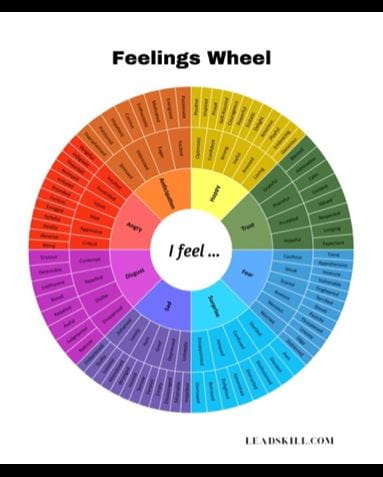
Try this at home- Use any version of a “feelings wheel” with your child and ask them “What’s the closest feeling to what you’re experiencing now?”
If your child isn’t sure, offer gentle guesses- “Your body is showing me that you are calm” or “You told me (what happened). I might feel (emotion) if that happened to me.” Another way you can adapt this for younger learners or more creative students is to ask them to choose an emoji or color that represents how they are feeling today. You can then help them connect this answer to a feelings word.
It is best to begin practicing this in a moment when children are feeling calm enough to communicate effectively. This practice alone will help them build emotional literacy, which is foundational for self-regulation, empathy, and communication.
- Creating a Climate of Trust
One of the most important ways children learn to self-regulate is by helping them feel physically and emotionally safe. In counseling sessions, students understand that what they share with me is private unless someone is in danger of being hurt or has been hurt. Ensuring privacy explicitly helps children open up without fear of being judged or getting in trouble.
At home, you might say: “You can always tell me how you’re feeling. I won’t be upset with your feelings; I just want to understand them.”
When they feel safe, their nervous system becomes more open to problem-solving and reflection. This sense of security builds a foundation for healthier coping strategies and helps children feel more confident expressing what’s really going on inside.
- Offer Fidgets and Movement
Studies show that sensory regulation supports attention and emotional calm, especially in younger learners (Pfeiffer et al., 2015). Tools like fidgets, stress balls, soft putty, or even simply drawing while talking can support the brain’s ability to stay grounded.
At home, it can be helpful to offer options to a child who may be struggling to talk through something hard. You can do this by keeping a small “calming basket” in shared spaces, and by allowing children to walk, pace, doodle, or manipulate a fidget while discussing feelings.
- Model Your own Regulation
Children often learn regulation by watching adults regulate themselves. You do not need to handle every situation perfectly- what matters most is showing them what it feels like to notice a feeling and make a choice
Some phrases you can try at home include “I am feeling overwhelmed, so I am going to take three deep breaths” or “I got frustrated/angry/overwhelmed, but I am working on calming myself down”
This aligns with decades of research on attachment and co-regulation that suggest children borrow the calm of an emotionally regulated adult (Siegel & Bryson, 2012). It can also help to make sure that their emotions are seen as signals, not problems.
- Co-Regulate First, Then Problem Solve
Children need their bodies need to feel safe and settled before they can access logic and reasoning. Rather than asking and then waiting for your child to regulate, it can be helpful to go through regulation together.
There are many actions that you can take to co-regulate:
- Lower your voice and speak calmly
- Sit beside them (not in front of them)
- Match your breathing to a slow pattern they can follow
- Say supportive phrases like “I’m here. We can get through this together”
Once your child’s nervous system settles, they can think more clearly about what happened and what they might do next time.
- Speak About Emotions with Curiosity, Not Judgment
Children open up when they sense curiosity rather than criticism. Instead of asking children directly why they may have done something, use “exploratory” questions instead.
Some examples include: “I notice your voice got loud when we were in the store today. What was your body feeling in the moment?” or “What were you needing when you did this today?”
By practicing this language, you are helping them to build internal awareness rather than shame.
- Build Emotional Practice into Daily Routines
Just like reading or math, emotional regulation grows through frequent, brief practice. Incorporating a check in to your morning or nighttime routine ensures that emotional conversations feel normal and are not isolated just to difficult moments.
Here are some simple ways you can practice this
- “Rose, Bud, Thorn” at dinner (rose is something good that happened today, bud is something they are hopeful for, and thorn is something that was hard)
- Picture books that explore feelings
- A Little Spot of Emotion series by Diane Alber
- The Rabbit Listened by Cori Doerrfeld
- The Invisible String by Patrice Karst
- You, Me and Empathy by Jayleen Sanders
- When My Worries Get Too Big by Kari Dunn Buron
- Listening to My Body by Gabi Garcia
- In My Heart by Jo Witek
- Introduce calm activities like yoga, mindfulness, or art to express emotions and promote wellbeing
- Hold weekly family check-ins using a feelings wheel or chart
Closing Thoughts
Emotional regulation is a lifelong skill that begins with trust, openness, and the knowledge that emotions are safe to explore. At BISB, we work with students every da to strengthen these skills, and when families partner with us at home, children experience more consistency and confidence in navigating their inner world.
If you would like more resources, visuals, or strategies tailored to your child’s age, please feel free to reach out. I am always here to support our students, and their grown-ups.
References & Further Reading
Lieberman, M. D., Eisenberger, N. I., Crockett, M. J., Tom, S. M., Pfeifer, J. H., & Way, B.
- (2007). Putting feelings into words: Affect labeling disrupts amygdala activity in response to affective stimuli. Psychological Science, 18(5), 421–428. https://sanlab.psych.ucla.edu/wp-content/uploads/sites/31/2015/05/Lieberman_AL-2007.pdf
Siegel, D. J., & Bryson, T. P. (2012). The Whole-Brain Child. https://drdansiegel.com/whole-brain-child-handouts/
Roche, M. A., Back, E., & Van Herwegen, J. (2024). Parental perspectives on the use of
fidget toys and sensory-seeking profiles in autistic and neurotypical children. Current Psychology, 43, 15872–15882. https://link.springer.com/article/10.1007/s12144-023-05483-3
Mathews, L. A., Osmani, K. J., & Martin, J. E. Examining the Effectiveness of Fidgets on
Attention of Elementary Students with ADHD. https://files.eric.ed.gov/fulltext/EJ1272882.pdf
Life Skills Advocate (2026): Fidget Tools for Regulation: Matching Sensory Needs to the
Right Tool. https://lifeskillsadvocate.com/blog/fidget-tools-for-regulation/
By Kasey Charron, MSW, Lower School Counselor
I am a clinically trained social worker with a master’s in social work from Simmons University and a BA in Psychology from Ithaca College. I have worked with children and adolescents for the past 10 years, beginning in my hometown of Canton, Connecticut, and later at Walden Behavioral Care in Dedham, MA as a mental health counselor and clinical intern.
In my work with students, I use cognitive behavioral therapy and play-based approaches to help children understand, express, and manage their emotions in a supportive and empowering way. Outside of school, I enjoy running and hiking outdoors, and baking sourdough when the weather takes a turn!
Related news
News image ![Girl Playing]() Blog | Advice and Guidance | Teaching Practice
Blog | Advice and Guidance | Teaching Practice
Blog | Advice and Guidance | Teaching Practice How You Can Help Your Child Practice Emotional Regulation at Home
Help your child build lifelong emotional regulation skills with warm, research-backed strategies you can start today. Discover simple tools—like feelings wheels, co-regulation techniques, and daily check-ins—that strengthen emotional literacy, resilience, and connection at home and school. Perfect for parents and caregivers who want practical, compassionate ways to support children through big feelings.
News image ![Where Will Your Child Thrive? : Key Questions to Consider When Looking for the Right School - Where Will Your Child Thrive]() Blog | Admissions | Advice and Guidance | Homepage Featured Article | Athletics | Student Success
Blog | Admissions | Advice and Guidance | Homepage Featured Article | Athletics | Student Success
 Blog | Admissions | Advice and Guidance | Homepage Featured Article | Athletics | Student Success
 Where Will Your Child Thrive? : Key Questions to Consider When Looking for the Right School
Choosing a school is one of the most important decisions a family will make. While academics, rankings, and facilities all play a role, finding the right fit goes much deeper. In this guide, we explore five key factors every parent should consider during their school search, including curriculum, student wellbeing, extracurricular opportunities, community, and long-term growth. Discover how the right learning environment can help your child build confidence, develop their passions, and thrive both inside and outside the classroom.
News image ![Why a Diverse Extracurricular Program Helps Students Discover Who They Are - Importance of Diversified Extra Curriculars]() Blog | Advice and Guidance | Arts and Culture | Athletics | Student Success
Blog | Advice and Guidance | Arts and Culture | Athletics | Student Success
 Blog | Advice and Guidance | Arts and Culture | Athletics | Student Success
 Why a Diverse Extracurricular Program Helps Students Discover Who They Are
At British International School of Boston, learning goes beyond the classroom. Through clubs, arts, sports, STEAM, outdoor learning, languages, and Nord Anglia global opportunities, students are encouraged to try new things, discover their passions, and develop the confidence, creativity, and character they need to thrive.
News image ![Made the Switch? Here's how to Help Your Child Adjust to a New School - Adjusting to a New School]() Blog | Homepage Featured Article | Student Success | Advice and Guidance
Blog | Homepage Featured Article | Student Success | Advice and Guidance
 Blog | Homepage Featured Article | Student Success | Advice and Guidance
 Made the Switch? Here's how to Help Your Child Adjust to a New School
Made the switch? Starting at a new school can be both exciting and challenging for children and parents alike. Discover practical tips to help your child build confidence, make new friends, and settle into their new school community with ease.