
Lao Tzu once said, “Nature doesn’t hurry, yet everything is accomplished.” I used to think that was just philosophical nonsense—until three weeks ago, when I arrived in Talamanca.
Hi, I’m ChunHue (Iris), a freshman at Country Day School in Costa Rica. In mid-January, I hit a breaking point. I needed to step away from classrooms, screens, textbooks, pressure, and noise. I needed somewhere quieter, wilder, somewhere that would let me reset. Let me tell you about where this ‘somewhere’ turned out to be.
About 64 kilometers south of Limón, tucked between the Talamanca Mountains and the Sixaola River, lies the SEED Farm, home to an incredible Bribri family. In just four days, they taught me more about nature than four years of textbooks ever could.
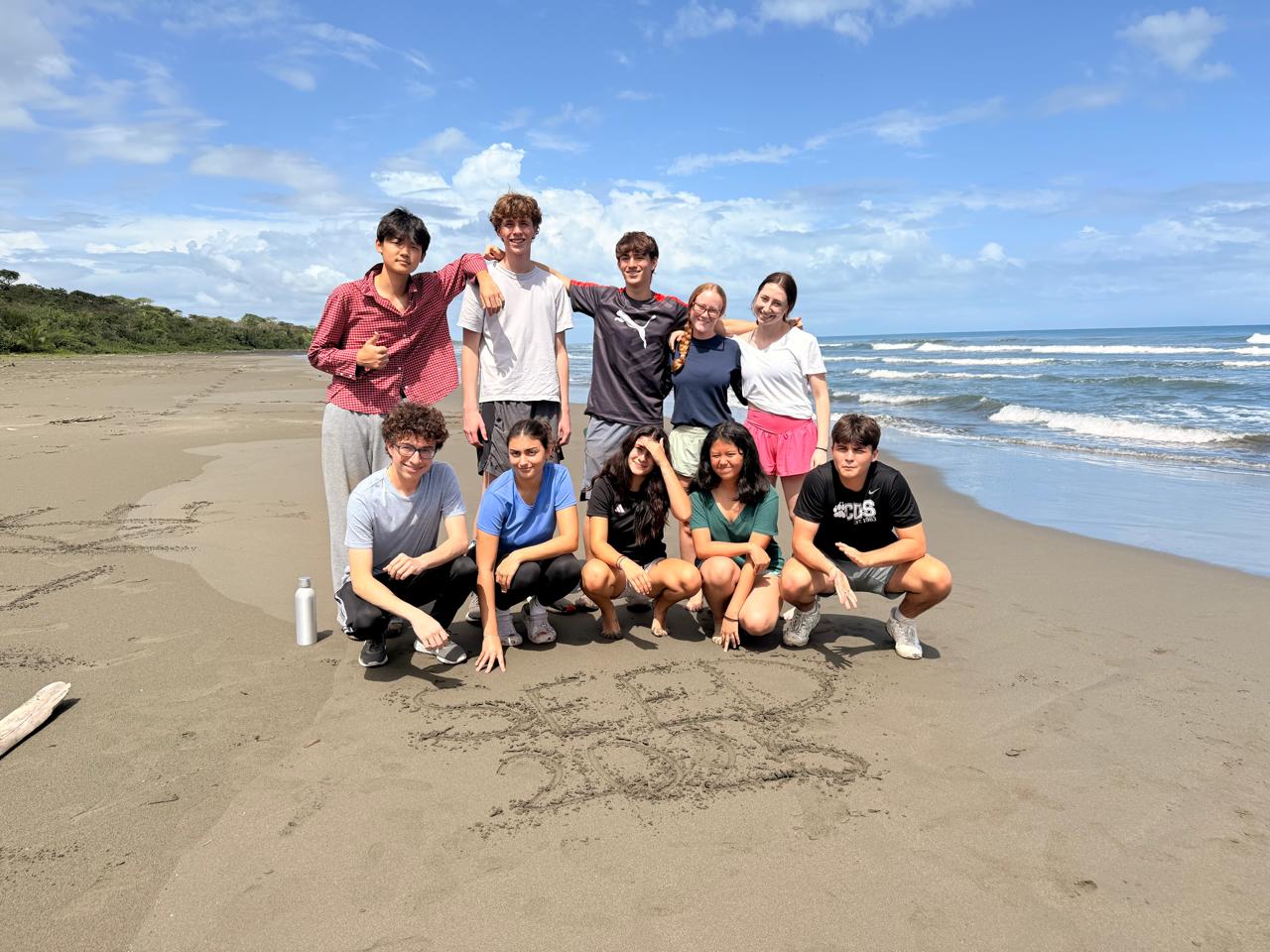
We began our journey on January 22, piling bags into the back of a slightly crammed bus. The ride was filled with Uno on a makeshift table, endless rounds of Impostor, and long stretches of window-watching. Outside, the landscapes of Puerto Viejo and Cahuita—beaches, crops, rivers—replaced the city views I was used to.
When we arrived, we met our guide, Ms. Rachel, who welcomed us warmly and drove us deeper into the greenery. From the back of the pickup truck, I saw more green than I ever had before with lush trees bursting with life, wild grass, herbs everywhere.
As soon as we arrived, two grinning kids ran up to us and hugged us like family. One of them grabbed my hand and challenged me to a race. I underestimated him. That six-year-old gave me the most intense game of tag of my life. Dinner followed, lamb stew cooked by Maricela and Leticia, and it was unforgettable.
That night, we stepped outside to look at the stars. They were unlike anything I’d ever seen. We stood quietly, amazed, wondering how a sky like this could exist when we’d never noticed it before.
So much happened over the next four days, but here are the moments that stayed with me most.
Tiny but Mighty
On our first full morning, we trekked through muddy jungle trails with Andrik and Elio (the kids), along with Bernadino and Evelio, who carefully guided us and kept us safe. Along the way, we met Oli, a 12-year-old Bribri prodigy already mastering weaving and basket-making.
At one point, I lagged and found myself aloneuntil Andrik came back for me. Despite being only six, he knew exactly where to step and where not to. Seeing me struggle, he took my hand and slowly guided me back. I couldn’t stop thinking about how effortlessly he navigated the jungle. He wasn’t small, he was capable.
The Skill of Patience
Not long after, we began putting the materials we’d collected to use which meant we began the roof-making. Our group split up into three partners each assigned to one of the 3 teachers, and luckily for Cris and I we got the pleasure of being taught by the oldest and most experienced Bernadino. We sat down and he patiently explained the process. He guided us through using the vines (known as a bejucos) to tie the set of leaves we’d gathered to the piece of wood we’d cut the previous day. Being a painfully slow learner, I messed up the knot maybe a couple hundred times, but he re-explained and guided me each of those times until I was able to do it efficiently. But this wasn’t the only instance of great teaching, later that afternoon we started basket weaving. Evelio and Oli were teaching more unique complex patterns, but I settled on the basic one as it seemed the most doable. Bernadino calmly explained to us how basket-weaving was like sewing. It was a lattice pattern where each of the strips goes in then out. He repeated the process for us as we began weaving and nodded approvingly when after multiple tries, I found my rhythm.
The Tenacity of the Ants
Throughout the trip Evelio shared everything he knew about his culture to us. How the indigenous tribe system worked, how they scattered in between the mountains, the importance of medicinal herbs, to even the legendary Usekras (Shape-shifting leaders who were at the top of their pyramid). But of all the things he told us one thing stayed ingrained in my mind, and that was the clans.
Evelio told us how a person’s clan was extremely important to the indigenous as it represented who they were. It revealed their core values and personality traits, acting as a "social sorting" mechanism based on desired, rather than just existing, attributes. When we asked what clan their family was part of, he told us they were members of the ant clan. Upon a bit of researching when I got home, I realized just how much their clan made sense. Their values did in fact line up with those of the ants.
Slow Down
Of everything I learned, the most important lesson was this: I needed to slow down.
Our world constantly tells us to hurry—to do more, be more, achieve more. I live in that mindset more than I’d like to admit. I wake up thinking about my to-do list and fall asleep worrying about tomorrow.
At the start of the trip, I worried about how we’d get everything done. We had leaves to collect, herbs to learn, roofs to build, baskets to weave. Surely,we’d have to rush. I was wrong.When I walked too fast, I slipped. When I tied vines too tightly, they snapped. When I rushed grinding cacao, the bean cracked. Every mistake led back to the same lesson: slow down.
Nature doesn’t hurry, yet everything gets done. Seeds don’t rush to grow. Rivers don’t force their way forward. And somehow, everything still works. Living in Costa Rica made this experience possible, a country rich in biodiversity and home to eight resilient indigenous groups still preserving their heritage. Trips like this give us a chance to listen to the side of the story we often ignore: nature’s.
So maybe we should take their advice. Maybe we should slow down. And maybe, if we do, we’ll accomplish everything.
This blog is part of our A Student’s View series, where our students share their voices and experiences. We are deeply grateful to the indigenous communities who generously welcome our students, allowing them to learn from their knowledge, traditions, and way of life. Discover how Country Day School’s Secondary Program creates meaningful, real-world learning experiences that empower students to grow, reflect, and lead with purpose.