Artificial intelligence is not something from the future. It is already part of our daily lives, our learning, and our work. At Nord Anglia International School Shanghai, Pudong (NAIS Pudong), we embrace AI as a powerful tool that enhances teaching and learning while also nurturing the deeper thinking skills that no algorithm can replicate.
Our students benefit from both worlds. They use AI purposefully and also develop metacognitive skills that prepare them for university and life beyond.
How We Embrace AI to Support Every Learner
At NAIS Pudong, AI acts as a smart learning assistant, making lessons more engaging and supporting each child’s progress:
- Personalised support: AI helps students with reading, writing, and revision in ways tailored to their level, making learning more accessible and building confidence.
- Creative learning: AI generates images, prompts, and ideas that inspire imagination and curiosity.
- Thinking and reasoning: Students can debate ideas with AI or receive low-stakes feedback on projects, helping them refine arguments and strengthen critical thinking.
- Independent learning: AI acts as an on-demand tutor, explaining tricky concepts or quizzing students, encouraging self-directed study.
In short, AI helps our students learn smarter, not just faster, while leaving the thinking and decision-making firmly in their hands.

How We Teach the Human Skills AI Cannot Replace
At the same time, NAIS Pudong is part of a global movement in education that focuses on teaching students how to think, not just what to learn.
Across the Nord Anglia family of schools, a landmark research partnership with Boston College explored a simple but profound question:
“What happens when children are explicitly taught how to think, not just what to learn?”
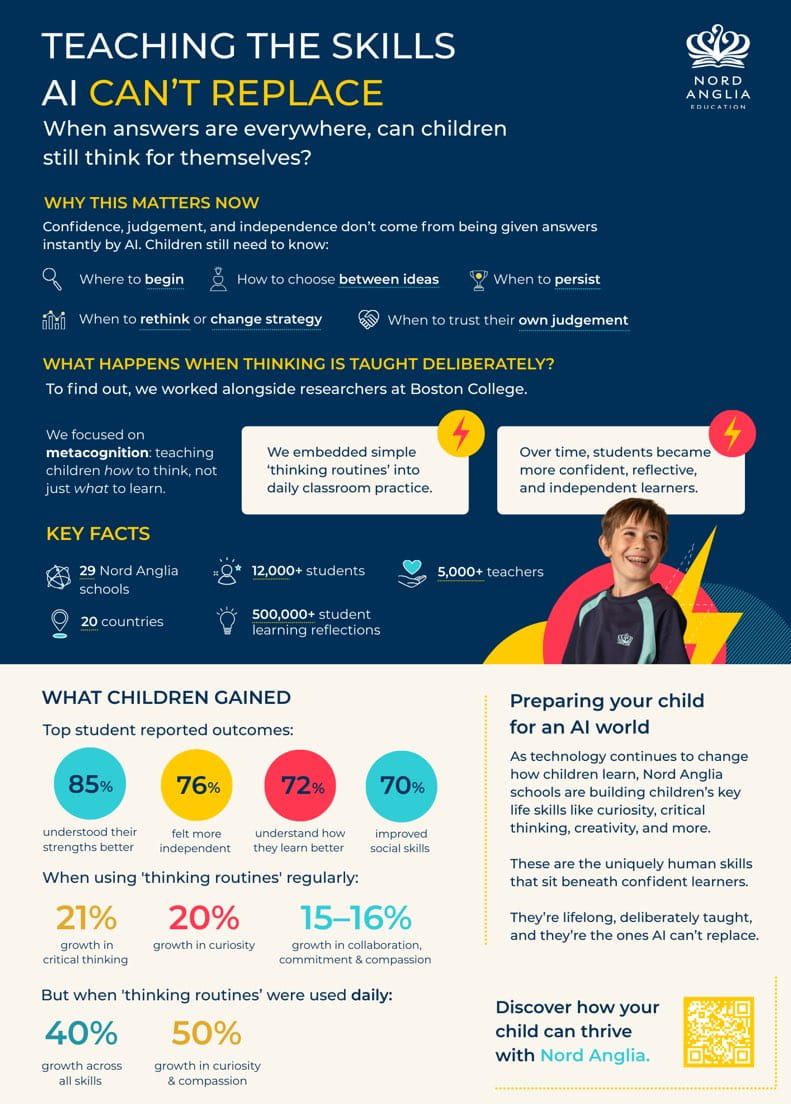
This two-year study, involving more than 12,000 students in 27 schools across 20 countries, found that when teachers intentionally embedded structured “thinking routines” into daily learning, students developed measurable growth in future-ready skills.
One routine, See, Think, Wonder, prompts students to ask:
- What do I notice?
- What does that tell me?
- What questions do I still have?
Over time, these simple questions stop feeling like classroom prompts and instead become lifelong habits of thoughtful reflection.
What the Research Shows
By the end of the study:
- Students engaging regularly with thinking routines such as See, Think, Wonder showed measurable growth in critical thinking (+21%), curiosity (+20%), and collaboration, commitment, and compassion (+15–16%).
- In classrooms where routines were used daily, growth exceeded 40% across all core skills, with some approaches driving almost 50% growth in curiosity and compassion.
- Students reported increased confidence in navigating uncertainty, greater independence (+76%), and improved self-awareness of how they learn (+72%).
- Teachers recognised that deliberate thinking routines generate more thoughtful questions, clearer explanations, and greater resilience in learners, with up to 96% of Nord Anglia teachers agreeing that these approaches help students succeed not just in school but beyond it.
These are outcomes that no algorithm can deliver by itself.
Why This Matters
Today, answers are everywhere. AI can summarise, translate, and suggest within seconds, at a speed no human can match. But as the Boston College metacognition research emphasises, the real question is not whether children should use technology, it is whether they can still think for themselves with it.
AI can generate answers, but it cannot decide:
- When to persist
- When to adjust strategy
- When to trust your own judgement
Those decisions, rooted in reflection, resilience, and self-awareness, remain deeply human.
At NAIS Pudong, we intentionally cultivate:
- Critical judgement
- Intellectual resilience
- Creative problem-solving
- Metacognitive awareness
- Ethical reasoning
- Collaborative leadership
These skills allow our students to navigate complexity, not just memorise facts, giving them an edge in competitive pathways to universities around the world.

The Best of All Worlds
At NAIS Pudong, we do not shy away from AI. We harness it purposefully to enhance learning and personalise support.
We also teach the deeper thinking skills that AI, for all its power, cannot replicate.
This combination of technological fluency and human intellectual strength defines our confident, future-focused, academically ambitious learners. It is one of the reasons why our school’s reputation continues to grow, with strong outcomes such as an average IB score of 37 and graduates progressing to prestigious universities across the USA, Europe, and Asia.
In a world of rapid change, our students are prepared not just to keep up, but to lead.
If you are interested to read the full research on Metacognition, please click here





.jpg?rev=-1&hash=4B1ADA74AB0E829CB2ECEE6BEF89D006)

