


We use cookies to improve your online experiences. To learn more and choose your cookies options, please refer to our cookie policy.
26 November, 2026
Growing up digital: Helping children use technology safely, responsibly and with purpose
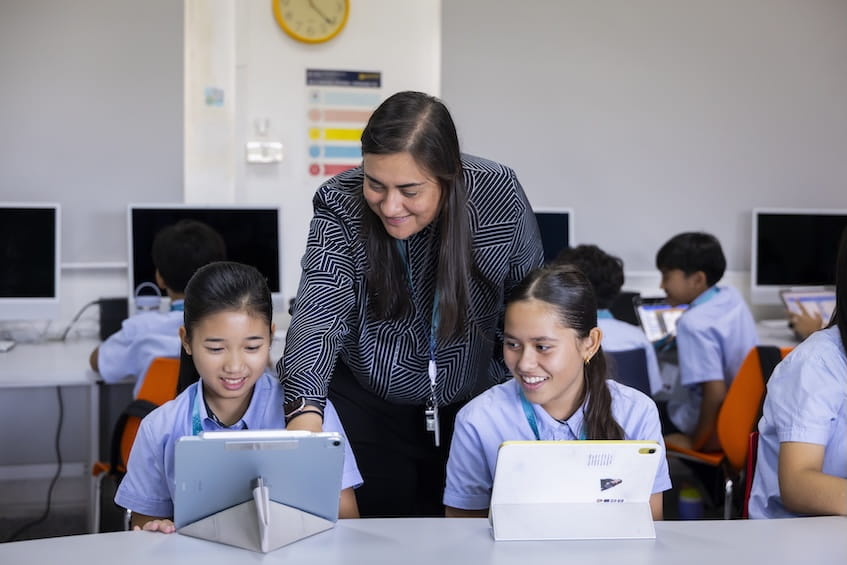
How families and schools can help children develop the judgement, confidence and digital literacy to thrive in a changing world.
Technology is woven into childhood in ways that would have been difficult to imagine a generation ago. Children use digital tools to learn, create, communicate, and play, while artificial intelligence (AI) is rapidly changing how they find information, solve problems, and approach their learning.
For parents and educators, the challenge is not simply deciding how much technology children should use. It is helping them develop the judgement to understand when technology adds value, when it is time to step away, and how to use it safely and responsibly.
Preparing children for a changing digital world
Every generation has faced questions about new technology. Writing, the printing press, calculators, the internet and, more recently, generative AI have all prompted debate about their impact on learning and society.
Today, simply removing technology is unlikely to prepare children for the world they will enter. Digital tools will continue to evolve, and students need opportunities to learn how to navigate them thoughtfully. That means helping children understand both the possibilities and the boundaries.
Four areas are particularly important to protect as children grow up digitally: sleep, safety, attention and the opportunity to think for themselves.
Nicole Sargeant, Head of Innovation at Regents International School Pattaya explains, “Preparing children for a digital future is about much more than teaching them how to use technology. We want them to understand when it adds value, when to step away, and how to make thoughtful, responsible choices. Most importantly, technology should support children’s curiosity and thinking, rather than replace them.”
Not all screen time is equal
One of the most useful shifts for families is to move beyond looking only at the number of minutes spent on a screen.
Consider four different experiences: video-calling grandparents overseas, creating a stop-motion film, playing an online game with friends, and watching autoplay videos in bed after lights-out. All involves screen time, but what children gain from them, and what each activity might replace, is very different.
Rather than asking only, “How much screen time?”, parents can ask:
- What is my child getting from this? Is it supporting creativity, learning, connection, enjoyment, or relaxation?
- What is it replacing? Is it crowding out sleep, physical activity, schoolwork or family time?
- Could we change how it is used? Would changing when, where or with whom it happens create a healthier balance?
This creates a more meaningful conversation about healthy technology use than focusing on time alone.
Digital safety starts with open communication
Teaching children to navigate the online world safely is just as important as teaching them to navigate the physical one.
Children need to understand how to protect their personal information, recognise potentially unsafe interactions, and know when something should be shared with a trusted adult. They also need strategies for responding when an uncomfortable situation occurs, whether that means leaving a private chat, blocking or reporting an account, or refusing to share harmful content.
But perhaps the most important safeguard is creating an environment in which children know they can ask for help without fearing an immediate negative reaction.
Sometimes the best first response is simply: “I’m glad you told me.”
At Regents International School Pattaya, these skills form part of a broader approach to digital citizenship, supported across subjects, Growing Minds, assemblies, pastoral care and safeguarding education.
AI should support thinking, not replace it
Artificial intelligence has brought a new dimension to digital learning. AI can explain concepts, generate ideas, provide feedback, and adapt questions to a student’s level. But whether AI supports learning or bypassesit depends largely on how it is used.
There is an important difference between asking AI to write an explanation of how solar panels work and asking it to pose one question at a time, offering a hint only when the student gets stuck. In the first example, AI does much of the thinking. In the second, it becomes a tool that helps the student think.
Children need to learn to question AI-generated information, verify important claims, protect their privacy, and follow their teacher’s guidance about when AI is appropriate. Most importantly, they should still be able to explain and demonstrate their own understanding.
The goal is not simply to teach children how to use AI, but how to remain curious, critical, and independent thinkers while using it.
Creating healthy digital habits at home
Healthy digital habits do not necessarily require complicated rules. Clear and consistent routines can often make the biggest difference.
If gaming is interfering with sleep, devices could charge outside bedrooms on school nights. If stopping an online game is difficult, agreeing on an end time and using a timer can help children develop greater independence. Families can also use tools such as Apple Screen Time, including Downtime, App Limits, Content & Privacy Restrictions and Communication Safety, to reinforce agreed boundaries.
Adults have an important role too. Children notice how the people around them use their phones and other devices. Agreeing that everyone puts devices away during dinner, for example, is more powerful when adults follow the same expectations.
The aim does not need to be eliminating technology. Instead, families can keep what adds value, including learning, creativity, maintaining relationships and playing with friends, while deliberately protecting time for sleep, movement, schoolwork, and spending time together.
School and home: One shared message
Children develop digital habits across both school and home, which makes consistency particularly valuable.
At school, digital citizenship, safeguarding and responsible technology use can give children the knowledge and skills they need. At home, families can reinforce these habits by exploring apps and games together, agreeing age-appropriate boundaries and modelling responsible technology use themselves.
Instead of beginning every conversation with rules, parents can also show curiosity: “Can you show me how this works and what you like about it?”
Understanding children’s digital worlds creates opportunities to talk about them, and those conversations become increasingly important as children grow older and gain greater independence.
Ready for the future
We cannot know exactly which technologies today’s children will use at university, in their careers or as adults. The digital landscape will continue to change.
What we can give them are the skills that endure: the ability to think critically, protect themselves, question information, make responsible choices and recognise when technology is genuinely helping them.
At Regents Pattaya, innovation is therefore not simply about giving students access to the latest technology. It is about helping them develop the curiosity, judgement and confidence to use it purposefully.
Because preparing children for a digital future should never mean technology doing more of the thinking. It should mean helping children become better thinkers.
Discover learning at Regents Pattaya
How do we prepare children for a future shaped by technology and AI?
By teaching them not only how to use new tools, but how to question, create, think independently and make responsible choices with them.
Discover how Regents International School Pattaya prepares students with the skills and confidence to thrive in a changing world. Book a personalised school tour.
Related news
News image ![pearson-outstanding-learner-awards-highest-marks-world - pearson-outstanding-learner-awards-highest-marks-world]() News | Choosing A School | Outstanding Learning | Secondary School
 News | Choosing A School | Outstanding Learning | Secondary School
Highest marks in the world for Regents Pattaya students in the Outstanding Pearson Learner Awards
Regents Pattaya students earn Outstanding Pearson Learner Awards, including Highest Marks in the World, Asia and Thailand in Pearson Edexcel qualifications.
News image ![Four Regents students named top in Thailand in the 2026 Outstanding Cambridge Learner Awards - cambridge-outstanding-learner-awards-2026]() News | Choosing A School | Outstanding Learning | Secondary School
 News | Choosing A School | Outstanding Learning | Secondary School
Four Regents students named top in Thailand in the 2026 Outstanding Cambridge Learner Awards
Four Regents International School Pattaya students achieve Top in Thailand in the 2026 Outstanding Cambridge Learner Awards for exceptional Cambridge IGCSE™ results.
News image ![Future Ready Education: The 6Cs at Regents International School Pattaya - future-ready-learning-6cs-regents-pattaya]() Blog | Outstanding Learning | Choosing A School
 Blog | Outstanding Learning | Choosing A School
Future-ready starts here: How Regents Pattaya develops the skills that matter most
Discover how Regents International School Pattaya develops curious, creative, critical, collaborative, compassionate and committed learners through its future-ready 6Cs framework.
News image ![How Regents Builds Strong Literacy Foundations in Early Years | Regents Pattaya - early-years-literacy-foundations-regents-pattaya]() Blog | Early Years | Choosing A School
 Blog | Early Years | Choosing A School
Building strong literacy foundations in Early Years
Discover how Regents International School Pattaya develops confident readers, writers and communicators through personalised learning, Monster Phonics, a carefully curated reading spine, Forest School and the Curiosity Approach.


