


We use cookies to improve your online experiences. To learn more and choose your cookies options, please refer to our cookie policy.

December 18, 2025
The Science of Early Reading: Phonological Awareness in the Early Years
Why Phonological Awareness Comes Before Letter Sounds
Learning to read begins long before children encounter the alphabet. It starts within oral language, with the ability to perceive, manipulate, and understand the sound structure of spoken words. This foundational skill, phonological awareness, is one of the strongest predictors of later reading success. Research across education, psychology, and neuroscience consistently shows that strong phonological skills support smoother, more efficient reading development.
This term should not be confused with phonemic awareness as the terms are commonly interchanged but relate to different aspects. It is important to establish the distinction.
- Phonological awareness is the umbrella skill: recognizing and working with larger chunks of sound such as syllables, rhyme, alliteration, and onset–rime.
- Phonemic awareness is a subset of phonological awareness: the ability to isolate, blend, segment, and manipulate the smallest individual sounds in words (phonemes).
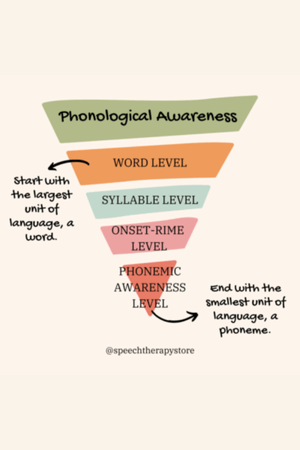
Children must develop broad phonological awareness first, before refining skills at the phoneme level. These provide the essential foundations for later learning.
Why Phonological Awareness Comes First
Phonological awareness includes identifying environmental sounds, replicating pitch and volume, noticing rhymes, and clapping syllables. Before children learn letter–sound correspondences, they benefit greatly from understanding that words are composed of smaller sound units. This prepares the brain to map speech onto print when reading instruction begins.
Children with strong phonological awareness understand that spoken words contain discrete sounds. This makes learning letters and the sounds they represent far easier. Without this foundation, connecting phonemes (the letter sounds) to graphemes (the written letter) can be difficult. Brain-imaging studies show that strong early phonological awareness is linked to robust activation in regions involved in speech processing and print–sound mapping. Early specialization in these regions predicts later reading success. Phonological awareness is a key predictor in later decoding, word recognition, fluency, and comprehension success. Children who lack foundational phonological awareness often struggle to blend sounds together, making early reading more challenging and less automatic.
At BISC-LP, we build strong phonological foundations from the very beginning. Throughout Pre-Nursery, Nursery, and into Reception, our curriculum focuses heavily on oral sound-play such as rhyming, syllable games, and oral blending and segmenting before explicit letter-sound instruction begins. This ensures children have the prerequisite skills and confidence to access our phonics program independently and make sustained progress once they begin the program. These elements are interwoven into routines so that children access them readily and consistently. You will likely walk into a classroom and hear a teacher clapping a rhythm as an attention grabber or using songs to support children lining up. All of this, though it may not seem like it, is early reading development in action.
Things to do at home
At home, you can reinforce phonological skills through simple, enjoyable games or activities as part of your everyday routines.
- I Spy - using initial sounds rather than letters e.g. “I spy with my little eye something beginning with sssssss”).
- Simon Says - using segmented words: “Simon says touch your l-e-g,” “Simon says jump up and d-ow-n.”
- Rhyme stories/songs – when singing a song, have the children fill in the missing rhyming word with their own.
- Clapping syllables – create repeating patterns while clapping syllables e.g. caterpillar, butterfly.
- Silly Soup/silly shopping list – create recipes or shopping lists of objects that all begin with the same sound.
- Giving segmented instructions in regular routines – put on your ‘h-a-t’ next.
Language is key
Some years ago, I wrote a blog about the importance of talking in a child’s developmental journey It's good to talk. This relates very well to the concept of phonological awareness as; it is the learning of language that precedes this skill. From the moment a child is babbling and replicating sounds they hear, they begin their development of phonological awareness. Of course, without language, there is nothing to apply phonological awareness to. Later down the line, a wide vocabulary is hugely important in reading comprehension and writing composition. Words matter. Interactions are powerful. Tuning into sounds is key.
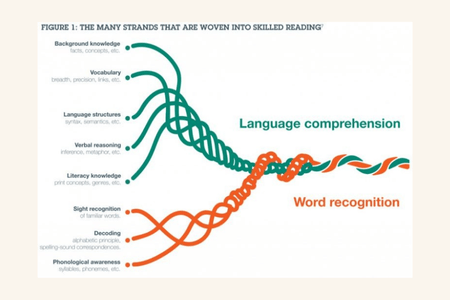
Phonological awareness is the foundation of skilled reading. Strong early sound skills shape the brain networks that connect speech to print, enabling fluent, confident reading. By prioritizing oral language and building robust sound-play experiences, children are being prepared for successful reading which also leads onto writing. Learning to read (and later to write) is a marathon, not a sprint and we must honor the important foundations to ensure the development of these skills is developmentally appropriate, enjoyable, and motivating to create eager readers and writers.
No apps, no expensive resources, just simple word play, and your voice is all it takes.
Stephanie Davis
Reception Teacher & Curriculum Director
Related news
News image ![The Science of Early Reading - The Science of Early Reading]() Blog | Featured | Global Education
Blog | Featured | Global Education
Blog | Featured | Global Education The Science of Early Reading: Phonological Awareness in the Early Years
Stephanie Davis explores the science of early reading, showing how phonological awareness builds strong foundations before letter sounds.
News image ![Year 3 Leader, Carla Williamson]() Blog | Featured | Global Education
Blog | Featured | Global Education
 Blog | Featured | Global Education
 The Importance of Self-Regulation in Children: A Foundation for Learning and Wellbeing
Discover how co-regulation, emotional awareness, and practical strategies support children in managing emotions and building resilience at BISC Lincoln Park.
News image ![Lowri Covello]() Blog | Featured
Blog | Featured
 Blog | Featured
 Meet the BISC-LP Student Community Directors: How BISC-LP Supports Student Wellbeing, Safety and Belonging
Meet the Student Community Directors at British International School of Chicago, Lincoln Park and learn how they support student wellbeing, positive behavior, safeguarding, and belonging across our school community.
News image ![Our Restorative Approach at BISC-LP - Our Restorative Approach at BISC-LP]() Blog | Featured
Blog | Featured
 Blog | Featured
 Building Character Through Connection: Our Restorative Approach at BISC-LP
Discover how BISC-LP's restorative approach to behavior helps students build character, strengthen relationships, and develop emotional intelligence through respect, connection, accountability, and restorative practices.


