


We use cookies to improve your online experiences. To learn more and choose your cookies options, please refer to our cookie policy.

December 04, 2025
Drama: The Beating Heart of Learning
.png?h=788&iar=0&w=940&rev=d90cba9b09fb4c8fab7fac061b6b1f8b&hash=6370E2794516618F223C4FD12B4A6659)
How story, language, and imagination connect every subject in primary education
When I walk into my classroom each day, I am not greeted by rows of desks and chairs, but instead an empty black room and a stage. Not a stage for exhibition; but a stage for exploration, and education that comes alive through storytelling and imagination. Drama isn’t an “extra,” nor simply a break from the “serious” subjects. It is a way of falling in love with learning; a way of knowing, expressing, and connecting ideas that nurtures children’s love of language and literature while weaving together the tapestry of history, science, geography, culture, empathy, and personal development and relationships.
As a primary educator and former actor, director, and playwright, I believe drama, rooted in the first pastime of story, is a thread that connects learning across the curriculum. It ignites curiosity and nurtures a lifelong love of language, and learning, and plainly but perfectly – teaches us to work together.
The Language of Story
Theatre, in its essence, is literature lived out loud. When children inhabit a character, speaking their words and navigating their dilemmas, they experience those words not as lines to decode, but as a medium for meaning. When children step into a character’s shoes, they don’t just read words — they feel them.
In my Year 4 class, students re-enacted journal entries from passengers arriving at Ellis Island. Their tableaus revealed a deeper grasp of history and human experience than any written exercise could capture. Abstract text became embodied understanding of segregation. Drama helps translate written accounts into a relatable resource, whilst nurturing a love of language not as something to analyze, but something to feel.
Drama also offers a safe, playful space for multilingual learners to experiment with new words in context, building vocabulary, fluency, and confidence. Through the Juilliard Creative Curriculum, students explore the language of performance in lessons such as The Shakespearean Ladder, developing curiosity, and awareness. Drama enables students to see the world through
many lenses, to interpret, to empathize, and to celebrate the diversity of human experience through story.
Theatre as the Great Connector: Bridging Subjects and Minds
Drama does not sit in isolation. It is the connective tissue between disciplines — the bridge children instinctively walk across when learning. When students act out a science concept, step into a historical role, or imagine themselves as explorers, they don’t just memorize facts; they experience them.
We move from Greek Chorus work to Shakespearean performance, exploring the roots of the performing arts. A history unit might see children re-create a Tudor market or an Ancient Egyptian court. In science, they might dramatize the push and pull of magnetic forces or Geography; the cycle of clouds.
As a class teacher, I once wove Treasure Island through English, drama, music, geography, art, and science. Students created character studies through hot seating, wrote sea shanties, built compasses, designed maps, and navigated their own routes in character. Through drama, abstract ideas became tangible; content knowledge translated into embodied understanding. Drama turns subjects into narratives — and children into curious navigators of those narratives.
Drama, Culture, and the World: Building Empathy and Global Understanding
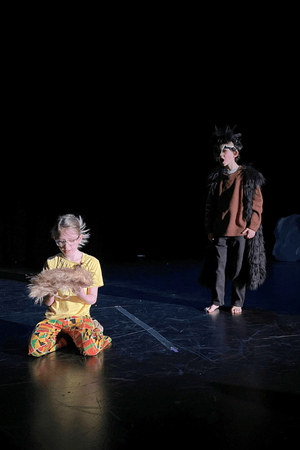
One of the most profound powers of drama is its ability to foster empathy — the imaginative act of stepping into another’s perspective. In primary classrooms, role-play becomes a rehearsal for empathy. Children negotiate conflicts, imagine community helpers, and dramatize stories from around the world, learning to listen, to negotiate, and to consider multiple viewpoints.
I’m reminded of a father who once told me about a moment with his child after school. After hearing the story of the day, he gently asked, “Now tell me that story again, but this time from someone else’s perspective.” Such a simple invitation — yet a perfect example of what drama sees in every lesson.
Drama becomes both a mirror and a window: a mirror reflecting their own lives and a window into the lives of others. Through this, children grow into thoughtful, compassionate global citizens in an interconnected world.
Thinkers, Creators, and Future Makers
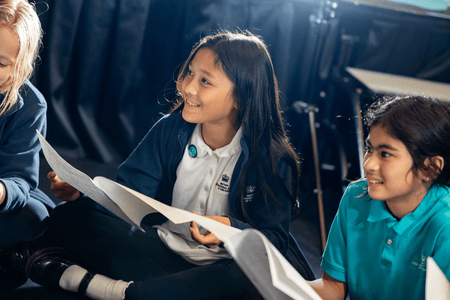
Education systems everywhere value communication, collaboration, critical thinking, and creativity. Drama delivers all four — naturally and powerfully. In every lesson, children must listen, negotiate, adapt, and create together. They communicate not only with words, but with tone, and gesture.
At BISC–LP, this lies at the heart of our vision to develop thinkers, creators, and future makers. In Year 6, students are currently devising fifteen original plays — essentially forming six young theatre companies. When they devise, they innovate. When they work in ensemble; they collaborate. When they interpret text and produce and stage direct; they think deeply and critically. And when they step into another’s world, they imagine futures beyond their own. These are the adaptable dispositions our rapidly changing world demands.
Drama as the Thread That Connects
If education is, at its core, the telling of humanity’s story through reflection on the lessons learned by curious minds of the past, and the preparation of its future; drama can provide a confluence for the rivers of its subjects to meet. Many of my Drama School peers now work far beyond theatre, yet all credit their training and relationships to having sharpened their confidence, creativity, and collaborative skills in drama.
In the primary classroom, where curiosity is boundless and imagination runs free, drama can breathe playfulness, depth, and life into abstract curriculum objectives, turning knowledge into story and story into meaning. Learning, like theatre, is a collective act of creation — one that always begins with the words:
“Let’s imagine…”
Sionelle Mallon
Drama Specialist
Learn more about our approach to Drama lessons and our Juilliard Collaboration here!
Related news
News image ![Lowri Covello]() Blog | Featured
Blog | Featured
 Blog | Featured
 Meet the BISC-LP Student Community Directors: How BISC-LP Supports Student Wellbeing, Safety and Belonging
Meet the Student Community Directors at British International School of Chicago, Lincoln Park and learn how they support student wellbeing, positive behavior, safeguarding, and belonging across our school community.
News image ![Our Restorative Approach at BISC-LP - Our Restorative Approach at BISC-LP]() Blog | Featured
Blog | Featured
 Blog | Featured
 Building Character Through Connection: Our Restorative Approach at BISC-LP
Discover how BISC-LP's restorative approach to behavior helps students build character, strengthen relationships, and develop emotional intelligence through respect, connection, accountability, and restorative practices.
News image ![Make the most of Summer in Chicago - Summer Fun and Learning]() Blog | Featured
Blog | Featured
 Blog | Featured
 Summer Fun & Learning: Make the most of Summer in Chicago
In our latest teacher blog, Pre-Nursery Assistant Directors Alex Duryea and Caitlin Stevens explore Chicago’s top summer destinations while supporting your child’s growth through play, discovery, and hands-on learning.
News image ![Moving on Up - Moving on Up]() Blog | Featured
Blog | Featured
 Blog | Featured
 Moving on Up: Navigating Transitions to a new grade with confidence
Matt Gregory, Deputy Head of Campus – Community & Well-Being and Designated Safeguarding Lead, shares practical tips to help children transition confidently to a new grade, supporting wellbeing, routines, and a smooth start to the school year.


