.png?h=48&iar=0&w=233&rev=48be0e4e096845f48547850b335e51de&hash=C13D6F4889A0A50528B9E85C304F1EB5)
.png?h=48&iar=0&w=213&rev=f7cf81b2a83744e2ac2843364cfedd35&hash=1865B09BD250CAE4C2EA44E1B4D49B0D)

We use cookies to improve your online experiences. To learn more and choose your cookies options, please refer to our cookie policy.
May 18, 2026
Bringing Medical School-Level Learning to High School
How The Village School is Redefining Pre-Med Education
What does it really mean to prepare students for the future of medicine?
At most schools, it starts with strong science classes and ends with college aspirations. At The Village School, it goes much further. It means giving students access to the tools, experiences and environments they will encounter in medical school and beyond, starting in high school.
That vision is now a reality.
A New Standard for Pre-Med Learning
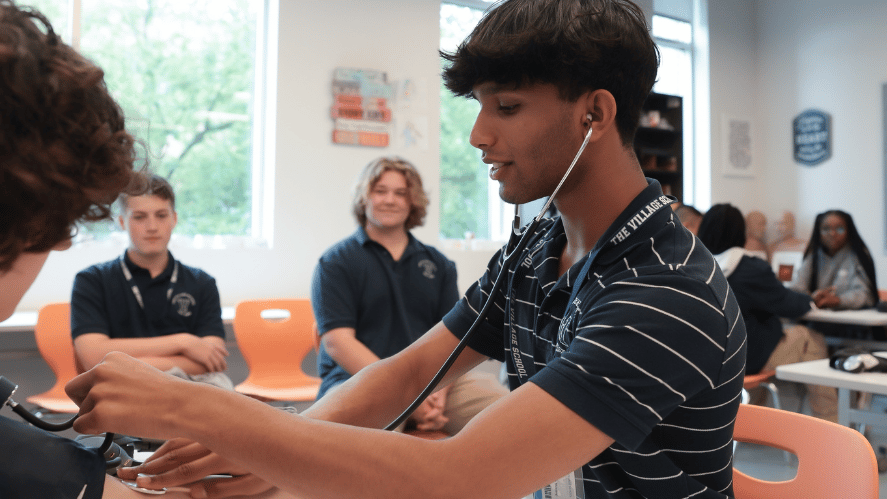
The Village School has taken another major step forward in its Pre-Medical Science Diploma Program with the introduction of advanced clinical simulation technology typically reserved for universities and professional training programs.
Two new tools are redefining what’s possible at the high school level:
•The Anatomage Table, a life-size 3D anatomy visualization system
•The Noelle Birthing Simulator, a clinical training platform used in nursing and medical programs
Together, they create an immersive, hands-on learning environment that mirrors real medical education. Students aren’t just reading about anatomy. They’re conducting virtual dissections, isolating body systems and exploring the human body in full 3D. They aren’t just discussing childbirth in theory. They’re observing and practicing clinical scenarios in a controlled, realistic setting.
It’s a level of access that sets a new benchmark—not just in Houston, but across Texas.
Why Simulation Matters
In medicine, knowledge alone isn’t enough. Application is everything. Simulation-based learning bridges the gap between classroom theory and real-world practice. It allows students to:
•Build confidence before entering clinical environments
•Develop critical thinking in high-stakes scenarios
•Explore complex systems in a safe, repeatable way
By introducing these tools now, The Village School is helping students internalize concepts earlier and more deeply—long before college begins. As Head of School Dr. Ryan Kelly puts it, the goal is simple: create learning environments that reflect what students will experience next.
Built on a Foundation of Real-World Experience
The addition of simulation technology is just one part of a larger, intentionally designed program. Since launching in 2022 with just three students, the Pre-Medical Science Diploma has grown rapidly, graduating 23 students this year. That growth reflects both rising interest in healthcare careers and the strength of the program itself.
What makes it different? The balance between academic rigor and real-world application. Students engage in:
•Internships in clinical settings
•Physician shadowing
•Research opportunities with industry professionals
These experiences aren’t add-ons. They’re core to how students learn, helping them test their interests and build practical skills along the way.
Outcomes That Speak for Themselves
Preparation matters because outcomes matter. Graduates of the program are already matriculating to leading universities such as Brown, USC, NYU, UC San Diego and Case Western Reserve University. Just as importantly, they’re arriving with clarity. They don’t just say they want to pursue medicine. They’ve experienced it. They understand the realities of the field and the commitment it requires.
The Future of Healthcare Starts Here
Houston is home to the world’s largest medical center. It’s a city built on innovation in healthcare. At The Village School, that same spirit of innovation is shaping how students learn. With the addition of clinical simulation technology, Village becomes the only high school in Texas offering this level of advanced anatomical and clinical training within a pre-med pathway. But more importantly, it signals something bigger.A commitment to preparing students not just for college, but for meaningful, impactful careers. A belief that high school students are capable of more when given the right tools. And a clear vision for what education should look like when it’s truly aligned with the real world.
Related news
News image ![Lower School Line]() News
News
 News
News The Village School Ranked #2 Private K–12 School in Texas by Niche
The Village School ranks #2 Best Private K–12 School in Texas and #1 Most Diverse Private K-12 Schools in Niche’s 2027 rankings.
News image ![Finding the Right School Fit - Finding the Right School Fit]() Blog
Blog
 Blog
Blog Finding the Right School Fit: What Families Should Look For
Finding the right school is about more than academics. Learn what sets The Village School apart and why families from around the world choose it for their child's educational journey.
News image ![Moving to Houston - Moving to Houston]() Blog
Blog
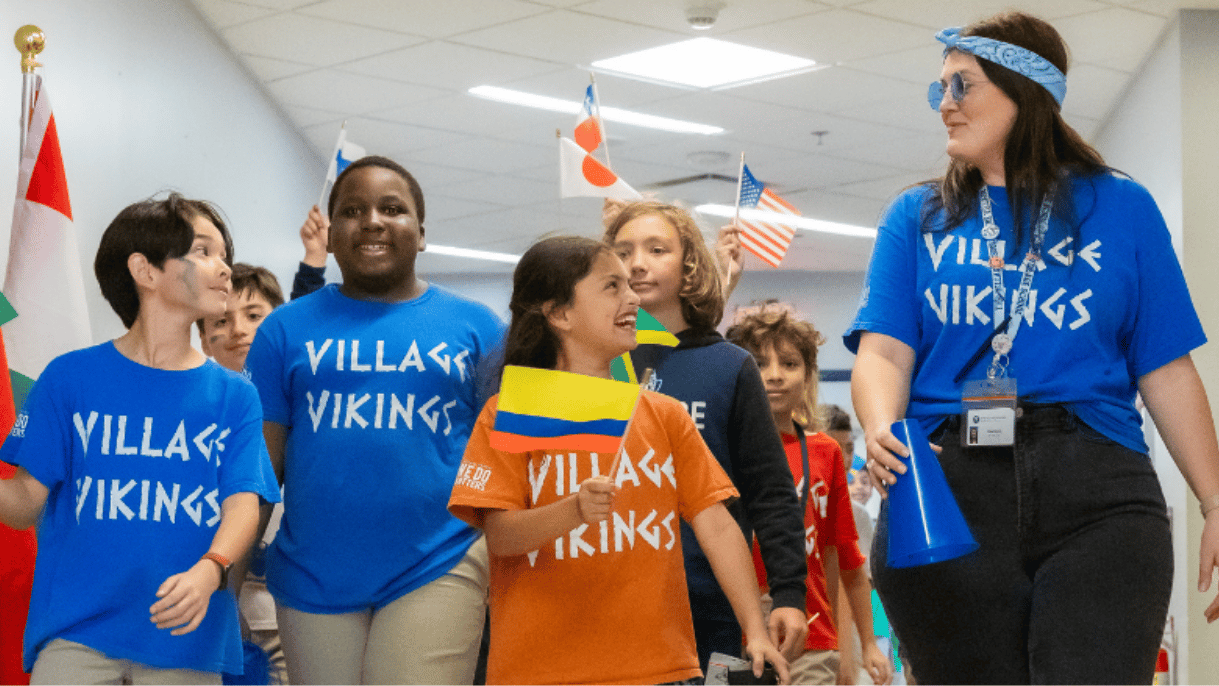 Blog
Blog Moving to Houston: A Guide for International Families
Known for its diversity, economic strength and welcoming culture, Houston continues to attract families from around the world looking for both stability and possibility.
News image ![Village School Student]() Blog
Blog
 Blog
Blog Teaching the Skills AI Can’t Replace: Can Your Child Tell When AI Is Wrong?
Critical thinking helps students pause before accepting information, question where it came from and evaluate whether it should be trusted. At Nord Anglia Education, we believe that ability may become one of the most valuable skills your child can develop in the age of AI.

.svg?rev=9fe0e392449346898bfb5359a1712c74&hash=0CFEC6C43B078E93E0FF4FFFF79FD684)

.svg?rev=c1fad1a5d67c42c181bab95cecd7c167&hash=7818833ACDD57A69E399597406805939)
