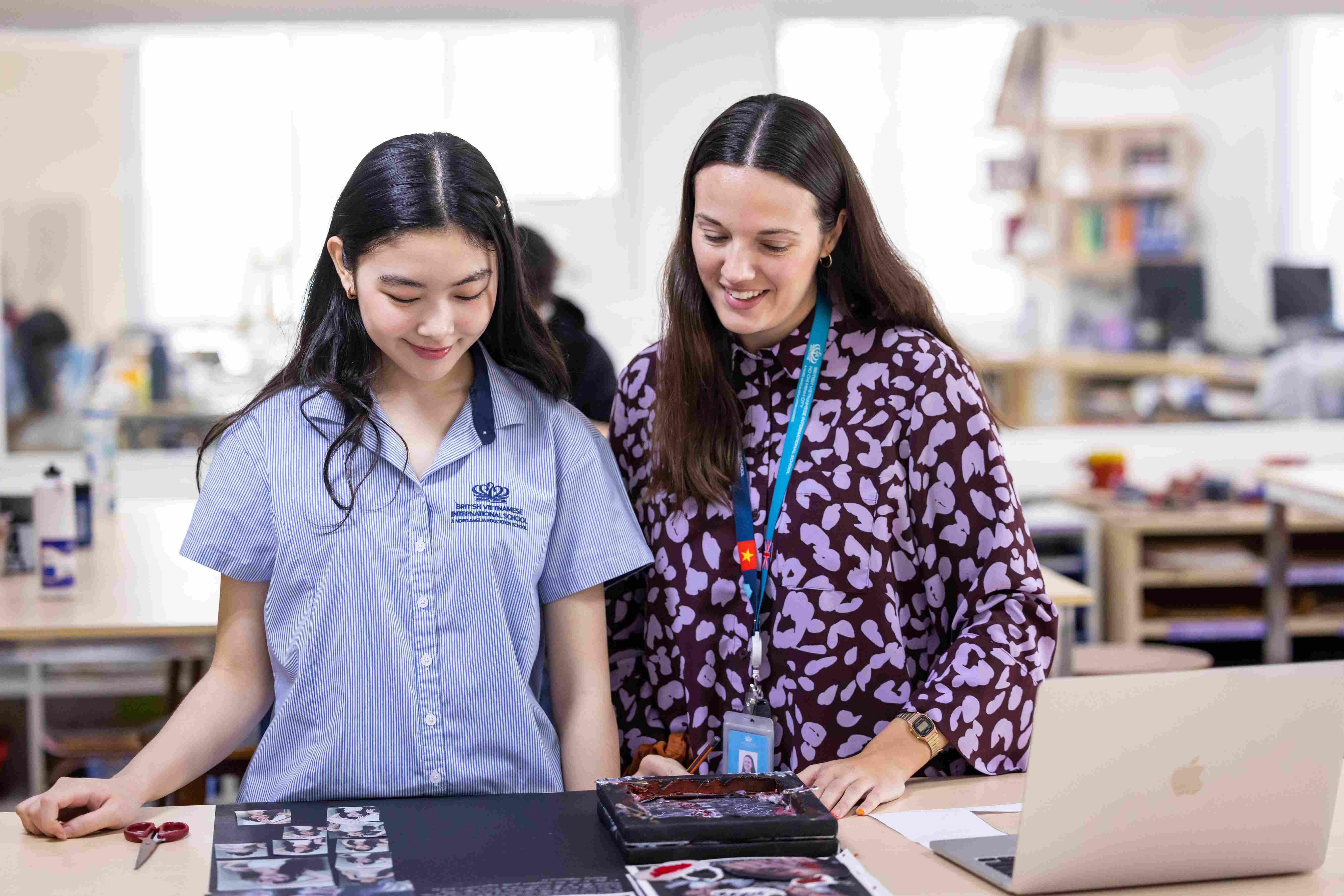
What Is IGCSE?
IGCSE (International General Certificate of Secondary Education) is an internationally recognised secondary qualification based on the British education system, typically for students aged 14 to 16. Equivalent to GCSEs in the United Kingdom, the IGCSE programme is designed specifically for international learners and is offered by leading examination boards including Cambridge International, Pearson Edexcel and OxfordAQA.
The IGCSE programme typically lasts two years and provides students with a solid academic foundation while developing analytical thinking, problem-solving abilities and independent learning skills. It also prepares students for post-16 qualifications such as A Level, the International Baccalaureate Diploma Programme (IBDP) and other equivalent pathways.

Students personalise their IGCSE subject choices by combining core subjects with electives that align with their interests, strengths and future aspirations
IGCSE Subject Options:
Depending on the school and curriculum structure, IGCSE students typically study a combination of core and elective subjects. The IGCSE programme offers a broad selection of subjects, including:
- Core Subjects: English, Mathematics, Science
- Humanities and Social Sciences: History, Geography, Economics, Business Studies, Psychology
- Arts and Creative Subjects: Art and Design, Music, Drama
- Technology Subjects: Information and Communication Technology (ICT), Computer Science, Design and Technology
- Physical Education
This flexibility enables students to build a broad academic foundation while exploring their interests, identifying their strengths and considering potential future areas of study.
>> Parents may also be interested in:
What Is A Level?
A Level (General Certificate of Education Advanced Level) is an advanced secondary qualification within the British education system, typically designed for students aged 16 to 18. Offered by internationally recognised examination boards such as Cambridge International and Pearson Edexcel, A Level enables students to develop specialist subject knowledge aligned with their future university courses and career aspirations.
A Level is typically completed over two years, progressing from foundational learning to greater academic depth. During the first year, students study AS Level, usually selecting three to four subjects to build a strong foundation of subject knowledge and skills. In the second year, students progress to A2 Level, where they continue studying the same subjects at a more advanced level, providing excellent preparation for university and future careers.
Recognised by universities worldwide, A Level is one of the most respected pre-university qualifications and plays an important role in university applications and subject specialisation.

BVIS students choose A Level subjects that reflect their strengths, interests and future aspirations (Source: BVIS Ho Chi Minh City).
A Level Subject Options:
Unlike IGCSE, A Level does not require students to study compulsory subjects. Students can choose subjects that best match their strengths, interests and university ambitions, including: Mathematics, Physics, Chemistry, Biology, Economics, Business, Geography, History and many more. Selecting the right combination of subjects enables students to build on their strengths while developing the knowledge and skills needed for their chosen degree programmes and future careers.
>> Discover more: Top five benefits of studying International A Level programme at BVIS Ho Chi Minh City
Comparing IGCSE and A Level
Although both qualifications form part of the British education system, they are designed for different stages of a student's educational journey.
| Criteria | IGCSE | A Level |
Age
| 14–16
| 16–18
|
| Purpose | Build academic foundations, develop abilities and identify strengths | Develop specialist knowledge and prepare for university and future careers |
| Number of Subjects | Typically 6-10 subjects, including core and elective options | Typically 3-4 specialist subjects |
| Academic Depth | Broad foundation across multiple disciplines | In-depth study of selected subjects |
| Assessment | Combination of examinations and coursework, depending on the subject and examination board | Primarily examination-based, depending on subject and examination board requirements |
| Qualification Value | International secondary qualification recognised worldwide and used as preparation for further qualifications after age 16 | Advanced qualification within the British education system recognised by universities worldwide and commonly used for university admission |
| Typical Progression | A Level, IB Diploma Programme or equivalent qualifications | University applications and higher education preparation
|
In summary, IGCSE establishes strong academic foundations, while A Level enables students to deepen their knowledge and focus on specialist subjects before progressing to university.
>> Read more:
Benefits of Studying IGCSE and A Level
Students who follow the IGCSE and A Level pathway enjoy a range of advantages, particularly when pursuing an international education.
- A Continuous British Curriculum Pathway: Together, IGCSE and A Level create a coherent educational journey from Secondary through to university preparation, allowing students to develop their knowledge and skills progressively.
- Strong Academic Development: Both qualifications place a strong emphasis on critical thinking, analysis, problem-solving and the practical application of knowledge.
- Personalised Learning Opportunities: Students can choose subjects that align with their strengths, interests and aspirations, particularly at A Level where specialisation becomes increasingly important.
- Preparation for International Universities: The teaching methodologies and assessment approaches encourage independent learning, research skills and academic confidence, helping students transition successfully into higher education.
- International Recognition: IGCSE and A Level are globally recognised British qualifications accepted by universities and institutions around the world, opening doors to a wide range of future opportunities.
>> Discover more: 7 benefits of studying at an international school
Why Study Continuously from IGCSE to A Level?
Following a continuous pathway from IGCSE to A Level allows students to build a clear and purposeful academic journey, progressing from discovering their strengths to developing specialist expertise aligned with their future ambitions.
At the IGCSE stage, students explore a broad range of subjects and establish strong academic foundations. As they move into A Level, they can focus on subjects closely connected to their intended university courses. This progression helps students make meaningful connections across disciplines, strengthen their academic thinking and make informed decisions about their futures.
However, students do not necessarily need to complete IGCSE before studying A Level. Entry requirements vary between schools, subjects and programmes. Parents should review specific admission requirements carefully when considering their educational options.
>> Learn more: Top 6 International School Curriculum and How to Choose the Right One for Your Child
Where Can Students Study IGCSE and A Level in Vietnam?
Today, students in Vietnam can study IGCSE and A Level at international schools offering the British curriculum. When choosing a school, parents should consider factors such as curriculum continuity, teaching quality, university guidance and opportunities for all-round development.
In Ho Chi Minh City, the British Vietnamese International School (BVIS) offers a continuous British education pathway from Early Years through to Secondary, enabling students to progress smoothly from IGCSE to A Level.
As a member of Nord Anglia Education, BVIS combines academic excellence with personalised support, helping students develop their strengths, explore future aspirations and prepare for applications to leading universities in Vietnam and around the world.
>> Read more:
Why Choose the IGCSE and A Level Pathway at BVIS HCMC?
A Seamless Learning Journey from IGCSE to A Level
At BVIS HCMC, students in Year 10 and 11 (ages 14-16) follow the IGCSE programme, studying Mathematics, English and Science alongside three elective subjects that reflect their strengths and interests. Through a personalised learning approach, BVIS supports each student’s academic growth according to their individual learning needs and aspirations.
Following IGCSE, students progress to the A Level programme in Year 12 and 13 (ages 16-18), where they focus on three to four subjects aligned with their strengths, interests and intended field of study. Delivered through internationally recognised examination boards, including Cambridge International and Pearson Edexcel, the A Level programme enables students to deepen their subject knowledge, develop advanced academic skills and prepare confidently for university applications.
Outstanding Academic Achievement and University Success
The continuous pathway from IGCSE to A Level at BVIS HCMC has led to exceptional outcomes in both academic achievement and university admissions. During the 2024-2025 academic year, 12 Secondary students received Outstanding Learner Awards from Cambridge International and Pearson Edexcel, including three Highest in the World awards, nine Highest in Vietnam awards and three High Achievement awards.
These achievements are reflected in the school's excellent examination results. In the 2025-2026 academic year, 57% of all IGCSE grades were awarded A-A*, significantly higher than the England average of 22%. At A Level, 44.4% of all grades achieved A-A*, surpassing the England average of 28.3%.
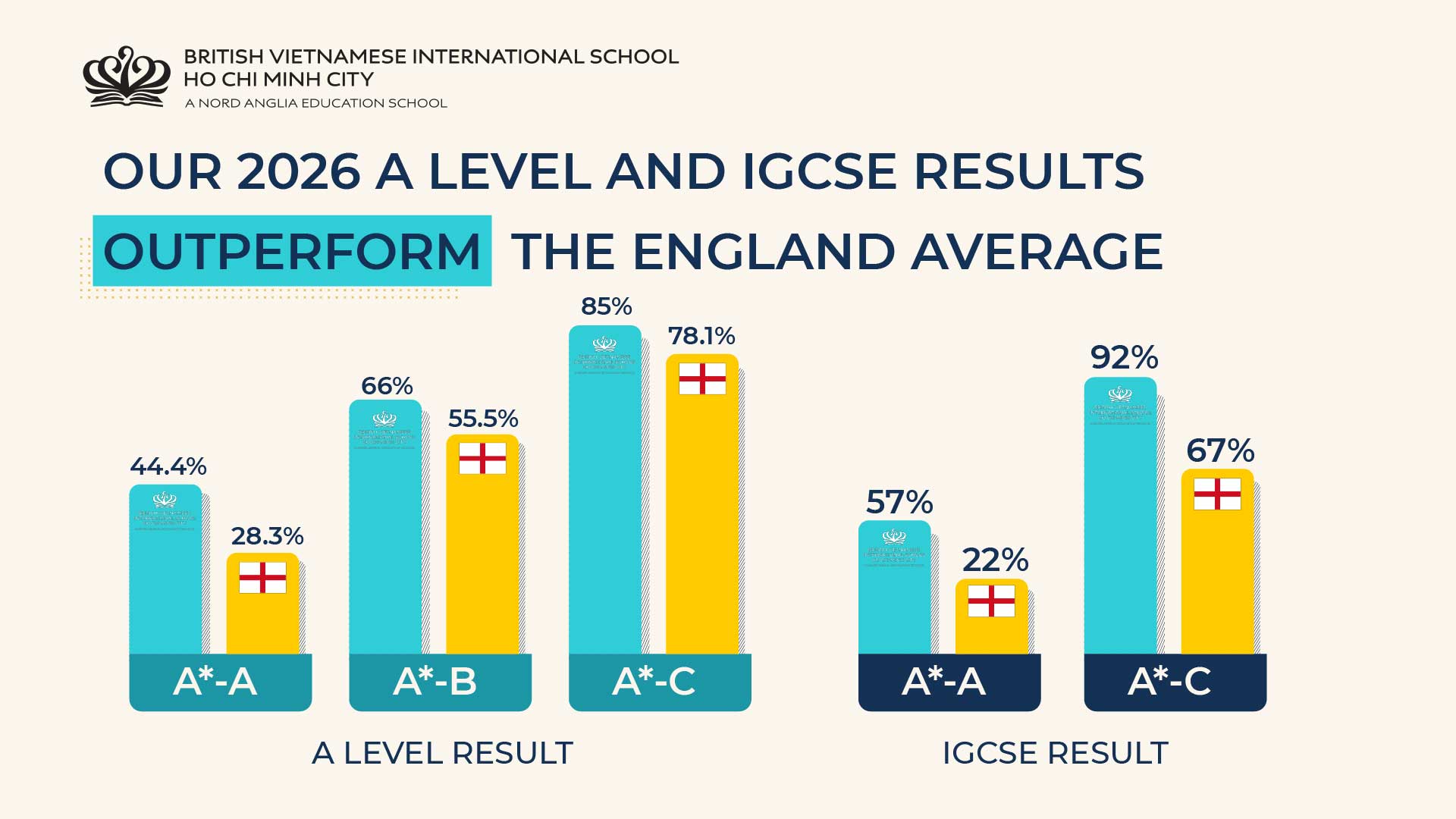
BVIS Ho Chi Minh City A Level and IGCSE results for the 2025-2026 academic year (Source: BVIS Ho Chi Minh City)
Building on this strong academic foundation, BVIS students continue to receive offers from leading universities around the world. The Class of 2026 has secured offers from prestigious institutions including Imperial College London, University College London (UCL), the University of California, Berkeley (UC Berkeley), Georgia Institute of Technology (Georgia Tech) and many other top universities worldwide.
>> Read more: The complete guide to understanding National Curriculum Levels
Personalised University and Careers Guidance
From Year 11, BVIS students benefit from personalised support from the University and Careers Guidance Team, including advice on A Level subject selection, career pathways and university admission requirements. In Year 12 and 13, dedicated one-to-one guidance sessions help students develop their university plans, prepare competitive applications and make informed decisions aligned with their future aspirations.
Global Learning Opportunities Through Nord Anglia Education
As a member of Nord Anglia Education, BVIS Ho Chi Minh City provides students with opportunities to take part in international programmes and experiences delivered in collaboration with world-renowned organisations, including the Massachusetts Institute of Technology (MIT), The Juilliard School, UNICEF and IMG Academy. These collaborations allow students to broaden their horizons, deepen their interests and explore fields such as science, the arts, sport and global citizenship.
IGCSE and A Level together form a clear and well-structured British curriculum pathway, providing students with excellent opportunities for academic and personal growth. Choosing the right learning environment helps students build on their strengths, develop the foundations for future success and make confident decisions about their educational journey.
To learn more about the IGCSE and A Level programmes at BVIS Ho Chi Minh City, please contact our Admissions Team:
- Hotlines:
- Primary: +84 (28) 3758 0709 (Extension 111)
- Secondary: +84 (28) 3758 0717 (Extension 211)
- Email: admissions@bvisvietnam.com
- Office Hours: Monday to Friday, 8:00 am – 5:00 pm
Discover more about BVIS: