


16 October, 2026
What is the SAT? Key things you need to know about the SAT exam

The SAT is one of the standardised tests used by many universities as part of their admissions process, particularly in the United States. For students planning to study abroad or apply to international universities, understanding what the SAT is, its test structure, and how it is scored can help families prepare more effectively for the university application process. Explore the key information about the SAT to help build an academic pathway and application plan that aligns with a student's higher education goals.

TABLE OF CONTENTS
- 1. What is the SAT?
- 2. What role does the SAT play in international university applications?
- 3. SAT test structure and content
- 4. SAT Scoring System and Score Scale
- 5. When are SAT results released and where can students access their SAT scores?
- 6. Is the SAT difficult?
- 7. Average SAT scores at top universities in the United States
- 8. How does the curriculum at BVIS HCMC support SAT preparation?
- 9. Is the SAT the right choice for every international school student?
1. What is the SAT?
1.1 Overview
The SAT (Scholastic Assessment Test) is a standardised test designed to assess a range of academic skills considered important for university study, with a particular focus on Mathematics and Reading and Writing. The test is developed and administered by the College Board, a non-profit educational organisation based in the United States.

SAT is a standardised test that assesses students' skills in Mathematics, Reading and Writing. It is developed and administered by the College Board. (Source: Internet)
>> Learn more:
- What is A Level? A Complete Guide for Parents
- What Is the IGCSE Curriculum? Subjects, Standards & Benefits
1.2 The History of the SAT
The SAT has undergone several changes to its name, structure and scoring system since it was first introduced in 1926. Key milestones in its development include:
- 1926: The test was first introduced as the Scholastic Aptitude Test, consisting of two main sections: Verbal and Mathematical, with each section scored on a scale of 200 to 800.
- 1990: The test was renamed the Scholastic Assessment Test, although its overall structure remained largely unchanged.
- 1994: The exam became known as the SAT I: Reasoning Test, distinguishing it from the SAT II: Subject Tests, which assessed subject-specific knowledge in individual academic disciplines.
- 2005: The name was shortened to the SAT Reasoning Test. The test consisted of three sections: Critical Reading, Writing and Mathematics, with a maximum score of 2,400.
- 2016: The College Board simplified the name to SAT. The test structure and scoring system were revised, returning the maximum score to 1,600, based on Reading and Writing and Mathematics.
- 2023: The Digital SAT was introduced for international test takers, replacing the traditional paper-based format. The updated test has a duration of approximately 2 hours and 14 minutes, significantly shorter than the previous version.
- 2024: The Digital SAT was launched in the United States, completing the transition to a fully computer-based testing format.
Over the years, the College Board has continuously refined the SAT's name, structure and delivery format to align with evolving university admissions requirements and approaches to assessing student achievement.
Previously, the SAT was divided into SAT I and SAT II:
- SAT I (SAT Reasoning Test): Assessed core academic skills in Reading, Writing and Mathematics. The test previously included an optional Essay section, which was discontinued by the College Board in 2021.
- SAT II (SAT Subject Tests):Evaluated students' subject-specific knowledge in areas such as Mathematics, Chemistry, Biology, History and Languages. The College Board officially discontinued SAT Subject Tests in 2021.
Following the removal of SAT II, only one version of the SAT remains. Since 2023, international candidates have taken the Digital SAT, with the United States adopting the same format in 2024. The test lasts approximately 2 hours and 14 minutes, uses a multistage adaptive testing approach, and consists of two main sections: Reading and Writing and Mathematics.
>> Learn more:
- Top 6 International School Curriculum and How to Choose the Right One for Your Child
- 7 benefits of studying at an international school
2. What role does the SAT play in international university applications?
The SAT can form part of a university application, depending on the admission requirements of individual institutions and academic programmes. For universities that require or accept SAT scores, the test can provide admissions officers with an additional standardised measure of a student's academic ability alongside school transcripts, personal statements, extracurricular activities, reference letters and other admission criteria.
>> Read more: How to write an impressive personal statement for university?
3. SAT test structure and content
Compared with the previous paper-based format, the Digital SAT has been streamlined into two sections: Reading and Writing and Mathematics. The test takes approximately 2 hours and 14 minutes to complete and includes a scheduled break between sections.
3.1 Mathematics Section
The Mathematics section lasts 70 minutes and consists of 44 questions. Students are permitted to use a calculator throughout the entire section. The content is organised into four main domains:
A detailed comparison of the Mathematics section in the paper-based SAT and the Digital SAT is shown below:
| Format | Digital SAT | Paper-based SAT |
| Duration | 70 minutes | No calculator: 25 minutes Calculator allowed: 55 minutes |
| Number of Questions | 44 questions | Reading: 15 Writing & Language: 30 |
The Mathematics questions in the Digital SAT are divided into the following content domains:
- Algebra (35%): equations, inequalities and systems of equations.
- Advanced Mathematics (35%): quadratic equations, polynomials and more advanced mathematical concepts.
- Problem-Solving and Data Analysis (15%): ratios, percentages, units of measurement and data interpretation.
- Geometry and Trigonometry (15%): geometric principles, area, volume and trigonometric concepts.
These questions are designed to assess students' ability to apply mathematical knowledge, analyse data and solve problems in both academic and real-world contexts.
3.2 Reading and Writing section
In the Digital SAT, the previous Reading and Writing and Language sections have been combined into a single Reading and Writing section. This section lasts 64 minutes and consists of 54 questions.
A detailed comparison of the Reading and Writing section in the Digital SAT and the paper-based SAT is outlined below:
| Format | Digital SAT | Paper-based SAT |
| Duration | 64 minutes | Reading: 65 minutes Writing and Language: 35 minutes |
| Number of Questions | 54 questions | Reading: 52 questions Writing and Language: 44 questions |
| Reading Passages | 54 passages, each consisting of 25-150 words with one question per passage | 5 passages of 600-700 words, each followed by 10-11 questions. 3 passages of 500-700 words, each followed by 11 questions. |
The content focuses on students’ ability to comprehend and analyse information, use standard English accurately, and express ideas effectively, across four main domains:
- Craft and Structure (28%): understanding vocabulary in context, and analysing the structure and reasoning of a text.
- Information and Ideas (26%): identifying main ideas, analysing information, and drawing conclusions based on texts, charts or data.
- Standard English Conventions (26%): assessing knowledge of grammar and the use of standard English.
- Expression of Ideas (20%): selecting appropriate ways to express and connect ideas in order to communicate information clearly and coherently.
Overall, the Digital SAT assesses not only knowledge of Mathematics and English, but also students’ abilities in analytical thinking, reading comprehension, reasoning and problem-solving, all of which are important for success at university.
>> Learn more: Tips for Applying to Study Abroad
4. SAT Scoring System and Score Scale
The Digital SAT continues to use a maximum score of 1,600, comprising 800 points for Mathematics and 800 points for Reading and Writing. A student's total score ranges from 400 to 1,600.
According to the College Board, scores are calculated based on the number of correct answers across the test modules and are then converted into section scores on a 200-800 scale. Because the Digital SAT uses an adaptive testing format, scores depend not only on the number of questions answered correctly but also on the difficulty level of the questions presented.
Each test administration may use a different score conversion process to ensure fairness across exams with varying levels of difficulty. Therefore, the number of correct answers alone should not be used to estimate an SAT score precisely. Instead, results should be interpreted according to the official score conversion scale for each test administration.
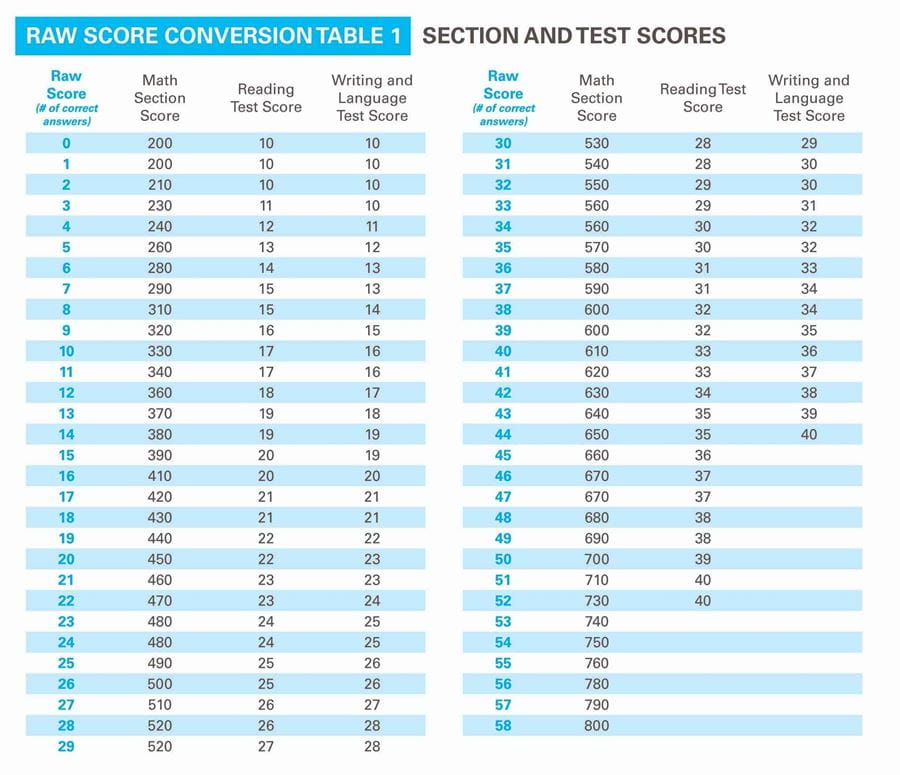
The Digital SAT is scored on a scale of 400-1600, with Math and Reading & Writing each contributing up to 800 points (Source: Internet).
5. When are SAT results released and where can students access their SAT scores?
For the Digital SAT, students can typically view their scores online according to the College Board score release schedule, usually within one to two weeks after the test date. Results are made available through the student's College Board account.
If SAT scores are being used for university applications, students may also request that the College Board send their scores directly to universities, subject to each institution's admissions requirements. It is therefore important to check both score release dates and application deadlines to ensure that results are submitted on time.
>> Explore: How your child’s learning needs evolve from primary years to university readiness
6. Is the SAT difficult?
There is no fixed level of difficulty for the SAT, as the challenge varies depending on each student's mathematical foundation, English reading comprehension skills, analytical thinking ability, and familiarity with the test format.The Digital SAT requires students not only to demonstrate subject knowledge but also to analyse information, draw conclusions and solve problems within a limited timeframe. As a result, early preparation and a strong academic foundation can help students approach the test with greater confidence.
An international school environment may offer certain advantages, as students regularly use English in their learning, apply mathematical concepts, and develop analytical thinking, reasoning and problem-solving skills across a range of subjects. These are also competencies that align closely with the skills assessed in the SAT.
For students planning to take the SAT, families can begin by identifying university goals, researching admission requirements, and evaluating the student's current academic profile. From there, students can develop a study plan that aligns with both their current curriculum and their target SAT score.
>> Read more: Making decisions about university and future careers: When is the right time?
7. Average SAT scores at top universities in the United States
SAT scores are one of the factors considered in the admissions process at many leading universities in the United States, helping admissions committees assess the academic readiness of applicants from a wide range of secondary schools and educational backgrounds.
At highly selective universities, successful applicants often achieve very strong SAT results, with competitive scores commonly falling within the 1500+ range. The table below provides a general overview of SAT score ranges at leading universities in the United States, helping students set realistic goals and develop an appropriate preparation strategy.
| University | Khoảng điểm SAT |
| Princeton University | 1500–1580 |
| MIT | 1510–1580 |
| Harvard University | 1500–1580 |
| Stanford University | 1510–1580 |
| Yale University | 1500–1580 |
| California Institute of Technology (Caltech) | 1530–1570 |
| Duke University | 1520–1570 |
| Johns Hopkins University | 1530–1580 |
| Northwestern University | 1490–1580 |
| University of Pennsylvania | 1500–1570 |
| Cornell University | 1480–1560 |
| University of Chicago | 1510–1570 |
| Brown University | 1500–1570 |
| Columbia University | 1490–1580 |
| Dartmouth College | 1500–1570 |
8. How does the curriculum at BVIS HCMC support SAT preparation?
At British Vietnamese International School (BVIS) HCMC, students follow a British curriculum pathway from Early Years Foundation Stage (EYFS) and Primary School through to Secondary School, including the IGCSE and A Level programmes. Structured to support students at each stage of their development, the curriculum provides a continuous learning journey and a strong foundation for students who are planning to prepare for the SAT.
Students study Mathematics and other subjects through academic English, providing opportunities to strengthen their mathematical knowledge, reading comprehension skills and ability to use English confidently in an academic environment. These foundations are directly relevant to the two main sections of the SAT.
In addition to subject knowledge, students have opportunities to develop analytical thinking, reasoning and problem-solving skills through their learning experiences. These competencies can help students engage more effectively with SAT question types that require inference, analysis and application of knowledge.
BVIS does not focus solely on preparing students for a single examination, but on developing long-term academic capability. Through the IGCSE and A Level pathways, students continue to deepen their subject knowledge, develop essential skills, and prepare for applications to universities in the United States, Canada, the United Kingdom, and many other countries.

BVIS HCMC provides a strong foundation in Mathematics, academic English and analytical thinking, supporting students in preparing confidently for the SAT and their journey towards international university admission. (Source: BVIS HCMC)
>> Explore the outstanding mathematics achievements of BVIS Ho Chi Minh City students:
- Senior Level World Mathematics Competition
- FOBISIA Primary Mathematics Competition 2025
- Cambridge and Pearson Edexcel Outstanding Learner Awards 2025
9. Is the SAT the right choice for every international school student?
Not every international school student needs to take the SAT. Today, many universities have adopted test-optional admissions policies, allowing applicants to decide whether or not to submit SAT scores. In addition, students studying programmes such as IB and A Levels may use their academic results alongside other application components to meet university entry requirements, depending on the admissions criteria of each institution.
Therefore, before deciding whether to take the SAT, parents and students should research the admission requirements of their target universities while also considering the student's academic background, strengths and future aspirations. The SAT should be viewed as an additional option that may strengthen a university application, rather than a mandatory requirement for all international school students.
>> Parents may also be interested in:
- IGCSE and A Level: Understanding the Key Differences and Choosing the Right Pathway
- Where to study A Levels in Vietnam: Key factors to consider when choosing the right school for your child
Understanding what the SAT is, its structure, scoring system and role in university admissions can help students and parents make more informed decisions when planning an international education pathway. However, the SAT is not a requirement for every student. The most important step is to identify university goals and choose a pathway that aligns with each student's abilities and aspirations.
For students planning to apply to international universities, a strong academic foundation, English proficiency and well-developed analytical thinking skills are valuable preparation, regardless of whether they choose to take the SAT. Parents and students may wish to explore The British Vietnamese International School (BVIS) HCMC, where students have opportunities to develop academic excellence and build essential skills through the British curriculum.
To learn more about admissions and the academic programmes at BVIS HCMC, parents are welcome to contact the school:
Discover more about BVIS:
Related news
News image ![What is the SAT Test? Everything you need to know about SAT - sat la gi]() Blog | Educational Insights
Blog | Educational Insights
Blog | Educational Insights What is the SAT? Key things you need to know about the SAT exam
What is the SAT used for? Exploring the SAT (Scholastic Assessment Test): a standardised assessment of academic ability widely used in university admissions in the United States.
News image ![What Is Personalised Learning? Key Benefits for Student Success - personalised learning la gi]() Blog | Educational Insights
Blog | Educational Insights
 Blog | Educational Insights
 What Is Personalised Learning? Benefits of a Personalised Approach to Education
Personalised learning is an educational approach that customizes customises instruction, pace, and learning materials to fit each student's unique strengths, needs, and interests. Discover the benefits and how to apply effectively.
News image ![Top 8 International Kindergartens in District 7 Chosen by Parents - truong mam non quoc te quan 7]() Blog | Educational Insights
Blog | Educational Insights
 Blog | Educational Insights
 Top 8 International Kindergartens in District 7 Trusted by Families
Discover the top 8 International Kindergartens in District 7 for the 2026–2027 academic year, including British Vietnamese International School (BVIS HCMC), Kindy City, Mini Minds Preschool, Kid’s Club and more.


