If you'd like to download this article, click here.
Last night, your child might have been stuck.
Not because the work was too hard, and not because they didn't know enough.
But because they didn’t know where to begin.
Which idea to choose. How to shape it. Whether to keep going or think about giving up.
If you’re a parent, you’ll recognise that pause. The uncertainty. The unspoken question: “Can they work this out on their own?”
They’re moments many parents quietly notice, because they hint at whether a child feels confident in their own judgement.

A question that’s becoming harder to ignore
Today, answers are everywhere.
AI can explain, summarise, translate, and suggest in seconds. And at a speed that no one can match.
But many parents are sensing something deeper: "If answers come too quickly, will my child still learn how to think for themselves?"
Research shows that while AI can support learning, relying on it too early — or too often — can weaken something essential: the ability to wrestle with uncertainty, to make decisions, and to persist when things don’t work the first time.
At the same time, employers are clear about what still matters most. The World Economic Forum highlights analytical thinking, creativity, adaptability, and lifelong learning as essential skills for the future — with nearly 40% of today’s core skills expected to change by 2030.
So, the challenge isn’t whether children should use technology. It’s whether they can still think for themselves, without relying on it.
What happens when thinking is taught deliberately?
Over two years, Nord Anglia partnered with Boston College to explore a simple but powerful question:
"What happens when children are explicitly taught how to think, not just what to learn?"
The difference showed up in everyday classroom practice.
Across more than 12,000 Nord Anglia students in 27 schools and 20 countries, teachers embedded simple “thinking routines” into daily learning. These routines encouraged students to pause, reflect, and explain how they were thinking, rather than rushing to an answer.
One routine, See, Think, Wonder, invites students to ask:
- What do I notice?
- What does that tell me?
- What questions do I still have?
Over time, these questions stopped feeling like prompts, and instead, became habits.
Now, picture your child starting a project.
Before, they might have:
Chosen the first idea that came to mind
Looked to you for reassurance
Waited for confirmation that they were “right”
Now, they pause.
- What do I already know?
- What does that suggest?
- What could I try next?
Now, they’re no longer waiting for an answer. Instead, they’re making a decision.
That ability — to pause, reflect, adjust and try again — is known as metacognition.
What the full research shows
By the end of the second year of Nord Anglia’s research, the impact was clear.
Students who regularly engaged with thinking routines demonstrated measurable growth in:
- Critical thinking (+21%)
- Curiosity (+20%)
- Collaboration, commitment and compassion (+15–16%)
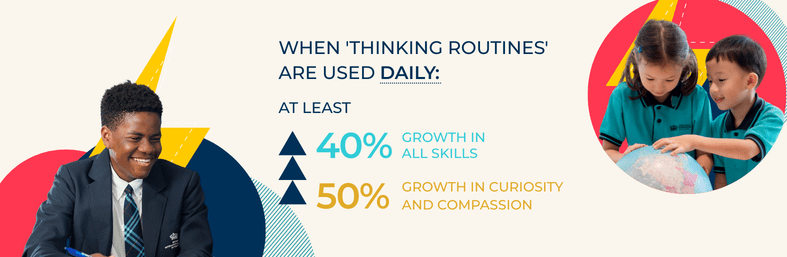
But, in classrooms where thinking routines were used daily, the results were even stronger:
- At least 40% growth across all skills
- Approaching 50% growth in curiosity and compassion
Just as importantly, students reported feeling more confident when navigating uncertainty, and that’s a skill no algorithm can replicate.
85% reported increases in knowing what they are good at, 76% reported increased independence, and 72% said their knowledge of how they learn improved.
Teachers noticed the difference, too.
Not louder classrooms, but:
- More thoughtful questions
- Clearer explanations
- Greater determination to keep going when things felt difficult
By the end of the research, up to 96% of teachers agreed that this way of teaching and learning helps students succeed — not just academically, but beyond school.
Why this matters in an AI world
AI can generate answers.
But it can’t decide:
- When to persist
- When to change strategy
- When to trust your own judgement
Those decisions are uniquely human, and the children who will thrive in the future won’t be the ones who simply know the most.
They’ll be the ones who can:
- Notice when something doesn’t quite add up, and pause rather than panic
- Decide what to try next without waiting to be told
- Stay with a problem long enough to work their way through it
These are the skills that sit beneath confident learners — and confident adults.

The bigger picture
As technology continues to change how children learn, one thing remains constant:
Children still need to learn how to think. Not just to succeed in exams, and not just to keep up with change.
But to face uncertainty with confidence, to make decisions without shortcuts, and to believe they can work things out; even when the answer isn’t immediate.
These are lifelong skills. It’s why Nord Anglia is helping its students develop them.
And they’re the skills AI can’t replace.
#SkillsAICantReplace









.jpg?rev=3a5ce86a70da47d2962969b2875b68bd&hash=DA7E6E1DA0C2B7CB3AAAE0927F72A6D4)